What Are Crypto Payments? A Plain-English Guide for Businesses (2026)
Crypto payments are blockchain-settled transactions that cut fees, eliminate chargebacks, and settle in seconds. A plain-English guide for business owners in 2026.
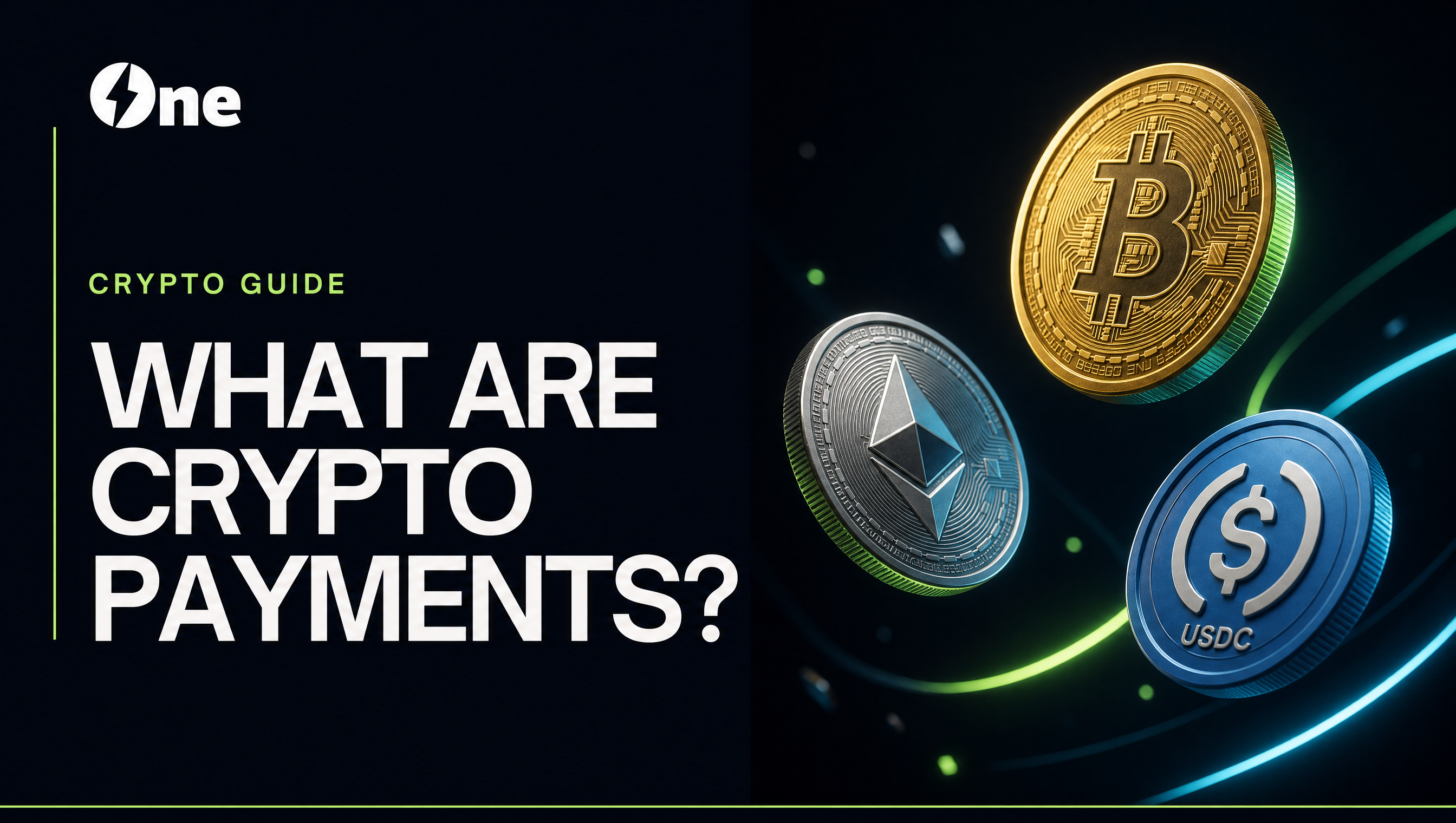
Crypto payments are financial transactions settled on a blockchain, which is a shared, distributed ledger that no single institution controls. Instead of a bank authorising and recording the transfer, a network of computers validates it using cryptographic rules. The result is a payment that settles in seconds, costs a fraction of a card transaction, and cannot be reversed once confirmed.
In 2025, stablecoins, the dollar-pegged version of crypto, settled more transaction volume than Visa and Mastercard combined, according to Chainalysis. That figure reflects a shift from speculation to commerce: businesses using crypto rails not to hold assets, but to move money faster and cheaper than the traditional payment system allows.
What to Know
- A crypto payment is a blockchain transaction where value moves from a sender's wallet to a receiver's wallet, validated by a decentralised network, with no bank or card network in between.
- Stablecoins are the practical choice for commerce because they combine crypto's low fees and speed with a fixed dollar value, eliminating the price volatility that makes Bitcoin impractical for everyday pricing.
- Crypto payments cannot be charged back. Once confirmed on-chain, no payment processor or bank can reverse the transaction. This is a property of the architecture, not a policy decision.
- Processing fees run 0.3%–1% compared to 2.6%–3.5% for card-not-present transactions, because there is no card network interchange, no issuing bank fee, and no chargeback reserve.
- Settlement is same-day or faster because most stablecoin transactions confirm in under a minute, while card settlements take 2–5 business days.
What Are Crypto Payments, Exactly?
A crypto payment is a transfer of value from one digital wallet to another, recorded on a public blockchain. The sender broadcasts a signed transaction to a peer-to-peer network. Nodes on that network verify the sender has sufficient funds and that the cryptographic signature is valid. Validators bundle the transaction into a block, add it to the chain, and the recipient's balance updates — permanently and publicly.
No bank approved the transaction, and no card network routed it. No correspondent bank held it overnight. The entire process runs on software governed by rules that every participant agreed to in advance.
For a business, this means receiving payment from a customer in Tokyo, Lagos, or São Paulo looks identical to receiving payment from a customer down the street. Same speed, same fee, same settlement process.
How Crypto Payments Actually Work: The Mechanism
Understanding the mechanism matters because it explains every practical difference between crypto and traditional payments.
In a card payment, the process involves at least four institutions: your bank (the acquirer), the card network (Visa or Mastercard), the customer's bank (the issuer), and often a payment processor sitting between your gateway and the acquirer. Each hop adds a fee, a potential delay, and a point of failure. Beyond that, the issuing bank has the unilateral ability to reverse the transaction for up to 120 days after the sale.
In a crypto payment, the process involves two wallets and a shared ledger. The customer's wallet signs a transaction message with their private key, which is a cryptographic proof that only they could have produced. The network validates the signature and the available balance, so the transaction is recorded as a consequence of that verification alone. That record is then replicated across thousands of nodes simultaneously. Changing it would require rewriting every block added since, a task that would require controlling more than half the network's computing power. On established blockchains, this is economically impractical.
This is why crypto payments are irreversible. It is not a policy. It is what the architecture produces.
Two Types of Crypto Payments: Volatile vs Stable
Not all crypto is the same for payment purposes. The distinction that matters most for merchants is between volatile cryptocurrencies and stablecoins.
Volatile Cryptocurrencies (Bitcoin, Ethereum)
Bitcoin and Ethereum fluctuate in price. A $500 order priced in Bitcoin today might be worth $430 or $580 tomorrow depending on market conditions. This creates a revenue recognition problem: the merchant priced the product in dollars, but the payment asset changed value between sale and settlement.
Volatile crypto payments work when merchants either convert immediately to fiat at the point of sale using a gateway that handles auto-conversion, or when they deliberately want crypto treasury exposure. They are not practical for merchants who want predictable revenue without any crypto management overhead.
Stablecoins (USDC, USDT, PYUSD)
Stablecoins are crypto tokens pegged to a fixed value, almost always one US dollar. USDC, issued by Circle, is backed 1:1 by cash and short-duration US Treasury bills, audited monthly. When a customer pays with USDC, the merchant receives exactly the dollar value invoiced, on crypto rails, in seconds, at a fraction of card fees.
Stablecoins are why the commercial adoption numbers are significant. The $33 trillion in 2025 settlement volume is overwhelmingly stablecoin volume, meaning dollars moving on blockchain rails, not speculation. For merchants evaluating crypto payments, stablecoins are the starting point.
The Real Cost Difference vs Card Processing
Card processing fees have four components, each charged by a different institution.
- Interchange — paid to the card-issuing bank, typically 1.5%–1.8% on US credit cards
- Assessment — paid to Visa or Mastercard for network access, typically 0.13%–0.15%
- Processor markup — paid to your payment gateway, typically 0.3%–0.5%
- Chargeback reserve — funds withheld by processors against potential disputes
Crypto payments eliminate the first two entirely. There is no issuing bank taking interchange because there is no card network. What remains is the gateway's processing fee, typically 0.3%–1% depending on the provider.
| Payment Method | Typical Fee | Cross-Border Fee | Chargeback Risk | Settlement |
|---|---|---|---|---|
| Card (card-not-present) | 2.6%–3.5% | 3.5%–5%+ | High | 2–5 business days |
| PayPal | 2.9% + $0.30 | 4.4% + fixed | Moderate | 1–3 business days |
| Bitcoin (auto-convert) | 0.5%–1% | 0.5%–1% | None | Minutes to hours |
| USDC / Stablecoin | 0.3%–0.8% | 0.3%–0.8% | None | Seconds to minutes |
For a merchant doing $100,000 per month, the difference between a 3% card rate and a 0.3% stablecoin rate is $2,700 per month, which adds up to $32,400 per year. See the full breakdown in our crypto payment fees guide.
Why Crypto Payments Cannot Be Charged Back
Chargebacks cost US merchants an estimated $11 billion annually. Every chargeback is only possible because a third party, the card-issuing bank, has the legal authority to unilaterally reverse a transaction on the cardholder's behalf, up to 120 days after the sale.
Blockchain transactions work differently. Once a transaction is included in a block and that block has been followed by additional blocks, reversing it would require rewriting that block and every subsequent block, then getting the majority of the network's validators to accept the rewritten history. On Bitcoin's network, doing this would require more than half of all mining hardware on earth running in coordination. The economic cost exceeds any realistic gain.
This is not a fraud-prevention policy. It is a property of consensus-based ledgers, which means there is no entity to call, no dispute form to file, and no 120-day window. For merchants in digital goods, gaming, software, or luxury categories where friendly fraud is a significant operational cost, this property alone can justify the integration. Read more in our deep-dive on transaction finality and why crypto payments cannot be charged back.
What Crypto Payments Are Not
Not a cryptocurrency investment. Accepting USDC for a $200 order and converting it to dollars immediately is not a crypto investment. It is a payment in a different format, immediately liquidated. No crypto exposure remains.
Not anonymous. Blockchain transactions are pseudonymous, meaning every transaction is permanently visible on a public ledger tied to wallet addresses. Regulated payment gateways apply KYC processes to merchant accounts the same way card processors do.
Not only Bitcoin. Bitcoin is one cryptocurrency. Stablecoins, Ethereum, Solana, and others run on different blockchains with different speeds and fee structures. A merchant choosing crypto payments is really choosing which assets and chains to support. Learn more in our guide to stablecoins for commerce.
Not the same as crypto trading. A crypto payment gateway moves a specific asset from payer to payee at a pre-agreed value. An exchange discovers and trades prices. Confusing the two leads merchants to use exchange accounts for merchant payments, which creates custody risk, compliance exposure, and no webhook infrastructure.
How Businesses Are Using Crypto Payments Today
- Cross-border B2B payments — paying international suppliers in stablecoins to avoid SWIFT delays and correspondent bank fees. B2B represented 60% of stablecoin payment volume in 2025.
- E-commerce checkout — online retailers adding stablecoin checkout alongside card, capturing incremental sales from crypto-holding demographics.
- iGaming and digital goods — high-chargeback categories where irreversibility is commercially significant and instant settlement improves cash flow.
- SaaS subscriptions — software companies billing international customers in stablecoins to avoid multi-currency complexity and card decline rates.
- Contractor payouts — businesses paying global contractors via stablecoin at 0% payout cost rather than $25–$50 international wire transfers.
The Risks Merchants Should Know
Tax reporting obligations. In the US, crypto received as business revenue is recognised at fair market value on the date received. From January 2026, Form 1099-DA requires payment processors that convert crypto to fiat to report cost basis automatically. Merchants using a compliant gateway with auto-conversion receive this reporting without manual effort.
Irreversibility cuts both ways. The property that eliminates chargebacks also means you cannot reverse a mistaken payout. Operational controls such as address verification and double-confirmation on large transactions are not optional.
Stablecoin regulatory status. Under the GENIUS Act (signed July 2025), only US-licensed issuers qualify as Payment Stablecoins for US commerce. USDC and PYUSD meet this standard. Merchants should use compliant assets from the start.
Gateway quality varies significantly. Webhook reliability, address generation, settlement workflows, and reconciliation tooling differ substantially between providers. A gateway that misses a payment confirmation or delivers webhooks inconsistently creates operational problems that scale with volume.
How to Start Accepting Crypto Payments
- Choose a gateway that supports GENIUS-compliant stablecoins, offers fiat auto-conversion, and provides HMAC-signed webhooks for reliable order automation.
- Start with two to three currencies because USDC and Bitcoin covers the vast majority of crypto-holding customers.
- Enable auto-conversion unless you have a reason to hold crypto on your balance sheet.
- Configure webhooks properly before going live, and test every order state: confirmed, underpaid, expired.
- Verify 1099-DA reporting is handled by your gateway before processing your first transaction.
For a detailed walkthrough, see the complete merchant acceptance guide or the Shopify-specific integration guide. Merchants evaluating infrastructure can review what AIO.cash offers, including 0.3% pay-in, 0% payout, multi-chain support, and full-lifecycle payment tracing.
Frequently Asked Questions
What is the difference between a crypto payment and a regular bank transfer?
A bank transfer moves a number in a private database a financial institution can reverse or freeze. A crypto payment updates a public blockchain ledger maintained by thousands of independent nodes — settling in seconds, at 0.3%–1% cost, with no chargeback window and no correspondent banking fees for cross-border transactions.
Are crypto payments safe for merchants?
Crypto payments eliminate chargeback fraud entirely — a confirmed blockchain transaction cannot be reversed. The main risks are operational: incorrect payout addresses, non-compliant stablecoins, and misconfigured webhooks. A reputable gateway with address verification handles most of these.
Do I need to understand blockchain to accept crypto payments?
No. A payment gateway handles all blockchain interaction. From the merchant's perspective the integration looks like any other payment method — an order comes in, a webhook confirms payment, the order is fulfilled.
Which cryptocurrencies should a merchant accept first?
Start with USDC (GENIUS-compliant dollar stablecoin) and Bitcoin. USDC covers customers who want stable-value crypto payments; Bitcoin covers the broadest holder base. Add Ethereum and others once you understand customer demand.
How are crypto payments taxed for businesses?
In the US, crypto received as income is recognised at fair market value on the date received. Merchants who auto-convert to fiat at point of sale have simple revenue recognition. From January 2026, Form 1099-DA requires compliant gateways to report this automatically.