
Crypto Payment Fees Explained: Every Cost Merchants Need to Know
A complete breakdown of crypto payment fees for merchants — what each charge buys, how they compare to card fees, and how to calculate your true annual cost.
Stablecoin real-world payment volume hit $400 billion in 2025, doubling year-over-year according to Chainalysis. B2B payments represent 60% of that volume. This is not speculative activity. It is businesses moving money across borders, paying suppliers, and settling invoices on blockchain rails because those rails are faster, cheaper, and more programmable than the alternatives.
This guide is for merchants, finance teams, and operators evaluating stablecoin payments as a practical tool. It covers how stablecoins work at the payment layer, which ones matter for business use in 2026, what the GENIUS Act changes, and exactly how a stablecoin payment flows from customer to your bank account.
What to Know
- Stablecoins are cryptocurrencies pegged 1:1 to a fiat currency (usually USD). You receive exactly the dollar value the customer sent.
- The payment rail (blockchain) is separate from the asset (the stablecoin). You get crypto speed and cost without crypto price risk.
- Real-world stablecoin payment volume reached $400 billion in 2025; B2B transactions make up 60% of that.
- The GENIUS Act (signed July 18, 2025, enforcement January 2027) creates the first federal licensing framework for stablecoin issuers in the US. USDC is compliant. Global USDT is not, though Tether launched USAT in January 2026 as a US-compliant product.
- Cross-border stablecoin transfers typically cost under 0.5% all-in and settle in seconds to minutes, versus 3–6% and 1–5 days for international wire transfers.
- Stablecoins are not the right tool for every business situation. Small domestic transactions, consumer payments in cash-dominant markets, and jurisdictions with stablecoin restrictions are scenarios where they add friction rather than remove it.
What Is a Stablecoin — The Payment-First Definition
Most introductions to stablecoins lead with investment framing: a "safe haven" in a volatile crypto market. That framing is wrong for businesses.
The payment-first definition: a stablecoin is dollar-denominated value on a crypto rail. It lets you move USD-equivalent amounts with the speed, global reach, programmability, and low cost of a blockchain, without holding a volatile asset.
The core problem stablecoins solve is this: crypto payment rails such as Bitcoin and Ethereum are fast and global, but the assets on those rails are volatile. A payment worth $500 at checkout might be worth $450 by the time you process it. Stablecoins decouple the asset layer from the rail layer, so the rail stays programmable and fast while the asset tracks the dollar.
For a merchant, this means you quote in dollars, receive dollars, and settle in dollars, yet the money moved in seconds across any border with no correspondent bank involved. Learn more about what crypto payments are and how they differ from traditional payment methods.
How Stablecoins Work: Reserve Backing, the 1:1 Peg, and the Issuer Model
Every dollar-pegged stablecoin maintains its peg through a reserve backing mechanism. The issuer holds assets, including cash, short-term US Treasuries, or other liquid instruments, equal to the total number of tokens in circulation. When you hold 1 USDC, Circle holds $1.00 in reserve. When you redeem it, they destroy the token and send you the dollar.
The issuer model matters enormously, because not all stablecoins are created with equal transparency or accountability.
- Fiat-backed stablecoins (USDC, USDT, PYUSD) are backed by real-world assets held in reserve. The risk is custodial: you trust the issuer to hold what they claim.
- Algorithmic stablecoins are maintained by on-chain mechanisms rather than real-world reserves. These carry substantially higher systemic risk and are not suitable as payment instruments for most businesses.
For payments, stick with fiat-backed stablecoins from regulated issuers. The peg reliability of USDC has been extremely high; the brief USDC depeg in March 2023 (to ~$0.87, caused by SVB exposure) resolved within 48 hours once Circle confirmed reserve coverage, a stress test that demonstrated both the vulnerability and the recovery mechanism.
USDC vs USDT vs PYUSD: Which Stablecoin for Business Payments?
Three stablecoins dominate merchant payment infrastructure in 2026. Here is how they compare on the dimensions that matter to a business:
| Stablecoin | Issuer | Reserve Transparency | GENIUS Act Status | Key Chains | Best Use Case |
|---|---|---|---|---|---|
| USDC | Circle (US-regulated) | Monthly attestations by Big Four firm; 1:1 cash + short-term Treasuries | Compliant | Ethereum, Solana, Base, Arbitrum, Polygon, CCTP-enabled chains | US merchants, regulated industries, B2B payables, any compliance-sensitive use case |
| USDT (global) | Tether (BVI) | Quarterly attestations; reserve composition has included commercial paper and other assets beyond cash/Treasuries | Not compliant (BVI entity) | Tron, Ethereum, Solana, BSC, many others | Global B2B, emerging markets, high-liquidity trading corridors. Not recommended for US-regulated use cases |
| USAT | Tether (US entity, via Anchorage Digital Bank) | Launched January 2026; US-regulated structure, 1:1 cash + Treasuries | Compliant | Expanding; initially US-focused chains | US merchants who want Tether liquidity with GENIUS Act compliance |
| PYUSD | PayPal / Paxos (NY-licensed trust company) | Monthly reserve attestations; 1:1 USD deposits + US Treasuries | Compliant | Ethereum, Solana | Merchants with existing PayPal integrations, consumer-facing payments where PayPal distribution adds value |
For most US-based merchants in 2026, USDC is the default choice: highest regulatory clarity, deepest institutional liquidity, strongest reserve transparency, and support across every major chain and gateway. See a deeper breakdown in our USDC vs USDT comparison.
The GENIUS Act: What It Changes for Stablecoin Payments
The Guiding and Establishing National Innovation for US Stablecoins (GENIUS) Act was signed into law on July 18, 2025, passing the Senate 68–30. Enforcement begins January 2027.
The law does two things that directly affect merchant payments.
1. It creates a federal licensing framework for stablecoin issuers. Issuers above $10 billion in outstanding tokens must obtain federal approval. Smaller issuers can operate under state-level frameworks. This means that by January 2027, every GENIUS-compliant stablecoin issuer must hold 1:1 reserves in cash or short-term Treasuries, undergo regular audits, and be subject to federal oversight.
2. It draws a clear line between compliant and non-compliant issuers. Circle (USDC) is compliant. Tether's BVI-domiciled global USDT entity is not GENIUS-compliant, so Tether responded by launching USAT in January 2026 as a US-regulated product under Anchorage Digital Bank. PayPal's PYUSD (issued by Paxos, a NY-licensed trust company) is compliant.
What this means practically for a US merchant: if you accept stablecoins and want regulatory certainty ahead of the January 2027 enforcement date, build your payment stack around GENIUS-compliant stablecoins now. Switching later is possible but involves integration work. For a full breakdown of what compliance requirements mean for your operations, see our GENIUS Act merchant guide.
How a Stablecoin Payment Actually Flows
Understanding the payment flow helps you evaluate gateways, set confirmation thresholds, and design your webhook handling correctly. Here is a step-by-step flow for a merchant using a payment gateway:
- Customer initiates payment. Your checkout or invoice generates a payment request. The gateway creates a unique deposit address for this transaction (or reuses a merchant address with memo/reference tagging, depending on the chain and gateway architecture).
- Customer sends stablecoins. The customer sends the exact amount from their wallet to the deposit address. On Solana or an L2, this takes seconds. On Ethereum mainnet, the transaction enters the mempool and gets confirmed in roughly 12–60 seconds.
- Gateway detects the incoming transaction. The gateway monitors on-chain activity. The moment the transaction appears in the mempool (unconfirmed) or in a block (confirmed), the gateway detects it and updates the payment state to pending.
- Confirmation threshold met. The gateway waits for the configured number of block confirmations (typically 1–3 for stablecoins on low-attack-risk chains). Once met, payment state moves to confirmed.
- Webhook fires to your backend. The gateway sends an HMAC-signed webhook to your configured endpoint, containing the payment details, amount, asset, chain, and status. Your system processes the webhook and updates the order state to paid, fulfilled, or similar.
- Settlement. The stablecoin sits in the gateway wallet or your non-custodial address. You can withdraw on-chain to your own wallet, or some gateways offer a fiat off-ramp where they convert and wire USD to your bank account. In a non-custodial setup, the funds are already yours and you initiate the payout when ready.
The critical operational design point: your webhook handler must be idempotent (safe to process the same event twice) and should verify the HMAC signature before acting on any payment status update. An unverified webhook is a fraud vector.
Cost Comparison: Stablecoin Payments vs Wires vs Cards for Cross-Border
The cost advantage of stablecoins is most visible in cross-border transactions. Here is a realistic comparison for a $10,000 international B2B payment:
| Method | Typical Total Cost | Settlement Time | FX Spread | Reversal Risk |
|---|---|---|---|---|
| International Wire Transfer | $25–$50 flat + 1–3% FX spread = $125–$350 total | 1–5 business days | High (bank sets spread) | Low (irreversible once cleared) |
| Credit/Debit Card (cross-border) | 1.5%–3.5% processing + 1–3% FX = $250–$650 total | 1–3 days to merchant account | High | High (chargebacks up to 120 days) |
| USDC on Ethereum | 0.3%–0.5% gateway fee + ~$0.50–$2 gas = $30–$52 total | Under 2 minutes | None (USD-denominated) | None (irreversible) |
| USDC on Solana / Base | 0.3%–0.5% gateway fee + <$0.01 gas = $30–$50 total | Under 10 seconds | None | None |
The numbers make the case plainly. For a business processing $500,000 per month in cross-border B2B payments, the difference between wire transfers (at a blended 2% cost) and stablecoin payments (at 0.4%) is roughly $8,000 per month, which adds up to $96,000 per year. That is not a marginal efficiency gain. It is a structural cost reduction.
Why B2B Payments Represent 60% of Stablecoin Volume
Consumer stablecoin adoption is real but uneven. It depends heavily on wallet literacy, on-ramp access, and regional payment norms. B2B adoption is accelerating faster for three structural reasons.
Invoice amounts are large enough for the per-transaction economics to dominate. A $50,000 supplier payment where stablecoins save 2% saves $1,000 on a single transaction. The same math on a $20 consumer purchase saves $0.40, which is not worth the friction of crypto wallet setup for most consumers.
Counterparty sophistication is higher. A treasury manager or CFO at a mid-market company can implement a stablecoin payment workflow. Asking a retail customer to set up a crypto wallet creates drop-off, so the B2B path encounters far less resistance.
Cross-border B2B flows are where the wire transfer pain is worst. Payroll for remote contractors in Southeast Asia, supplier payments in Latin America, platform payouts to global creators — these are exactly the corridors where wire transfers are slowest, most expensive, and most opaque. Stablecoins eliminate the correspondent banking chain entirely.
When NOT to Use Stablecoin Payments
Stablecoins are not the right payment tool in every situation. Be honest about these constraints before building them into your payment stack.
- Small domestic consumer transactions. If your average order value is $15–$50 and your customers are in the same country as your bank, card processing at 2% is simpler, more familiar, and already embedded in every checkout flow. The operational overhead of stablecoin on-ramping exceeds the cost savings.
- Jurisdictions with stablecoin restrictions. Some countries, notably China and various emerging markets, restrict or ban stablecoin usage. Accepting USDC from a customer in a restricted jurisdiction creates compliance exposure for them and potentially for you.
- When your customers have no crypto wallets. If your buyer base is not crypto-native, forcing a stablecoin payment option adds friction without benefit. The tool is appropriate where customers already hold stablecoins or can easily acquire them via regulated exchanges.
- When you need instant fiat settlement with no conversion step. If your treasury team requires next-day USD in a bank account with no additional steps, some stablecoin gateway setups add a conversion and withdrawal step that introduces a 24–48 hour delay. Evaluate your full settlement workflow before committing.
- When you cannot handle webhook failures gracefully. If your order management system cannot handle duplicate or delayed payment confirmations without human intervention, you have an integration readiness problem that stablecoin payments will expose. Fix the integration first.
How to Start Accepting Stablecoin Payments: Practical Steps
Getting stablecoin payments operational does not require building on-chain infrastructure from scratch. Here is the practical path.
- Choose your stablecoin(s) and chain(s). For a US business in 2026, start with USDC on Ethereum mainnet and at least one L2 such as Base, Arbitrum, or Solana. Cover the liquidity-heavy corridors first.
- Select a payment gateway that handles custody, confirmation, and webhooks. You need a gateway that abstracts the on-chain complexity: deposit address generation, confirmation monitoring, and signed webhook delivery. Evaluate gateways on fee structure (pay-in and pay-out), non-custodial options, chain support, and webhook reliability.
- Implement the webhook endpoint on your backend. Before going live, build the handler: verify the HMAC signature, validate the payment amount and asset, mark the order paid, and return 200 to acknowledge. Test with small amounts on testnet or mainnet first.
- Define your settlement workflow. Decide whether you will hold stablecoins on-chain (useful if you have suppliers who accept crypto), convert to fiat via an OTC desk or exchange, or use a gateway off-ramp. Build this workflow before you have funds waiting in it.
- Update your accounting and tax workflow. Stablecoin receipts are taxable income at face value. Configure your accounting software to recognize stablecoin inflows, or work with an accountant who handles digital asset reporting.
- Start with B2B or high-value use cases. Rather than replacing your entire checkout flow, start with a use case where the economics clearly favor stablecoins, such as large cross-border invoices, contractor payouts, or supplier settlements. Build operational confidence before scaling.
AIO.cash is built specifically for merchants running this workflow at scale. It charges 0.3% on pay-in and 0% on payout, one of the lowest combined fee structures available, and supports USDC and USAT across multiple chains via a single API. It operates in a non-custodial model so your funds stay under your control. HMAC-signed webhooks with retry logic are built into the payment flow, which means your backend receives confirmed, tamper-evident payment events without custom on-chain monitoring.
Frequently Asked Questions
Are stablecoin payments legal for businesses in the US?
Yes. Stablecoin payments are legal for US businesses. The GENIUS Act, signed July 18, 2025, created a formal federal licensing framework for stablecoin issuers. Compliant stablecoins like USDC and USAT can be used freely for payments. Businesses do not need a money transmitter license simply to receive stablecoin payments as a merchant.
What is the difference between stablecoin payments and regular crypto payments?
Regular crypto payments (Bitcoin, Ether) expose you to price volatility between the moment a customer pays and when you settle. Stablecoin payments are pegged 1:1 to USD, so the value you receive equals the value the customer sent. You get the speed and low cost of crypto rails without the exchange-rate risk.
Which stablecoin should a business use — USDC or USDT?
For US-based merchants, USDC is the stronger default choice for 2026. It is issued by Circle, regulated under US law, and is compliant with the GENIUS Act. USDT (BVI entity) does not meet GENIUS Act requirements, though Tether's new US-entity product USAT does. If you operate globally and regulatory compliance is less critical, USDT still has the deepest liquidity on most chains.
How fast do stablecoin payments settle?
On Solana and most Layer 2s (Base, Arbitrum, Optimism), finality is under 5 seconds. On Ethereum mainnet, effective settlement takes 30–90 seconds waiting for 1–3 confirmations. Compared to wire transfers (1–5 business days) or card settlements (1–3 days), stablecoins are dramatically faster for cross-border flows.
Do businesses owe taxes on stablecoin payment revenue?
Revenue received in stablecoins is taxable income at the USD value at the time of receipt, which is effectively face value for a USD-pegged stablecoin. The IRS treats stablecoins as property. If you immediately convert to fiat, the tax treatment is straightforward. Consult a crypto-aware accountant for your specific situation.
The Bottom Line on Stablecoin Payments for Business
Stablecoins answer one question cleanly: how do you move value with the speed, programmability, and global reach of a blockchain, without carrying the price risk of a volatile crypto asset? The answer is to peg the asset to the dollar and let the rail do the work.
The economics favor stablecoin payments most strongly where existing methods are worst, including large cross-border B2B transactions, contractor payouts across borders, and markets underserved by card networks. The $400 billion in annual real-world stablecoin payment volume is not speculative. It is businesses solving a real cost and speed problem with a mature tool.
The GENIUS Act removes the last major regulatory uncertainty for US merchants. With federal licensing requirements for issuers in effect from January 2027 and USDC already compliant, the infrastructure is as institutionally sound as it has ever been.
If your business runs high-value cross-border payments and you are still paying 2–3% for wire transfers that take three business days, the case for stablecoin payments is not theoretical. The cost reduction is real, the infrastructure is production-ready, and the regulatory framework now supports it.
AIO.cash provides the gateway infrastructure to run it, with multi-chain USDC and USAT support, 0.3% pay-in / 0% payout fees, non-custodial settlement, and signed webhook delivery with retry handling. Get started with AIO to see how stablecoin payments fit your specific payment workflow.
Frequently Asked Questions
What is the average crypto payment processing fee?
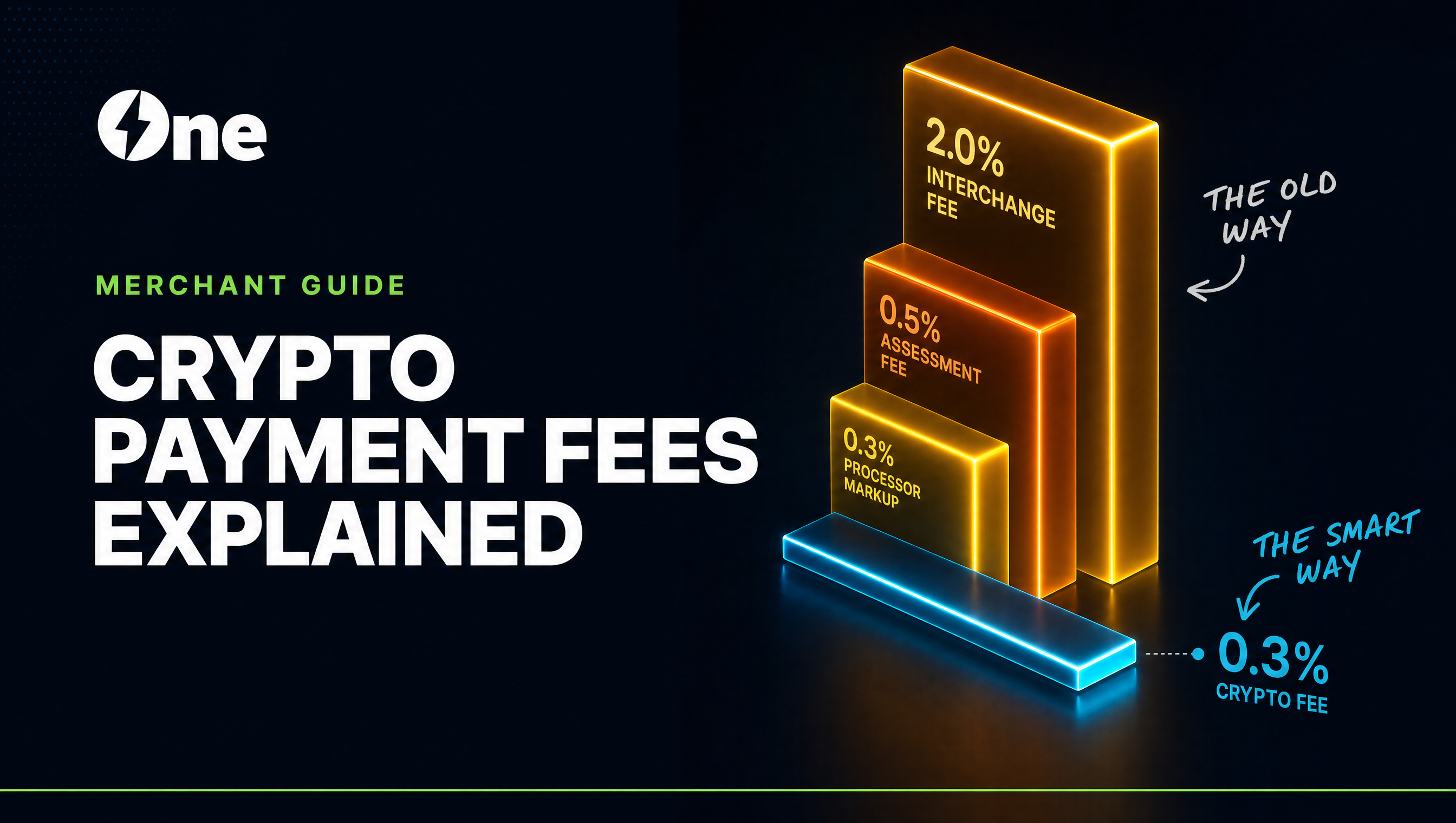
Most crypto payment gateways charge between 0.3% and 1.5% per transaction. That is significantly lower than card networks, which typically cost 1.5%–3.5% when interchange, assessment, and processor markup are combined. The exact rate depends on the gateway, the chain used, and whether the gateway charges a separate payout fee.
What is the difference between a pay-in fee and a payout fee?
A pay-in fee is charged when a customer sends a crypto payment to the merchant — it covers the gateway's processing and settlement work. A payout fee is charged when the merchant withdraws funds to their own wallet or bank. Many gateways charge both; AIO.cash charges 0.3% on pay-in and 0% on payout, which lowers the combined cost on every transaction.
Who pays the blockchain network gas fee — the merchant or the customer?
It depends on the gateway's architecture. In most setups, the gateway absorbs or estimates gas fees and builds them into its flat processing rate. Some gateways pass gas costs through explicitly. On low-fee chains like Solana or Base, gas is fractions of a cent and rarely affects merchant economics meaningfully.
Do crypto payments have chargebacks?
No. Blockchain transactions are irreversible by design. There is no chargeback mechanism equivalent to card networks. This eliminates chargeback fees (typically $15–$35 per dispute) and the rolling reserve that card processors require high-risk merchants to hold. Merchants handle refunds voluntarily by sending funds back — which is a separate, optional action.
How do stablecoin payment fees compare to Bitcoin payment fees?
The gateway fee structure is usually identical regardless of which asset the customer sends. The difference is network gas: Bitcoin transactions on mainnet can cost $0.50–$5+ during congestion; USDC on Base or Solana costs fractions of a cent. For merchants concerned about cost predictability, stablecoin payments on low-fee chains offer the most stable total cost.