What Is Transaction Finality? Why Crypto Payments Cannot Be Charged Back
Transaction finality in crypto explained: what it means technically, why confirmed blockchain payments cannot be reversed, and what this means for merchant chargeback risk.
US merchants lost $11 billion to chargebacks in 2023. Every one of those reversals was made possible by the same thing: a centralised ledger that a third party had the authority to override.
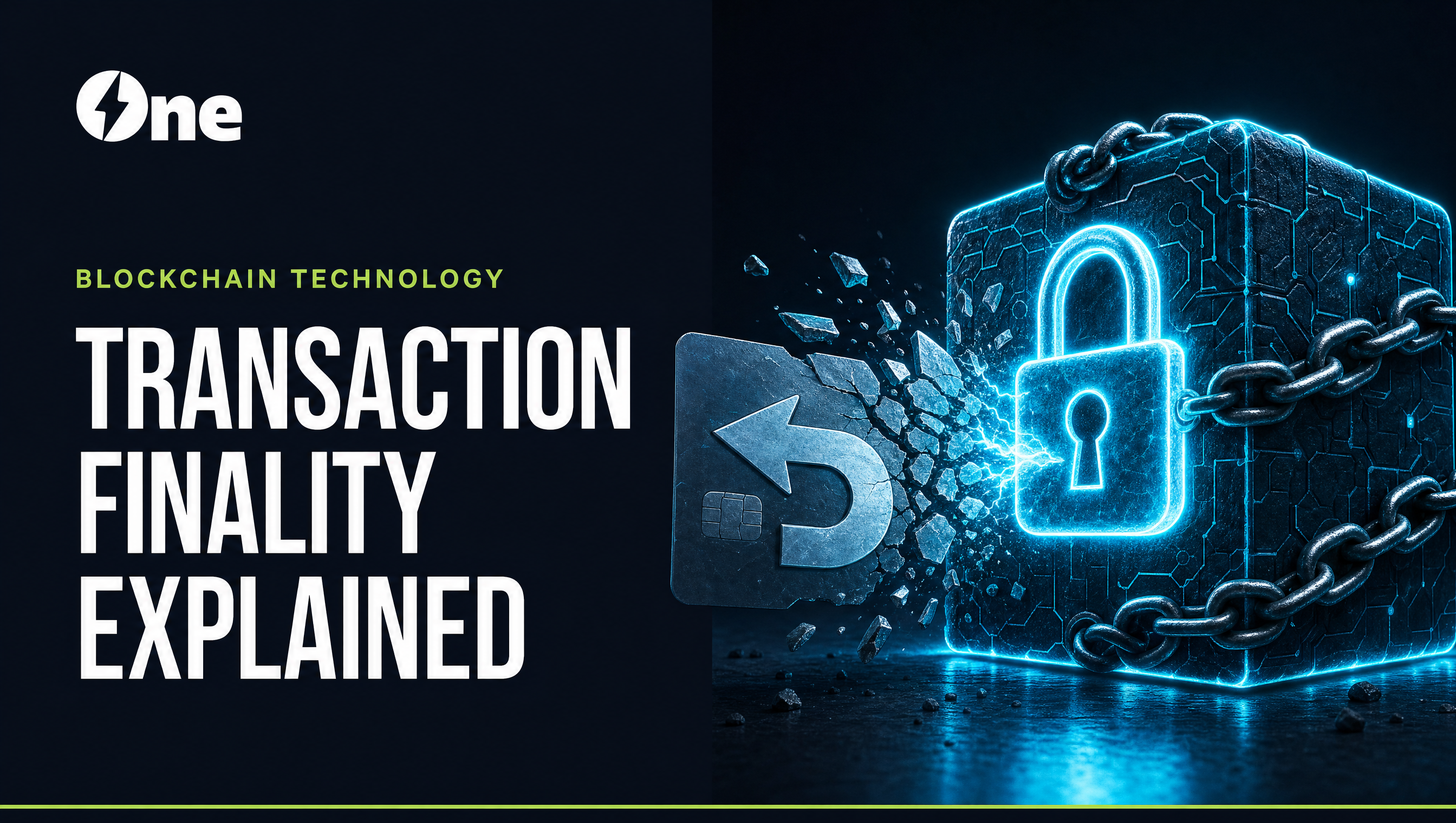
A chargeback is not a technical inevitability of digital payments. It is a policy decision made possible by a specific architectural choice, centralised control of the transaction record. Blockchain payments are built on the opposite architecture: a distributed ledger where no third party holds override authority. Understanding why that makes reversals impossible is the foundation of understanding crypto payment finality.
What to Know
- Transaction finality is the point at which a blockchain transaction becomes irrevocable. No party can reverse it through the payment network.
- Chargebacks are only possible because card networks and banks hold centralised authority over transaction records.
- Reversing a confirmed crypto transaction would require rewriting every block after it, which requires controlling more than 50% of the network's hash rate or stake.
- On established chains such as Bitcoin, Ethereum, Solana, and Base, this is economically impractical at any realistic transaction value.
- Bitcoin uses probabilistic finality, while Ethereum's Proof of Stake offers absolute (economic) finality.
- The trade-off is zero chargebacks for merchants and zero recourse for mistaken sends.
What Finality Means Technically
Finality in blockchain systems means a transaction's record is permanently embedded in the chain in a way that cannot be altered without reconstructing all subsequent blocks. Each block contains a cryptographic hash of the previous block, so altering block N requires recomputing block N, then N+1, then N+2, and so on, all while the honest network continues adding new blocks ahead of you. That is why tampering becomes computationally self-defeating the older a block gets.
On a Proof of Work chain like Bitcoin, the cost of this attack is physical: electricity and specialised mining hardware. At Bitcoin's current hash rate, controlling 51% of the network's compute would require an investment of hardware and energy measured in the tens of billions of dollars, and that investment would need to be sustained for the full duration of the attack. For any realistic transaction value, this attack is economically irrational.
On Ethereum's Proof of Stake, the cost of attack is the slashing risk on staked collateral. To finalize a block, two-thirds of validators must attest to it. Reversing a finalized block would require controlling one-third of all staked ETH and accepting that the protocol would slash (destroy) that entire stake as a penalty. At current staking levels, this makes reversal not just difficult but economically destructive to the attacker, which is why finality on Ethereum carries a fundamentally different guarantee than on proof-of-work chains.
Why Bank Payments Can Be Reversed
The chargeback system exists because Visa, Mastercard, and issuing banks control the authoritative record of who owns what. That record is a private database. The card network's rules grant cardholders the right to dispute a charge, and the network has both the technical ability and contractual authority to debit the merchant's account and credit the cardholder's account, regardless of whether the original transaction was legitimate.
This is not fraud. It is the intended design. The dispute system exists to protect consumers from unauthorised charges and merchant fraud, so the cost of running it gets passed on to merchants. That cost reached an estimated $11 billion in merchant losses in 2023, because the system is, by design, tilted toward the cardholder.
Merchants bear the cost through chargeback fees (typically $20–$100 per dispute), lost goods or services where the disputed amount is reversed regardless of whether goods were delivered, and chargeback ratio thresholds that can result in programme termination if exceeded. For high-risk merchant categories, chargeback abuse is an existential operational problem.
Why Crypto Payments Cannot Be Reversed
The answer is not that crypto has better fraud detection or better dispute policies. The answer is that there is no authority to appeal to.
A confirmed Bitcoin transaction exists in thousands of copies of the blockchain simultaneously. There is no Visa Operations team, no central bank, no legal entity with the technical ability to debit the recipient's wallet and credit the sender's. The only way to "reverse" a confirmed on-chain transaction would be to execute the 51% attack described above, a task that has never been successfully performed against Bitcoin or Ethereum and is economically implausible against any established chain.
This means a confirmed crypto payment to a merchant is unconditional. The customer cannot dispute it through their wallet provider, and there is no equivalent of a friendly fraud chargeback, that category of dispute where a customer who received the goods claims otherwise. That category of fraud, which represents a significant portion of all chargebacks, is structurally impossible with crypto payments.
Confirmation Thresholds by Chain and Value
| Network | Finality Type | Low-Value (<$500) | Mid-Value ($500–$10k) | High-Value (>$10k) |
|---|---|---|---|---|
| Bitcoin | Probabilistic | 1–2 confirmations (~20 min) | 3 confirmations (~30 min) | 6 confirmations (~60 min) |
| Ethereum | Absolute (PoS) | 1 confirmation (~12 sec) | 1 finalized checkpoint (~15 min) | 1 finalized checkpoint |
| Base (L2) | Soft then Absolute | 1 L2 confirmation (~2 sec) | 1 L2 confirmation | L1 settlement (~1 hour) |
| Solana | Probabilistic (fast) | 1 confirmation (<1 sec) | 1 confirmation | 1 confirmation + time buffer |
Note on Base: Base transactions achieve fast "soft" finality at the Layer 2 level within seconds. Absolute finality, where the transaction batch is settled back to Ethereum L1, takes approximately one hour. For merchant payments at retail values, L2 soft finality is operationally sufficient.
Probabilistic vs Absolute Finality: What Merchants Need to Know
Probabilistic finality means each additional confirmation exponentially reduces the probability of reversal, yet the probability never reaches exactly zero. Bitcoin's design means a transaction with one confirmation has a roughly 0.2% chance of being in a block that gets orphaned (replaced by a competing block). With six confirmations, the probability of successful reversal is negligible for any realistic attacker, but the theoretical possibility remains.
Absolute (economic) finality means reversal is not merely very difficult but economically self-defeating. Ethereum's slashing mechanism ensures that any attempt to reorganize finalized blocks destroys the attacker's own staked collateral. The transaction is final in a stronger sense because the protocol makes reversal economically destructive by design.
For most merchants, this distinction matters primarily for Bitcoin and primarily at high transaction values. For stablecoin payments on Ethereum, Base, or Solana, the distinction is academic. The practical finality window is seconds, and the economic cost of reversal is prohibitive at any merchant-relevant transaction size.
The Practical Implication: Zero Chargebacks, but Also Zero Recourse
Finality is not unambiguously good for every party in every transaction. The same property that eliminates chargebacks also eliminates recourse for genuine mistakes.
If a customer overpays, if a merchant double-charges, or if funds are sent to a wrong address, none of these can be corrected by the payment network. Resolution requires voluntary action by the party who received the funds. Because of this, merchants accepting crypto payments need clear refund policies, good reconciliation systems, and careful address verification workflows.
The operational implication is that crypto payment infrastructure needs to be precise. A system that generates unique payment addresses per order, monitors on-chain state accurately, and fires callbacks only on confirmed events eliminates the most common source of operational errors. AIO uses a trace ID across the full payment lifecycle, from payment request creation through on-chain confirmation, so every transaction state is auditable and every callback is tied to a specific confirmed event. That trace ID is what makes reconciliation reliable in a system without reversals.
For the full mechanics of how on-chain confirmation works, see How Do Crypto Payments Actually Work? For merchant security considerations beyond finality, see Crypto Payment Security for Merchants. For a foundational overview, What Are Crypto Payments? covers the essentials.
Frequently Asked Questions
What does transaction finality mean in crypto?
Transaction finality is the point at which a blockchain transaction becomes irreversible. Once a transaction reaches finality, no party, including the sender, the recipient, or any third party, can reverse or alter it through the payment network. The specific confirmation depth required varies by chain and consensus mechanism.
How many confirmations are needed for a crypto payment to be final?
It depends on the chain and transaction value. For Bitcoin, three to six confirmations (30–60 minutes) is considered sufficient for most merchant payments. On Ethereum, one finalized checkpoint provides absolute finality. On Base and Solana, a single confirmation is treated as practically final for retail payment values given the economic cost of reversal.
What is the difference between probabilistic and absolute finality?
Probabilistic finality means a transaction becomes increasingly unlikely to be reversed with each additional confirmation, but is never mathematically guaranteed. Bitcoin uses this model. Absolute finality means a transaction cannot be reversed without destroying a quantifiable amount of staked collateral. Ethereum's Proof of Stake provides this, making reversal economically irrational rather than merely difficult.
What happens if I send crypto to the wrong address?
Finality means the transaction cannot be reversed. Funds sent to the wrong address are permanently lost unless the recipient voluntarily returns them. This is the trade-off for chargeback immunity: merchants gain protection from fraudulent disputes, yet both parties lose the ability to correct genuine mistakes through the payment network.
Frequently Asked Questions
What does transaction finality mean in crypto?
Transaction finality is the point at which a blockchain transaction becomes irreversible. Once a transaction reaches finality, no party — including the sender, the recipient, or any third party — can reverse or alter it through the payment network. The specific confirmation depth required to reach practical finality varies by chain and consensus mechanism.
How many confirmations are needed for a crypto payment to be final?
It depends on the chain and the transaction value. For Bitcoin, three to six confirmations (30–60 minutes) is considered sufficient for most merchant payments; higher-value transactions may warrant more. On Ethereum, one finalized checkpoint (approximately 15 minutes) provides absolute finality. On Base and Solana, a single confirmation is treated as practically final for retail payment values given the economic cost of reversal.
What is the difference between probabilistic and absolute finality?
Probabilistic finality, used by Bitcoin, means a transaction becomes increasingly unlikely to be reversed with each additional confirmation, but is never mathematically guaranteed. Absolute finality, offered by Ethereum's Proof of Stake, means a transaction cannot be reversed without destroying a quantifiable amount of staked collateral — making reversal economically irrational rather than merely difficult.
What happens if I send crypto to the wrong address?
Finality means the transaction cannot be reversed. Funds sent to the wrong address are permanently lost unless the recipient of the wrong address voluntarily returns them. This is the trade-off for chargeback immunity: merchants gain protection from fraudulent disputes, but both parties lose the ability to correct genuine mistakes through the payment network. This is why payment address verification before sending is essential.