How Do Crypto Payments Actually Work? The On-Chain Mechanics Explained
Learn how crypto payments work on-chain: wallet signatures, node validation, block confirmation, and what every step means for merchants accepting crypto.
A USDC transfer on Solana confirms in under one second and costs less than $0.001. That is not a marketing claim. It is the current state of public blockchain infrastructure. Understanding why it works that way, and what every step between "send" and "confirmed" actually involves, is the foundation of every sensible merchant decision about crypto payments.
This article walks through the on-chain mechanics of a crypto payment from first principles: what a wallet does, what nodes do, what miners or validators do, and what "confirmed" actually means for your business.
What to Know
- A crypto payment is a digitally signed message broadcast to a peer-to-peer network. No bank is involved at any point.
- Nodes validate the signature and check the sender's balance before propagating the transaction.
- Miners or validators bundle validated transactions into a block; the block gets added to the chain.
- Once included in a block, the sender's balance decreases and the recipient's increases, permanently.
- Confirmation time varies widely by chain: Bitcoin takes 10–60 minutes; Solana takes under one second.
- Merchants need to understand confirmation thresholds, not just "received" status, before releasing goods.
How a Wallet Transaction Works, Step by Step
When you initiate a crypto payment, your wallet software does four things before any money moves.
- Constructs a transaction message. This includes the sender address, recipient address, amount, and a fee (called "gas" on EVM chains, or a transaction fee on Bitcoin).
- Signs the transaction with your private key. This cryptographic signature proves you authorised the payment without revealing your private key itself. It is mathematically tied to both the transaction data and your private key, so changing either one causes the signature to break.
- Broadcasts the signed transaction to the network. Your wallet sends it to one or more known nodes, which immediately begin propagating it peer-to-peer across the network.
- Waits. The transaction now sits in the mempool, a holding area of unconfirmed transactions, until a miner or validator includes it in a block.
Your funds have not moved yet. The transaction exists as a pending record that the entire network can see, but until it is included in a block, it has no finality.
What Nodes Actually Do
Every full node on the network independently validates every transaction it receives. The reason independent validation matters is that there is no central authority to trust, so the rules themselves enforce correctness. Validation checks three things: does the signature match the sender's public key, does the sender have enough balance to cover the amount plus the fee, and is this a duplicate of a transaction already processed?
A transaction that fails any check is silently dropped. No error message, no refund. It simply never propagates. This is why "broadcast" does not mean "sent." It means "submitted for validation."
Nodes that pass validation forward the transaction to their peers. Within seconds, a valid transaction reaches thousands of nodes worldwide. This propagation is how the network achieves global awareness of a pending payment without a central server.
What a Blockchain Confirmation Actually Means
Confirmation is not a binary state. It is a count.
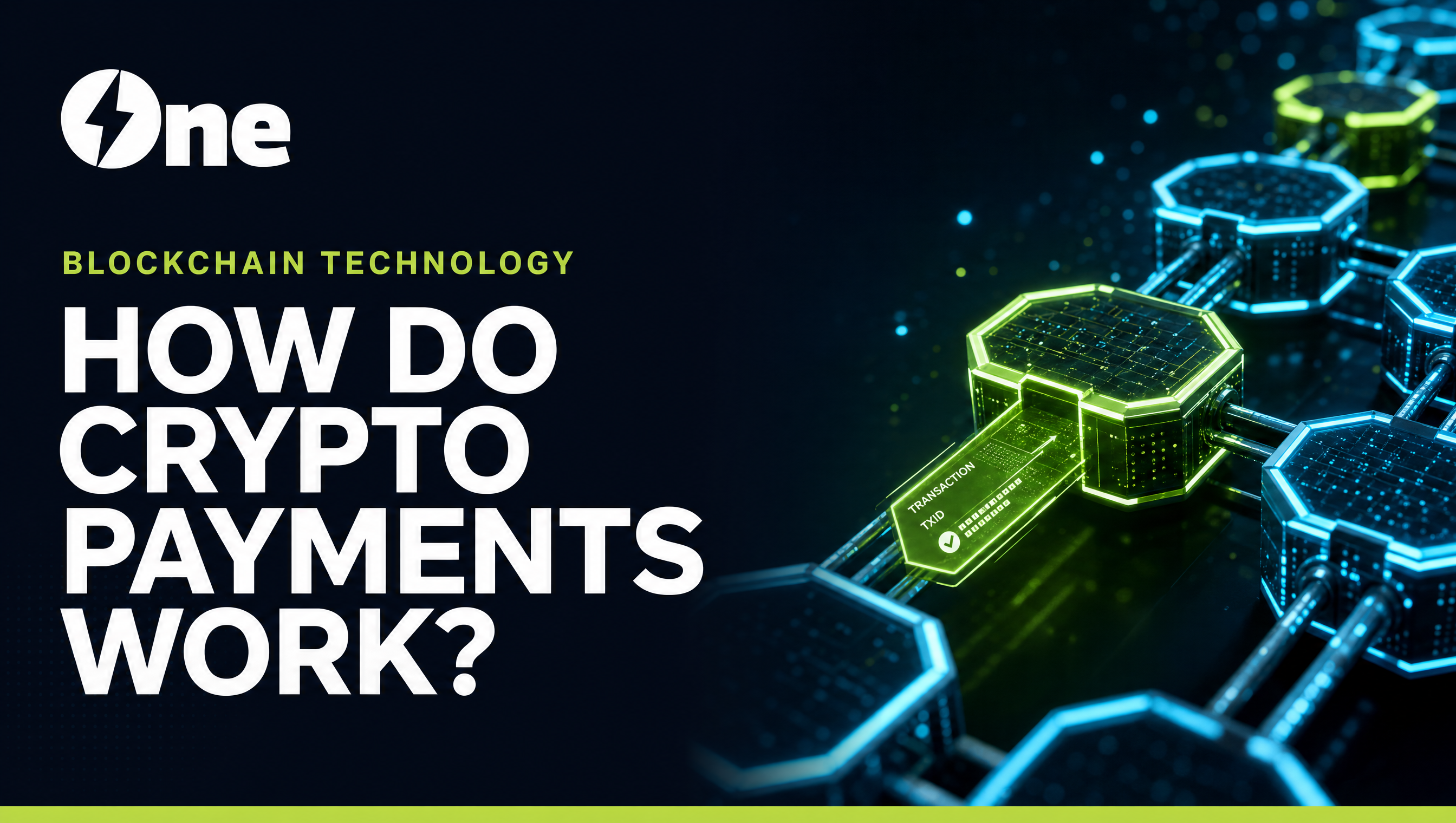
When miners or validators build a new block, they select transactions from the mempool, typically prioritising those with higher fees, and bundle them together. That bundle gets cryptographically linked to the previous block, creating the chain. Once your transaction is included in block N, it has one confirmation.
Every subsequent block added after block N gives your transaction one more confirmation. Six confirmations on Bitcoin means six blocks have been added on top of the block containing your transaction. Reversing it would require rebuilding those six blocks faster than the honest network. At current scale, that would require controlling more than half of Bitcoin's total mining power, making it economically irrational.
For merchants, the practical rule is: one confirmation is sufficient for small, low-risk transactions on established chains; three to six confirmations are appropriate for high-value payments on Bitcoin. On Solana and most Layer 2 networks, one confirmation is typically treated as final for all practical purposes.
Why Confirmation Times Differ So Widely by Chain
Confirmation time is a function of block time (how often a new block is produced) and the consensus mechanism (how the network agrees on which block is valid).
| Network | Consensus | Block Time | Typical Confirmation | Practical Use Case |
|---|---|---|---|---|
| Bitcoin | Proof of Work | ~10 minutes | 10–60 min (1–6 blocks) | High-value, store-of-value transfers |
| Ethereum | Proof of Stake | ~12 seconds | 15–90 seconds | DeFi, smart contracts, token transfers |
| Solana | Proof of History + PoS | ~400ms | Under 1 second | High-frequency payments, micropayments |
| Base | Optimistic Rollup (L2) | ~2 seconds | ~2 seconds | Low-cost stablecoin merchant payments |
Bitcoin's slow confirmation is not a flaw. It is a consequence of Proof of Work, which requires physical computational effort to produce each block. That physical cost is what makes rewriting Bitcoin's history prohibitively expensive. Solana trades some of that security margin for speed using a hybrid clock mechanism. Base inherits Ethereum's security while batching transactions off-chain, so it achieves faster and cheaper confirmations without compromising the underlying settlement layer.
What Happens If a Payment Gets Stuck
A transaction "stuck" in the mempool has been broadcast and validated by nodes but not yet included in a block. The most common cause is a fee set too low for current network demand, because when blocks are full, miners prioritise higher-fee transactions. A low-fee transaction can sit for minutes, hours, or on congested networks, even longer.
On Bitcoin, most wallets support Replace-By-Fee (RBF): the sender rebroadcasts the same transaction with a higher fee and the same inputs. The network replaces the pending low-fee version. On Ethereum and EVM-compatible chains, the sender resubmits with the same nonce and a higher gas price, and the second submission overwrites the first.
For merchants, the rule is simple: never release digital goods or trigger fulfilment based on a pending transaction. A pending transaction can be replaced or dropped, so only a confirmed transaction at your required threshold is safe to act on. Payment infrastructure that monitors transaction states and fires callbacks only on confirmed transactions eliminates this risk entirely.
What This Means for Merchants Accepting Crypto
Understanding the mechanics reveals several practical implications.
- Chain selection affects your customer experience. Asking customers to pay in Bitcoin and wait ten minutes is a checkout friction problem. Stablecoins on Base or Solana remove that friction entirely.
- Confirmation thresholds should match transaction value. A $5 digital download can proceed on one confirmation. A $10,000 B2B invoice should wait for three or more on a slower chain.
- Fee volatility on Ethereum mainnet is real. Gas prices on Ethereum L1 spike during periods of network congestion. Layer 2s like Base offer predictable, near-zero fees, typically under $0.01, by batching transactions before settling to Ethereum.
- Callback architecture must handle states correctly. A payment processing system should distinguish between "detected," "pending," "confirmed," and "finalized" states and expose those states through its callback mechanism so your system can respond appropriately.
Platforms like AIO handle these mechanics at the infrastructure layer, monitoring chain state, tracking confirmation thresholds per network, and firing HMAC-signed callbacks only when a transaction reaches the required confirmation depth. That means your application logic does not need to understand block times. It just needs to handle the confirmed event.
If you are evaluating crypto payment infrastructure, the right questions to ask are: which chains are supported, what confirmation thresholds are used per chain, and how does the system handle stuck or replaced transactions? The mechanics described above are what those answers need to address.
For a deeper look at what "confirmed" means in terms of settlement risk, see What Is Blockchain Settlement? Why It Matters for Merchants. For a broader introduction to accepting crypto payments in your business, What Are Crypto Payments? covers the full picture.
Frequently Asked Questions
How long does a crypto payment take to confirm?
Confirmation time depends on the network. Bitcoin takes 10–60 minutes for one confirmation. Ethereum averages 15–90 seconds. Solana confirms in under one second. Base confirms in roughly two seconds. The right network depends on your settlement requirements and your customers' wallets.
What happens if a crypto payment gets stuck in the mempool?
A transaction stuck in the mempool has been broadcast but not yet included in a block, usually because the sender attached a fee too low for current network demand. On Bitcoin, the sender can bump the fee using Replace-By-Fee (RBF). On EVM chains, they can resubmit with the same nonce and a higher gas price. Merchants should not release goods until the transaction reaches their required confirmation threshold.
Can a crypto payment be reversed after it confirms?
No. Once a transaction reaches sufficient confirmations on an established chain, it is economically impractical to reverse. This differs fundamentally from card payments, where chargebacks are possible for months after the sale. The trade-off is that mistakes, such as sending to the wrong address, cannot be corrected through the payment network.
What is a public key and why does it matter for payments?
A public key is the cryptographic identity that corresponds to a wallet address. When someone sends crypto, they sign the transaction with their private key. Nodes verify that signature against the sender's public key to confirm the transaction is authorised. Merchants receive funds at their own wallet address without ever sharing a private key.
Frequently Asked Questions
How long does a crypto payment take to confirm?
Confirmation time depends on the network. Bitcoin takes 10–60 minutes for one confirmation. Ethereum averages 15–90 seconds. Solana confirms in under one second. Base (an Ethereum Layer 2) confirms in roughly two seconds. The right network depends on your settlement requirements and your customers' wallets.
What happens if a crypto payment gets stuck in the mempool?
A transaction stuck in the mempool has been broadcast but not yet included in a block, usually because the sender attached a fee too low for current network demand. On Bitcoin, the sender can bump the fee using Replace-By-Fee (RBF) if their wallet supports it. On most EVM chains, they can resubmit with the same nonce and a higher gas price. Merchants should not release goods until the transaction reaches their required confirmation threshold.
Can a crypto payment be reversed after it confirms?
No. Once a transaction reaches sufficient confirmations on an established chain, it is economically impractical to reverse. This differs fundamentally from card payments, where chargebacks are possible for months after the sale. The trade-off is that mistakes — sending to the wrong address, for example — cannot be corrected through the payment network.
What is a public key and why does it matter for payments?
A public key is the cryptographic identity that corresponds to a wallet address. When someone sends crypto, they sign the transaction with their private key. Nodes on the network verify that signature against the sender's public key to confirm the transaction is authorised. Merchants receive funds at their own wallet address, derived from their public key, without ever sharing a private key.