
What Is a Stablecoin? The Payment-First Explanation
What is a stablecoin? A plain-language explanation of how stablecoins work, why they exist, the difference between fiat-backed and algorithmic types, and why they matter for merchant payments.
A merchant who accepts Bitcoin and finds that a $100 payment is worth $87 the next morning has a pricing problem. That problem is not exotic, because crypto assets routinely move 10–20% within a single trading day. Volatility is structurally incompatible with commerce.
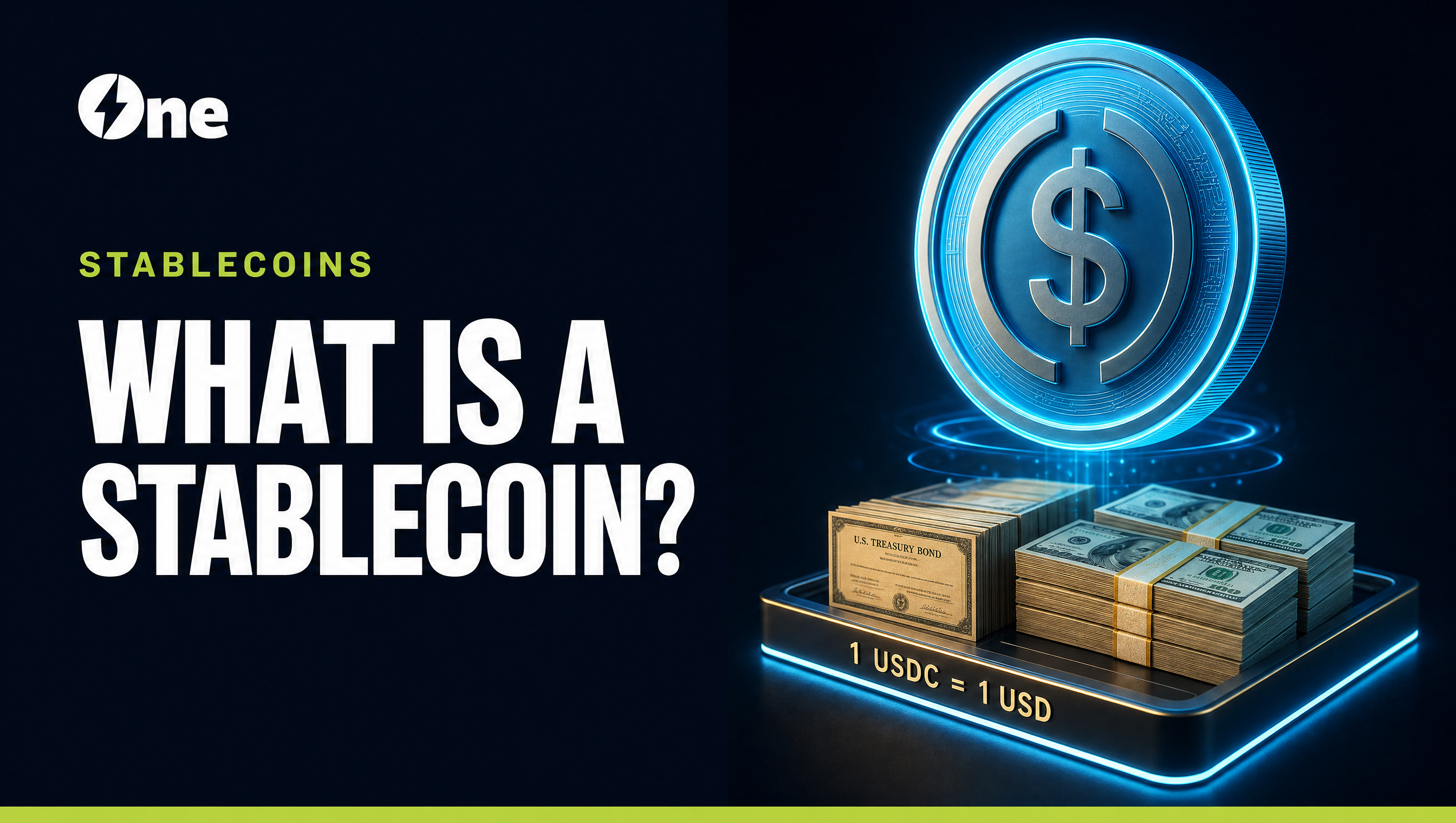
Stablecoins solve this. They keep the crypto rails, including instant global transfer, no intermediary, and programmable settlement, while removing the price risk that makes volatile crypto impractical for everyday business. USDC is backed 1:1 by cash and short-duration US Treasuries, with monthly reserve attestations by a major accounting firm. The blockchain underneath moves value; the peg mechanism holds the price.
What to Know
- A stablecoin is a cryptocurrency designed to maintain a stable value, typically pegged 1:1 to the US dollar.
- Fiat-backed stablecoins (USDC, USDT) maintain their peg through cash and cash-equivalent reserves held at regulated institutions.
- Algorithmic stablecoins attempt to maintain a peg through supply-and-demand mechanisms without hard backing, a model that failed catastrophically with Terra/LUNA in May 2022.
- USDC, USDT, and PYUSD are the three major USD-pegged stablecoins used in merchant payments today.
- Stablecoins settle globally in seconds and cost fractions of a cent on modern chains, making them the most practical form of crypto for business payments.
- The GENIUS Act, passed in 2025, established a federal regulatory framework for stablecoin issuers in the United States.
Why Crypto Prices Are Volatile
Bitcoin and Ether have no intrinsic cash flows to anchor their value. Their prices are determined entirely by what buyers and sellers agree to at any moment in a 24/7 global market with no circuit breakers and limited institutional price stabilisation. Because there is no earnings figure or redemption promise underneath, every price is purely a consensus about future expectations.
This is not a bug being fixed by future engineering. It is the nature of a freely traded asset with no earnings, no dividends, and no guaranteed redemption value. High volatility reflects genuine market uncertainty about long-term value, amplified by speculative trading and thin liquidity relative to traditional asset classes.
For a store of value or speculative asset, this is acceptable. For a payment instrument that must give merchants predictable revenue in fiat terms, it is not.
What a Peg Mechanism Is
A peg mechanism is the system that keeps a stablecoin's price at its target value, typically $1.00, despite market forces that would otherwise cause it to drift. The core idea is simple: if you can always redeem the token for exactly one dollar, the market price can never stray far from one dollar.
For fiat-backed stablecoins, the peg mechanism works through direct redemption. If USDC trades below $1.00, arbitrageurs buy it cheaply and redeem it with Circle for $1.00 in cash, pocketing the difference and pushing the price back up. If it trades above $1.00, they deposit $1.00 with Circle, receive new USDC, and sell it for a profit. This arbitrage loop holds the peg tightly as long as Circle can honour redemptions.
The strength of this mechanism depends entirely on the quality and liquidity of the reserves. If reserves are insufficient or inaccessible, redemption fails, and the peg breaks.
Types of Stablecoins: What Works and What Failed
There are two main types relevant to merchants. A third type, commodity-backed stablecoins pegged to gold or other assets, exists but is not widely used in commerce.
Fiat-backed stablecoins hold dollar-equivalent reserves at regulated financial institutions. For every stablecoin in circulation, one dollar (or equivalent short-term Treasury) sits in custody. This is the dominant model for payment applications because it is simple, auditable, and legally legible to regulators.
Algorithmic stablecoins attempt to maintain a peg without full reserves, using token supply expansion and contraction triggered by price signals. The root problem with this approach is that it relies on market confidence to sustain itself. The most prominent example, TerraUSD (UST), collapsed in May 2022. When large holders began selling UST, the price dropped below $1.00. The algorithm responded by minting more of the sister token LUNA to buy UST and restore the peg. This created a hyperinflationary spiral in LUNA, destroying confidence in both tokens simultaneously. Approximately $40 billion in combined market value was erased within days.
The lesson is clear: algorithmic peg mechanisms without hard asset backing cannot reliably maintain stability under coordinated selling pressure. No algorithmic stablecoin has achieved meaningful sustained adoption in merchant payments.
USDC, USDT, and PYUSD Compared
| Stablecoin | Issuer | Reserves | Reserve Transparency | Key Chains |
|---|---|---|---|---|
| USDC | Circle | Cash + short-term US Treasuries | Monthly attestation by major accounting firm | Ethereum, Base, Solana, Polygon, Arbitrum |
| USDT (Tether) | Tether Ltd | Cash, T-bills, other assets | Quarterly attestations; historically less transparent | Tron, Ethereum, Solana, many others |
| PYUSD | PayPal / Paxos | USD deposits + short-term US Treasuries | Monthly attestation by accounting firm | Ethereum, Solana |
USDC is the preferred choice for most merchants building payment infrastructure, primarily because of its reserve transparency and regulatory positioning. Circle operates under US money transmission licenses and has actively engaged with regulators in preparation for the GENIUS Act framework. USDT has the largest market cap and deepest liquidity on chains like Tron, which makes it dominant in regions where Tron-based payments have significant user adoption.
Why Stablecoins Are the Right Starting Point for Merchant Payments
Most businesses considering crypto payments should start with stablecoins rather than volatile assets for three reasons.
First, accounting is straightforward. A USDC payment denominated in dollars is a dollar payment for bookkeeping and tax purposes, so there are no mark-to-market calculations or realised gains from price movement between receipt and conversion.
Second, customer experience is consistent. Customers paying in USDC know exactly what they are spending. There is no "the price changed between when I added to cart and when I confirmed" problem.
Third, stablecoins have the best combination of payment properties. They settle in seconds on modern chains, cost fractions of a cent to send, work globally without FX conversion, and have no reversibility window, meaning no chargebacks and no dispute fees.
For a business starting with crypto payments, USDC on Base is a reasonable default: low fees, fast settlement, transparent reserves, and broad wallet support. A payment gateway that accepts multiple stablecoins across multiple chains, with a single integration, gives you coverage across the full landscape of customers without managing per-chain complexity yourself.
For a comparison of USDC and USDT in merchant contexts, see USDC vs USDT for Merchant Payments. For the full guide to accepting stablecoin payments in your business, see The Stablecoin Payments Business Guide. For a foundational overview of crypto payments, What Are Crypto Payments? is the place to start.
Frequently Asked Questions
Is a stablecoin the same as regular cryptocurrency?
A stablecoin is a type of cryptocurrency, but engineered to maintain a stable value rather than float freely on the market. Regular cryptocurrencies like Bitcoin and Ether have prices determined entirely by supply and demand and can swing 10–20% in a single day. Stablecoins maintain their peg through reserves or mechanisms designed to counteract price movement.
What backs USDC?
USDC is issued by Circle and is backed 1:1 by cash and short-duration US Treasury securities held in segregated accounts at regulated US financial institutions. Circle publishes monthly reserve attestations prepared by a major accounting firm, confirming that reserves equal or exceed the amount of USDC in circulation.
Why did Terra/LUNA collapse and what does it mean for stablecoins?
TerraUSD (UST) was an algorithmic stablecoin maintaining its $1 peg through a minting-and-burning mechanism tied to its sister token LUNA. In May 2022, a large sell-off broke the peg. The mechanism designed to restore it accelerated the collapse instead, destroying approximately $40 billion in combined market value within days. It demonstrated that algorithmic peg mechanisms without hard asset backing cannot reliably maintain stability under stress.
Can I lose money holding stablecoins?
Fiat-backed stablecoins carry issuer risk: if the issuer becomes insolvent or reserves are insufficient, the peg could break. In March 2023, USDC temporarily de-pegged after Circle disclosed $3.3 billion in reserves at Silicon Valley Bank, which had just failed. The peg was restored within days after the FDIC guaranteed SVB deposits. The risk is real but has historically been temporary for major issuers with transparent reserves.
Frequently Asked Questions
Is a stablecoin the same as regular cryptocurrency?
A stablecoin is a type of cryptocurrency, but it is engineered to maintain a stable value rather than float freely on the market. Regular cryptocurrencies like Bitcoin and Ether have prices determined entirely by supply and demand and can swing 10–20% in a single day. Stablecoins maintain their peg through reserves or mechanisms that counteract price movement.
What backs USDC?
USDC is issued by Circle and is backed 1:1 by cash and short-duration US Treasury securities held in segregated accounts at regulated US financial institutions. Circle publishes monthly reserve attestations prepared by a major accounting firm, confirming that reserves equal or exceed the amount of USDC in circulation.
Why did Terra/LUNA collapse and what does it mean for stablecoins?
TerraUSD (UST) was an algorithmic stablecoin that maintained its $1 peg through a minting-and-burning mechanism tied to its sister token LUNA. In May 2022, a large coordinated sell-off broke the peg. The mechanism designed to restore it instead accelerated the collapse, destroying approximately $40 billion in combined market value within days. The collapse demonstrated that algorithmic peg mechanisms without hard asset backing cannot reliably maintain stability under stress.
Can I lose money holding stablecoins?
Fiat-backed stablecoins carry issuer risk: if Circle or Tether were to become insolvent or their reserves were found to be insufficient, the peg could break. In March 2023, USDC temporarily de-pegged to $0.87 after Circle disclosed $3.3 billion in reserves held at Silicon Valley Bank, which had just failed. The peg was restored within days after the FDIC guaranteed SVB deposits. The risk is real but has historically been temporary for major issuers with transparent reserves.