AIO.cash: Crypto Payment Infrastructure at 0.3% Pay-In and Zero Payout Fees
AIO.cash charges 0.3% on pay-ins and 0% on payouts — the lowest combined fee in the market. Here's what the infrastructure actually solves for merchants.
Most crypto payment gateways are priced like a convenience tax. You pay 1% to accept a payment, then pay again to move money out. At $100,000 per month in volume, that is $1,000 to $3,500 in processing costs for infrastructure that, in many cases, still exposes you to webhook failures, ambiguous transaction states, and no real operational controls.
AIO.cash charges 0.3% on pay-ins and 0% on payouts. That alone puts $700 to $3,200 per month back on the table at $100k volume. But the fee structure is a consequence of how AIO is built, not a marketing decision. Understanding what AIO actually solves and for whom is more useful than the headline number.
What to Know
- Fee structure. AIO charges 0.3% on incoming payments (pay-ins) and 0% on outgoing transfers (payouts), the lowest combined rate among commercial crypto payment gateways in 2026.
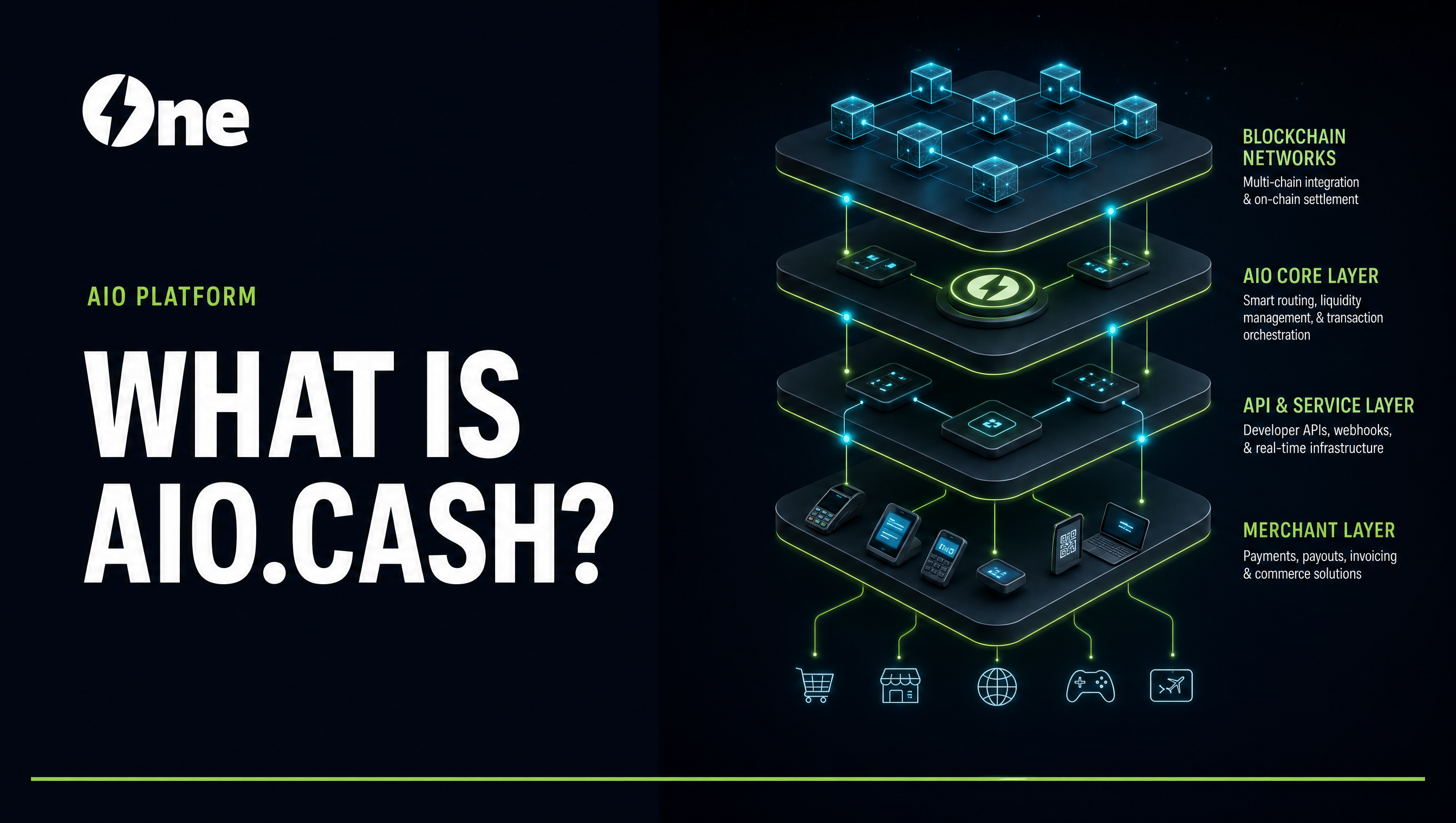
- Architecture. Non-custodial, multi-chain, single unified API. You control your funds; AIO handles state, callbacks, and settlement routing.
- Built for operations. Trace ID across the full payment lifecycle, HMAC-signed callbacks with a retry pool, and a four-tier account model (Admin, Agent, Merchant, Sub-account) with isolated balances and per-account fee configuration.
- Security baseline. TOTP 2FA on sensitive operations, IP whitelisting at both account and API key level, and 30-day audit log retention.
The 4 Problems AIO Is Built to Solve
Most teams evaluating crypto payment infrastructure focus on coin support and fee rates. The harder problems show up after go-live. AIO is designed around four of them.
State Reliability
Blockchain transactions do not have a binary confirmed/failed state. They have pending, unconfirmed, partially confirmed, reorganised, and dropped states, and most payment gateways abstract this poorly. When your backend receives a webhook saying "payment received," you need to know whether that signal is final. AIO's payment state model is explicit: every transaction carries a trace ID across its full lifecycle, so your system always knows where a payment actually is, not just where the gateway thinks it is.
Operational Control
Payment infrastructure that works in staging frequently breaks in production because nobody planned for multi-merchant isolation, per-account fee differences, or role-based access to sensitive operations. AIO's four-tier account hierarchy, Admin, Agent, Merchant, Sub-account, gives operators granular control over fund isolation, fee configuration, and access permissions before those problems surface. Each tier has isolated balances, so a single compromised sub-account does not expose your entire merchant portfolio.
Integration Trust
The most common integration failure in crypto payment systems is not a missing feature. It is a webhook that fires once and never retries. If your fulfilment system misses it, the order stalls. AIO uses HMAC-signed callbacks with a retry pool: every callback is cryptographically signed so your server can verify it was not tampered with, and the retry pool ensures delivery even if your endpoint is temporarily unreachable. That combination makes the callback layer a reliable signal rather than a best-effort notification. Learn more about how crypto payments work end-to-end.
Fiat Conversion Flow
Accepting crypto does not mean holding crypto. Most merchants want to convert some or all of their receipts to fiat, and the conversion flow is where hidden costs live, including FX spreads, withdrawal minimums, and payout fees that compound quickly. AIO's 0% payout fee removes one layer of that cost entirely. Combined with the 0.3% pay-in rate, the total cost of moving money in and out is lower than any major commercial alternative, without requiring self-hosting or giving up support. For a full breakdown of where costs accumulate, see this crypto payment fees breakdown.
The Fee Structure in Context
Fee comparisons in crypto payments are frequently misleading because providers quote pay-in rates while omitting payout costs, conversion spreads, and chain-specific surcharges. The table below uses confirmed 2026 rates for like-for-like commercial gateway plans.
| Gateway | Pay-In Fee | Payout / Withdrawal Fee | All-In Cost at $100k/mo |
|---|---|---|---|
| AIO.cash | 0.3% | 0% | ~$300 |
| Coinbase Commerce | 1% | Network fee | ~$1,000+ |
| BitPay (standard) | 1–2% | Network fee + spread | $1,000–$2,000+ |
| Stripe (stablecoin) | 1.5% | Included | ~$1,500 |
| NOWPayments | 0.5% | Variable | ~$500–$800 |
At $1,000,000 per month, the difference between AIO's 0.3%/0% structure and a 1%/variable alternative is $7,000 to $17,000 in monthly processing costs. That gap compounds faster than most finance teams expect when they are first modelling crypto payment costs.
One caveat: AIO's fee advantage is most meaningful when volume is consistent and the merchant controls the conversion timing. If you need instant fiat settlement with no crypto exposure, the total cost picture changes and should be modelled separately.
Who AIO Is Built For
The fee and architecture story only makes sense in context of who actually operates it. AIO is not a consumer checkout button. It is infrastructure for teams that have payment operations to run.
Product and Engineering Teams
Teams building payment flows into a product, rather than bolting on a checkout widget, need an API they can trust at the operational level. AIO's single unified API for multi-chain payments removes the integration overhead of managing per-chain connections. The trace ID system means your logs and your payment provider's logs speak the same language, which cuts debugging time significantly when something goes wrong in production.
Merchant Platform Operators
If you are running a platform where multiple merchants each need their own payment configuration, including isolated balances, different fee rates, and separate audit trails, the four-tier model (Admin, Agent, Merchant, Sub-account) is purpose-built for this. Most gateways offer flat account structures that require workarounds to achieve tenant isolation. AIO's multi-tenant architecture makes it a native fit for marketplace, SaaS billing, and platform payment infrastructure. See the complete merchant acceptance guide for implementation patterns.
Fintechs Bridging Fiat and Crypto
Companies operating at the boundary between fiat and crypto payment rails face constant reconciliation complexity. AIO's non-custodial model means funds are always under merchant control, which matters for balance sheet treatment and compliance posture. The 0% payout fee makes frequent conversion events economical, and per-account fee configuration allows different conversion policies for different business units or merchant segments.
Security and Compliance Stakeholders
Finance and compliance teams signing off on crypto payment infrastructure need specific assurances. AIO provides TOTP 2FA on all sensitive operations, IP whitelisting configurable at both the account and API key level, and 30-day audit log retention. These are not optional add-ons. They are part of the baseline, and having them built in rather than bolted on reduces implementation risk for teams operating under financial regulation or handling enterprise security reviews.
Key Technical Capabilities
The following capabilities are confirmed features, described as they function operationally.
Trace ID across the full request lifecycle. Every payment request carries a consistent trace ID from initiation through confirmation. This means your application logs, your support team's view, and AIO's internal records all reference the same identifier, a basic requirement for production debugging that many gateways do not provide.
HMAC-signed callbacks with retry pool. Callbacks are signed using HMAC, allowing your server to cryptographically verify that each notification originated from AIO and was not modified in transit. The retry pool ensures callbacks are re-attempted if your endpoint is unavailable, removing the need for your team to build a separate polling mechanism as a backup.
Multi-chain via a single unified API. AIO abstracts the differences between supported chains behind one API interface. You do not need to manage per-chain connection logic, fee estimation differences, or confirmation depth thresholds separately, because the infrastructure layer handles that. This is particularly relevant for teams accepting stablecoins across multiple chains, where the chain-specific differences are operationally irrelevant to the merchant.
Multi-tenant account model. The four-tier hierarchy (Admin, Agent, Merchant, Sub-account) with isolated balances and per-account fee configuration supports complex organisational structures without requiring custom development. Role-based access at each tier means operators can grant the minimum required permissions to each account level.
IP whitelisting at account and API key level. This is unusual for a crypto payment API, as most gateways offer IP restrictions only at the account level. AIO supports whitelisting at the API key level, which allows different access policies for different integration points within the same account.
Getting Started
If you are evaluating crypto payment infrastructure for a production use case, whether that is a merchant platform, a fintech product, or a high-volume merchant operation, the right starting point is a fee model and architecture that does not penalise you as you scale. AIO.cash is built around that principle: low, predictable costs at the infrastructure level, with the operational controls that serious payment teams require.
Visit AIO.cash to review the documentation, explore the API, or speak with the team about your integration requirements.
Frequently Asked Questions
What does AIO.cash charge for crypto payments?
AIO charges 0.3% on pay-ins (incoming payments from customers) and 0% on payouts (outgoing transfers to merchants or recipients). There are no hidden withdrawal fees layered on top of the payout rate, making the all-in cost straightforward to model.
Is AIO.cash custodial or non-custodial?
AIO is non-custodial. Merchants retain control of their funds throughout the payment lifecycle. AIO handles the infrastructure layer, including state management, callbacks, and multi-chain routing, without holding merchant funds.
What chains does AIO support?
AIO supports multiple chains via a single unified API. Rather than managing per-chain integrations, merchants connect once and AIO handles the chain-specific differences. Check the AIO.cash documentation for the current list of supported networks.
What security controls does AIO provide?
AIO includes TOTP 2FA for sensitive operations, IP whitelisting configurable at both the account and API key level, HMAC-signed callbacks to verify notification authenticity, and 30-day audit log retention. These controls are part of the base product, not optional add-ons.
What is the multi-tenant account model and who needs it?
AIO uses a four-tier hierarchy including Admin, Agent, Merchant, and Sub-account. Each tier has isolated balances and can have different fee configurations. This is designed for platform operators, marketplaces, and any business that needs to manage payments across multiple merchants or business units from a single integration, without accounts bleeding into each other.
Frequently Asked Questions
What does AIO.cash charge for crypto payments?
AIO charges 0.3% on pay-ins (incoming payments from customers) and 0% on payouts (outgoing transfers to merchants or recipients). There are no hidden withdrawal fees, making the all-in cost straightforward to model.
Is AIO.cash custodial or non-custodial?
AIO is non-custodial. Merchants retain control of their funds throughout the payment lifecycle. AIO handles the infrastructure layer — state management, callbacks, multi-chain routing — without holding merchant funds.
What chains does AIO support?
AIO supports multiple chains via a single unified API. Rather than managing per-chain integrations, merchants connect once and AIO handles the chain-specific differences. Check the AIO.cash documentation for the current list of supported networks.
What security controls does AIO provide?
AIO includes TOTP 2FA for sensitive operations, IP whitelisting at both account and API key level, HMAC-signed callbacks, and 30-day audit log retention. These controls are part of the base product, not optional add-ons.
What is the multi-tenant account model and who needs it?
AIO uses a four-tier hierarchy: Admin, Agent, Merchant, and Sub-account — each with isolated balances and per-account fee configuration. It's designed for platform operators, marketplaces, and businesses managing payments across multiple merchants from a single integration.