How to Accept Crypto Payments: The Complete Merchant Guide (2026)
Learn how to accept crypto payments in 2026. Step-by-step guide covering gateway setup, KYC, webhooks, compliance, and the 4 technical problems every merchant must solve.
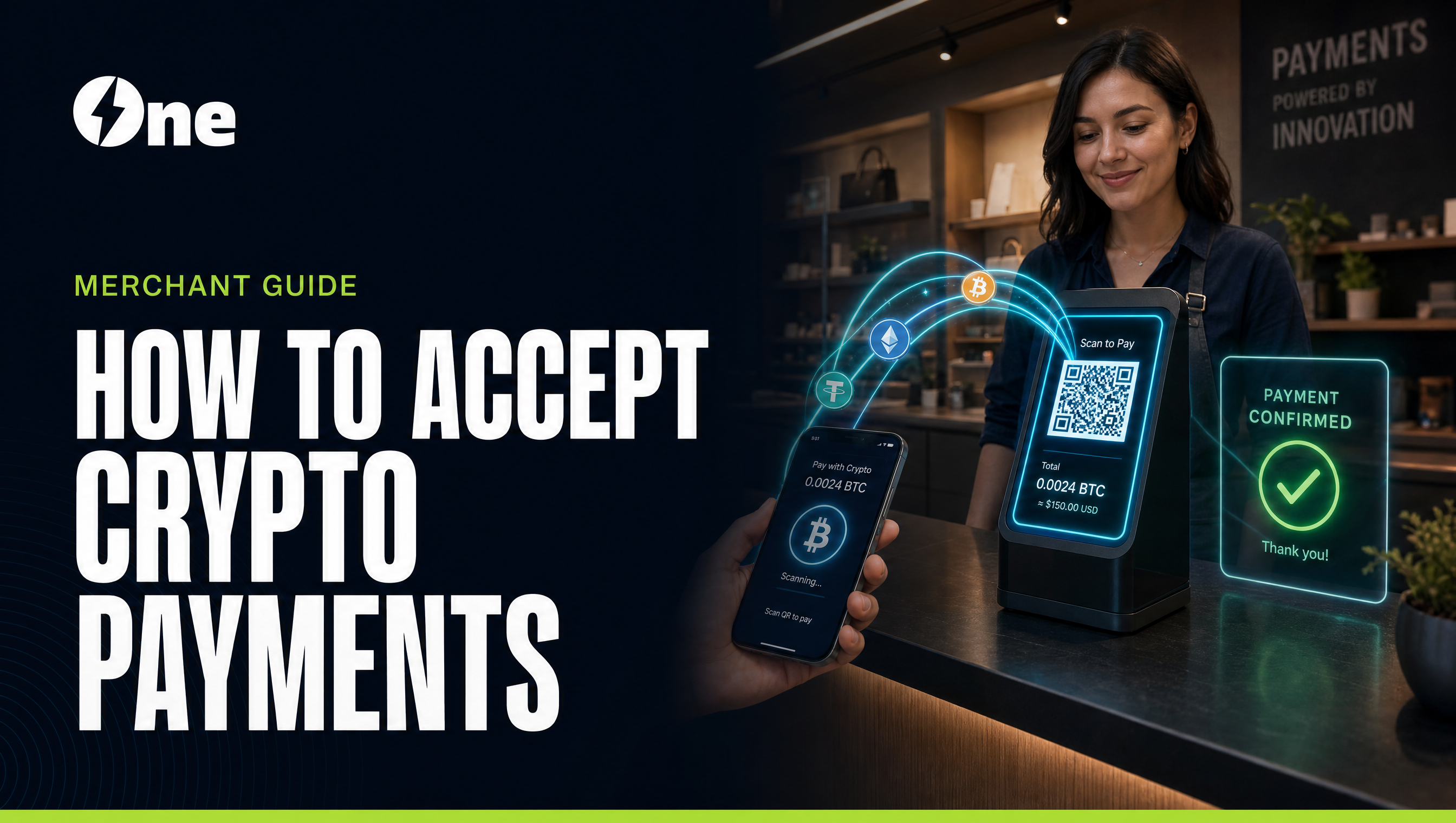
Merchants who integrate a crypto payment gateway report processing their first live transaction within an hour of starting integration. Building the equivalent from scratch, covering address generation, on-chain detection, reconciliation, and reliable webhook delivery, typically takes 3 to 6 months of engineering work. That gap exists because accepting crypto is not one problem. It is four distinct problems that must be solved in sequence, and skipping any one of them breaks the entire flow.
This guide walks through exactly what those problems are, how to evaluate your options, and the precise steps to get crypto payments live on your site or platform. Whether you run an e-commerce store, a SaaS business, or a marketplace, the underlying mechanics are the same. Understanding them before you integrate saves significant time debugging edge cases after you go live.
What to Know
- Accepting crypto requires solving four sequential problems, including unique address generation, on-chain deposit detection, amount reconciliation against expected value, and reliable webhook delivery to your application.
- A payment gateway solves all four. Building your own means solving all four from scratch, plus maintaining the infrastructure as chains and protocols evolve.
- Start with USDC, since it eliminates exchange-rate drift because it is dollar-pegged, which simplifies reconciliation and accounting.
- In the US, the GENIUS Act (2025) classifies payment stablecoins as regulated instruments, and 1099-DA reporting applies to digital asset transactions starting in 2026.
- A gateway integration typically requires account registration, KYC, currency selection, settlement configuration, API or plugin install, webhook endpoint setup, and an end-to-end test transaction.
The 4 Problems Every Merchant Must Solve Before Accepting Crypto
Most articles about accepting crypto payments skip the underlying mechanics. That is a mistake, because these mechanics explain every integration bug, every missed payment, and every reconciliation failure you will encounter.
Problem 1: Unique Address Per Customer
Blockchain payments are push transactions, which means the customer initiates a transfer to an address you control. If two customers pay to the same address at the same time, you cannot tell which payment belongs to which order. You need a fresh deposit address generated for each payment session. This is not optional. It is the foundation of the entire flow.
Managing a pool of reusable deposit addresses, rotating them safely, and linking each address to a specific order in your database is non-trivial. A gateway handles this automatically on every checkout call, so the problem is solved without any custom code on your part.
Problem 2: Detecting the On-Chain Deposit
Once you have a unique address, you need to know the moment a deposit lands. This means running a node or subscribing to a blockchain indexer, filtering transactions by address, and handling the latency between when a transaction is broadcast and when it receives enough confirmations to be considered final.
Confirmation requirements vary by chain and by your risk tolerance. A low-value transaction on a fast chain might be safe to accept after one confirmation. A high-value transaction on a chain with longer finality might need six. Getting this wrong means either accepting payments that never confirm or making customers wait unnecessarily. Both outcomes cost you money.
Problem 3: Reconciling the On-Chain Amount
If a customer is paying $100 and you invoice them in Bitcoin, the exchange rate changes between when you generate the payment request and when the transaction confirms. The on-chain amount may differ from the expected amount by several percent, so you need to decide what tolerance window you accept, and how you handle underpayments and overpayments.
This problem disappears when you invoice in a stablecoin like USDC. One dollar-denominated stablecoin unit equals one dollar, which means no drift, no tolerance window, and straightforward reconciliation. That is the main operational reason to prioritize stablecoins for merchant integrations.
Problem 4: Delivering the Payment Event Reliably
Your application needs to know when a payment is confirmed so it can fulfill the order, unlock the account, or trigger downstream processes. This requires a webhook, which is an HTTP POST your gateway sends to an endpoint you control. The webhook must be signed so you can verify its authenticity, and it must be retried if your endpoint is temporarily unavailable.
Building a reliable webhook delivery system with retry logic, exponential backoff, signature verification, and idempotency handling is its own engineering project. Skipping it means your fulfillment logic depends on polling, which is fragile, slow, and easy to miss.
Choosing Between a Gateway, an Exchange Account, and Building Your Own
These are the three real options. Each solves the four problems differently, and the tradeoffs are significant.
| Option | Setup time | Solves all 4 problems | Maintenance burden | Best for |
|---|---|---|---|---|
| Payment gateway (e.g. AIO) | 1–4 hours | Yes, out of the box | Low — provider maintains infrastructure | Most merchants, any volume |
| Exchange account (e.g. Coinbase Commerce) | 1–2 days | Partial — limited per-order address logic | Low, but constrained feature set | Very low volume, simple use cases |
| Build your own | 3–6 months | Only if you build it correctly | High — nodes, indexers, keys, retries | Exchanges, large platforms with dedicated infra teams |
Exchange account solutions are appealing because the brand names are familiar. Yet they are custody products adapted for payments, not purpose-built payment infrastructure. They often lack per-order address generation, sophisticated reconciliation, and configurable webhook retry logic. As a result, for merchants processing more than a handful of transactions per day, the operational gaps become visible quickly.
Building your own is appropriate if you are an exchange or a high-volume platform with a dedicated blockchain engineering team and a specific reason why no existing gateway meets your requirements. For the vast majority of merchants, it is the worst cost-to-benefit decision available.
A purpose-built gateway is the right default. The decision then becomes which gateway, covered in the steps below. For a full breakdown of what you pay across providers, see the crypto payment fee breakdown.
Step-by-Step: Setting Up Crypto Payments
Step 1: Choose a GENIUS-Compliant Gateway
The GENIUS Act (Guiding and Establishing National Innovation for US Stablecoins), signed into law in 2025, establishes a federal licensing framework for payment stablecoin issuers and sets conduct requirements for entities that process stablecoin payments for merchants. When choosing a gateway, verify that it operates within a compliant framework for the stablecoins it supports.
Practically, this means asking whether the gateway works with licensed stablecoin issuers, whether it has a documented AML and KYC program, and whether it issues or partners with entities that issue 1099-DA where required. A gateway that cannot answer these questions clearly is a compliance risk, not just an operational one.
Step 2: Register and Complete Merchant KYC
Every legitimate payment gateway requires merchant KYC before you can process live transactions. This typically means providing business registration documents, beneficial ownership information, a description of your business and expected transaction volumes, and in some cases bank account details for fiat settlement.
KYC review times vary. Some gateways approve accounts within hours for low-risk business types, while others take several business days. Start this step before you begin integration, because the API keys you need to go live are only issued after KYC approval.
Step 3: Select Your Currencies (Start With USDC + Bitcoin)
Most gateways let you enable multiple currencies and chains. Start narrow. Enable USDC on one high-throughput chain as your primary currency, since it eliminates exchange-rate drift and makes reconciliation straightforward. Add Bitcoin as a secondary option for customers who prefer it.
Resist the temptation to enable every available currency on day one. More currencies mean more reconciliation edge cases, more wallet compatibility questions from customers, and a more complex support surface. Expand once your core flow is stable and you understand your customers' preferences.
Step 4: Decide on Settlement (Auto-Convert vs. Hold Stablecoin)
You have two primary settlement options. Auto-convert means your gateway converts incoming crypto to a fiat currency (typically USD or EUR) and transfers it to your bank account on a scheduled basis. Holding stablecoin means confirmed USDC payments sit in a non-custodial wallet you control, available for you to move or convert on your own schedule.
Auto-convert is simpler for accounting and eliminates crypto balance management. Holding stablecoins gives you more control and may reduce conversion fees if you can time your offramps. For businesses new to crypto payments, auto-convert is the lower-friction starting point. Non-custodial settlement is valuable once you have a treasury workflow to support it.
Step 5: Install and Configure the Integration
Gateway integrations come in three forms: a hosted payment page (redirect the customer, the gateway handles everything), a JavaScript widget (embedded checkout, minimal dev work), or a direct API integration (full control, requires developer effort).
For e-commerce platforms, check whether your gateway offers a native plugin. Shopify, WooCommerce, and Magento plugins can reduce integration to a configuration step. For custom applications, the API path gives you the most flexibility. The Shopify integration guide covers the plugin path in detail.
Whichever method you choose, the core configuration is the same: set your API credentials, specify which currencies to accept, set your callback URL, and configure the success and failure redirect URLs for hosted flows.
Step 6: Configure and Test Webhooks
Webhooks are where most integration failures happen. Set your webhook endpoint URL in the gateway dashboard. Make sure your endpoint does each of the following.
- Accepts POST requests with a JSON body
- Verifies the HMAC signature on every incoming request before processing it
- Returns HTTP 200 within the gateway's timeout window (typically 5–30 seconds)
- Handles duplicate deliveries idempotently, because gateways retry on non-200 responses, so the same event may arrive more than once
- Queues fulfillment logic asynchronously rather than executing it inline during the webhook response
Use your gateway's test mode to send simulated payment events to your endpoint before going live. Verify that your application correctly handles all relevant event types, including payment received, payment confirmed, payment expired, and payment underpaid if your gateway exposes that state.
Step 7: Run a Full End-to-End Test Before Going Live
Before enabling crypto payments for real customers, run a complete transaction on the live network with a real (small) amount. Test mode simulators are useful, but they do not replicate actual blockchain latency, real wallet behavior, or the exact confirmation timing your gateway uses in production.
Send a real payment from a wallet you control. Verify that the deposit address is unique to the order, the gateway detects the transaction, your webhook fires with the correct payload after confirmation, your application fulfills the order, and the amount appears correctly in your gateway dashboard. Fix anything that does not work exactly as expected before accepting customer payments.
What a Crypto Payment Flow Looks Like in Practice
Once you are live, every customer payment follows the same sequence.
- Customer initiates checkout — they select crypto as the payment method and choose a currency.
- Gateway generates a unique deposit address — a fresh address is created for this specific order, tied to the expected amount and a payment expiry window.
- Customer sends the payment — they copy the address into their wallet or scan a QR code and broadcast the transaction.
- Gateway detects the transaction — the gateway's indexer sees the broadcast and marks the payment as pending.
- Transaction receives required confirmations — the gateway waits for the chain to finalize the block containing the transaction.
- Gateway fires a webhook — your endpoint receives a signed HTTP POST with the payment details including amount, currency, chain, order reference, transaction hash, and status.
- Your application fulfills the order — you verify the HMAC signature, match the order reference, confirm the status is confirmed, and trigger fulfillment.
The entire sequence, for a stablecoin payment on a fast chain, typically completes within 30 to 90 seconds of the customer sending the transaction. For Bitcoin, expect 10 to 60 minutes depending on confirmation requirements.
Common Mistakes That Break Crypto Payment Integrations
Reusing deposit addresses. Sending multiple customers to the same address makes reconciliation impossible, so always request a fresh address per order, per session. Never cache or reuse addresses.
Not verifying HMAC signatures. If your webhook handler processes any incoming POST without signature verification, an attacker can send fake payment confirmations to your endpoint and trigger order fulfillment without paying. Verify the signature before touching the payload.
Treating blockchain confirmations as instant. "Detected" is not "confirmed." Build your fulfillment logic to fire on confirmed status only, not on the first broadcast detection. The confirmation threshold is your protection against double-spend attacks.
Ignoring expiry windows. Payment addresses have an expiry time, typically 15 to 30 minutes from generation. If a customer pays after expiry, the gateway may not automatically match the payment to the order. Handle expired payment states explicitly in your UI and your webhook logic.
Skipping idempotency on webhook handlers. Gateways retry webhooks on non-200 responses. If your handler processes a confirmation event twice, you may fulfill the same order twice. Use the payment or trace ID to check whether you have already processed an event before acting on it.
Invoicing in volatile currencies without a tolerance window. If you invoice in Bitcoin rather than stablecoin, define a clear tolerance window for underpayments, such as accepting if within 0.5% of the expected amount. Failing to do this will result in legitimate payments being rejected due to minor exchange-rate movement between invoice generation and transaction broadcast.
Compliance Essentials: 1099-DA, GENIUS Act, and KYC
Crypto payment compliance has changed materially in 2025 and 2026. Merchants accepting crypto need to understand three frameworks.
1099-DA (US). The IRS digital asset reporting rule requires brokers and digital asset processors to issue Form 1099-DA to US persons for reportable transactions, effective for transactions occurring in 2026. If your gateway is a reporting entity under the rule, it will issue 1099-DA on applicable transactions. Merchants should confirm with their gateway whether 1099-DA applies to their account and ensure their business address and tax identification details are accurate in the gateway dashboard.
GENIUS Act stablecoin compliance. The GENIUS Act establishes that payment stablecoins must be issued by entities with a federal or qualifying state license, backed 1:1 by high-quality liquid assets, and subject to AML and KYC requirements. Accepting USDC from a compliant issuer (Circle) means you are accepting a regulated payment instrument, not an unregulated token. This distinction matters for your own compliance representation to banks, auditors, and insurers.
Merchant KYC and AML obligations. Even if your gateway handles KYC for your customers, you have your own obligations. Know-your-customer requirements apply to high-value transactions. If you are accepting crypto from businesses rather than consumers, you may have enhanced due diligence obligations under your jurisdiction's AML framework. Consult legal counsel if your transaction volumes or customer types trigger enhanced scrutiny.
For a broader overview of what crypto payments are and how the regulatory landscape is evolving, that guide covers the foundational concepts in more depth.
Where AIO Fits
AIO.cash is a non-custodial crypto payment infrastructure provider built for merchant operations. The fee structure is 0.3% on pay-in and 0% on payouts, with no markup on the payout side. Callbacks are HMAC-signed with a retry pool, addressing the webhook reliability problem directly. A trace ID follows each payment request through the full lifecycle, which makes reconciliation and support lookups straightforward. The API is multi-chain and unified, so you add chains and currencies through the same integration without maintaining separate provider connections. If you are evaluating gateways, AIO is worth including in that comparison.
Your next step is to register, complete KYC, and run a test transaction. The integration is documented and the first transaction typically happens the same day you start.
Frequently Asked Questions
How long does it take to start accepting crypto payments?
With a gateway, most merchants process their first live transaction within an hour of starting integration. The gateway handles address generation, on-chain detection, and webhook delivery. Building the equivalent from scratch typically takes 3 to 6 months of engineering work.
Do I need to hold crypto to accept it?
No. Most gateways offer auto-conversion, where incoming crypto is immediately converted to a stablecoin or fiat equivalent. If you accept USDC directly, you hold a dollar-pegged asset without exposure to Bitcoin or Ethereum price swings.
What is the difference between a crypto payment gateway and an exchange?
A gateway is designed for merchant payment flows. It generates unique deposit addresses per order, detects on-chain deposits, reconciles amounts against expected values, and sends real-time webhooks to your application. An exchange account is a trading and custody service. It is not built to handle high-volume, per-order payment processing reliably.
Which cryptocurrencies should I accept first?
Start with USDC on a high-throughput chain. It eliminates exchange-rate drift because it is pegged to the dollar, and it has broad consumer wallet support. Add Bitcoin as a secondary option for customers who prefer it. Expand to additional chains only once your core flow is stable.
What are my tax reporting obligations when accepting crypto?
In the US, the IRS treats crypto received as business income at fair market value on the date of receipt. Starting in 2026, brokers and processors are required to issue Form 1099-DA for reportable digital asset transactions. You should maintain per-transaction records of the asset received, USD value at receipt, and any conversion. Consult a tax professional for jurisdiction-specific guidance.
Frequently Asked Questions
How long does it take to start accepting crypto payments?
With a gateway, most merchants process their first live transaction within an hour of starting integration. The gateway handles address generation, on-chain detection, and webhook delivery. Building the equivalent from scratch typically takes 3-6 months of engineering work.
Do I need to hold crypto to accept it?
No. Most gateways offer auto-conversion, where incoming crypto is immediately converted to a stablecoin or fiat equivalent. If you accept USDC directly, you hold a dollar-pegged asset without exposure to Bitcoin or Ethereum price swings.
What is the difference between a crypto payment gateway and an exchange?
A gateway is designed for merchant payment flows -- it generates unique deposit addresses per order, detects on-chain deposits, reconciles amounts against expected values, and sends real-time webhooks to your application. An exchange account is a trading and custody service; it is not built to handle high-volume, per-order payment processing reliably.
Which cryptocurrencies should I accept first?
Start with USDC on a high-throughput chain. It eliminates exchange-rate drift because it is pegged to the dollar, and it has broad consumer wallet support. Add Bitcoin as a secondary option for customers who prefer it. Expand to additional chains only once your core flow is stable.
What are my tax reporting obligations when accepting crypto?
In the US, the IRS treats crypto received as business income at fair market value on the date of receipt. Starting in 2026, brokers and processors are required to issue Form 1099-DA for reportable digital asset transactions. You should maintain per-transaction records of the asset received, USD value at receipt, and any conversion. Consult a tax professional for jurisdiction-specific guidance.