What Is a Non-Custodial Crypto Payment Gateway?
BlockFi, Celsius, and Voyager froze withdrawals before bankruptcy. All were custodial. Non-custodial users kept access to their funds. Here is what custody means and why it matters for merchants.
BlockFi, Celsius, and Voyager were all custodial. All three froze withdrawals before filing for bankruptcy. Users, including merchants who had accepted crypto payments through custodial infrastructure, could not access their funds. Non-custodial users retained full access throughout. The distinction that made the difference was a single technical property: who controlled the private keys.
This article explains what non-custodial means in practice, how custodial and non-custodial gateways work differently, and why the distinction matters for regulatory compliance, counterparty risk, and operational continuity.
What to Know
- Custody in crypto means control of private keys. Whoever holds the private keys controls the funds.
- A custodial payment gateway holds your funds in wallets it controls. You have an account balance, not direct crypto ownership.
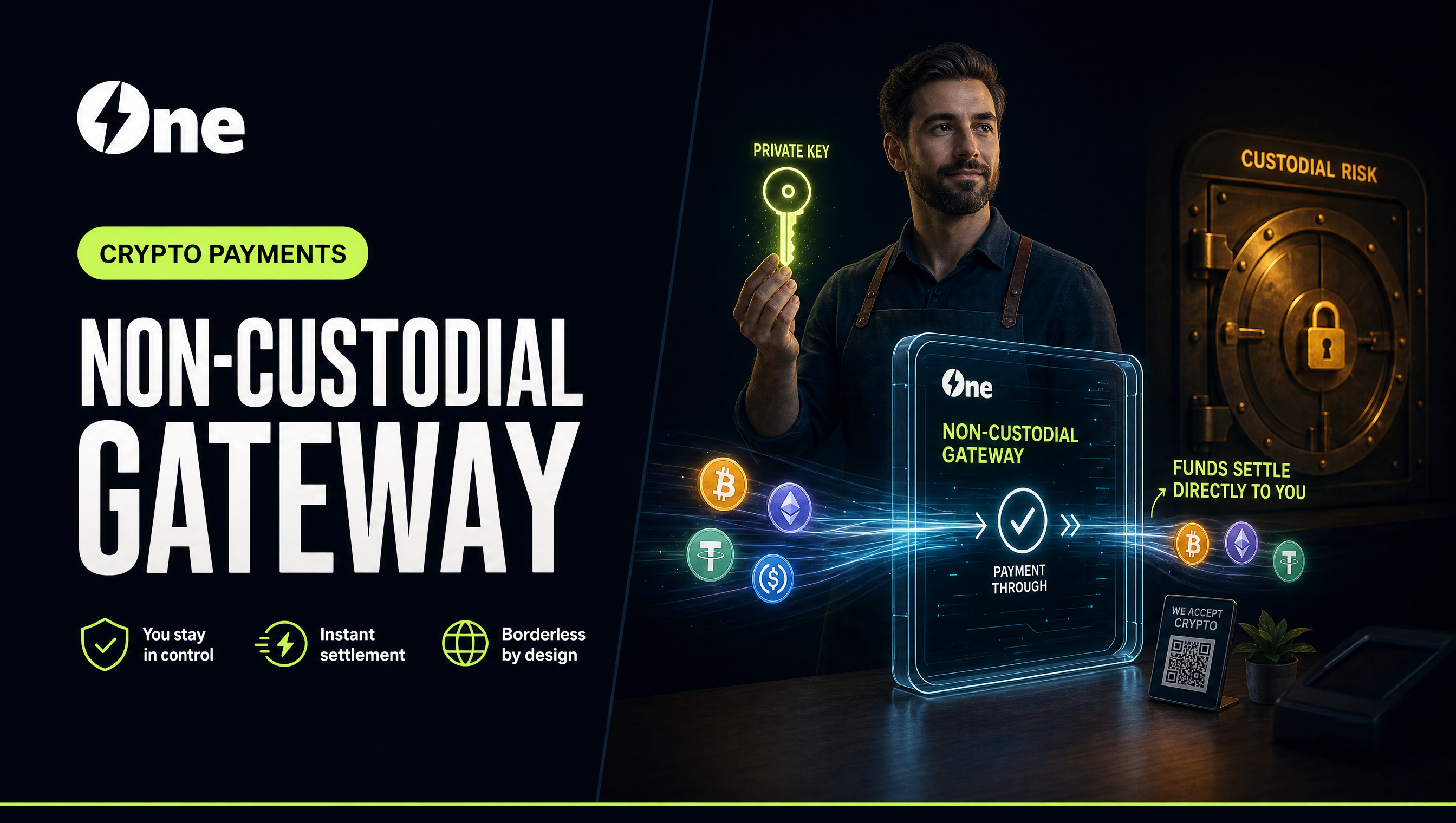
- A non-custodial payment gateway routes payments directly to wallets you control, or generates addresses whose keys you hold. The gateway processes transactions but never holds your funds.
- Custody is a regulatory trigger. In most jurisdictions, holding customer funds in custody requires a money transmitter license or equivalent. Gateways that are custodians take on licensing obligations, while those that are not may operate differently.
- If a custodial gateway fails or freezes withdrawals, your funds may be inaccessible, potentially for months during insolvency proceedings. If a non-custodial gateway fails, your already-settled funds remain in your wallet.
- AIO is non-custodial. Settled funds go to merchant-controlled wallets, and AIO does not hold merchant balances.
What Custody Means in Crypto
In traditional finance, custody refers to the safekeeping of assets. A bank or broker holds your stocks or bonds and you have a claim on them. In crypto, custody is more precise and more binary because it refers to who controls the private keys to a wallet.
A private key is a cryptographic secret that authorises the movement of funds from a wallet address. If you hold the private key, you can move the funds. If someone else holds it, they can move the funds and you cannot, regardless of what an account dashboard shows. The blockchain does not recognise account balances on a platform. It only recognises transactions signed with the correct key.
That is why "not your keys, not your coins" is a first-principle statement in crypto, not a slogan. It describes the actual technical reality of asset control on a public blockchain.
How a Custodial Gateway Works
A custodial payment gateway operates like a bank. When a customer pays you through a custodial gateway, the funds land in a wallet address controlled by the gateway operator, not in a wallet you control. The gateway then records a credit to your account balance in its internal database.
When you request a payout, the gateway initiates a transaction from its own wallet to your specified address. Until that transaction is completed and confirmed, your funds exist only as a database entry on the gateway's system. If the gateway's systems are unavailable, frozen by regulators, or subject to a bankruptcy filing, your ability to access those funds depends on the outcome of that process, not on any property of the blockchain.
Custodial gateways are easier to build and easier to onboard with. They handle all key management internally, which removes technical complexity for merchants. This convenience is the tradeoff for custody risk.
How a Non-Custodial Gateway Works
A non-custodial payment gateway processes the payment without ever holding the funds. The architecture can work in two ways.
Direct-to-wallet routing. The gateway generates deposit addresses that are derived from or linked to the merchant's own wallet keys. Incoming payments land directly in addresses the merchant controls. The gateway monitors those addresses and fires webhooks, but the funds are in the merchant's custody from the moment the transaction confirms.
Pass-through settlement. The gateway receives the payment into a short-lived operational address, immediately processes the settlement, and forwards funds to the merchant's designated wallet. The transit time is measured in seconds to minutes. The gateway's operational wallet holds funds only for the duration of the settlement step, not as a stored balance.
In both cases, the merchant never has an "account balance" with the gateway. There is nothing to freeze, seize, or lose in an insolvency. Your settled funds are already in your wallet.
The Regulatory Angle
Custody is a licensing trigger in most regulated jurisdictions. In the United States, a business that holds customer funds in custody is generally classified as a money transmitter under the Bank Secrecy Act. That classification requires state-level money transmission licenses in the states where it operates, a process that can take 2 to 3 years and significant capital. At the federal level, the OCC has frameworks for national bank charters that include custodial digital asset activities.
In the EU, the Markets in Crypto-Assets Regulation (MiCA) established a specific licensing category for Crypto-Asset Service Providers (CASPs), with custody of customer assets being a regulated service requiring authorisation.
Non-custodial gateways that never hold merchant funds may have a different regulatory profile. They are providing payment processing infrastructure, including address generation, monitoring, and webhooks, rather than custodial financial services. This distinction is not universal and varies by jurisdiction, but it is a meaningful operational and compliance consideration for merchants choosing between gateway models.
Note: This is not legal advice. Merchants should consult qualified legal counsel for compliance guidance specific to their jurisdiction and business model.
Counterparty Risk in Custodial Models
Counterparty risk is the risk that the other party in a transaction fails to fulfil their obligation. In custodial crypto, your counterparty is the gateway operator. Their solvency, operational continuity, and integrity directly affect your access to your own funds, so their failure becomes your financial problem.
The failures of BlockFi, Celsius, Voyager, and FTX demonstrated this at scale. In each case, the platform's internal accounting showed user balances that appeared intact. The issue was that underlying assets had been rehypothecated, lent out, or misappropriated. When customers tried to withdraw, there were not enough assets to cover the claimed balances. Bankruptcy proceedings froze remaining funds for months or years.
This is not a hypothetical risk. It happened, repeatedly, within a three-year period, to platforms with billions in claimed assets under management.
Non-custodial models eliminate this risk structurally. If the gateway becomes insolvent tomorrow, funds already settled to your merchant wallet are unaffected. The gateway's failure is operationally disruptive, because you need a replacement gateway, but it is not financially catastrophic.
When Custodial Might Still Make Sense
Non-custodial is the lower-risk model for most merchants. That said, custodial gateways are not universally wrong.
If your business needs built-in fiat conversion at settlement, receiving USD in a bank account directly, custodial infrastructure often provides a cleaner integration. That is because the gateway handles the crypto-to-fiat conversion and bank transfer in one flow, whereas non-custodial gateways settle crypto and leave the fiat conversion as a separate step.
If your team lacks the operational maturity to manage wallet security, including cold storage, key management, and access controls, delegating custody to a licensed, well-audited gateway is less risky than self-custody done badly. Poorly managed self-custody has its own failure modes.
If the gateway's custody infrastructure is insured, audited, and held with a regulated entity such as a qualified custodian under SEC or equivalent rules, the counterparty risk is substantially reduced compared to an unregulated exchange-style custodian.
The question is not "custodial is always bad" but rather whether you understand who holds your funds, under what conditions, and what happens if that entity fails.
AIO: Non-Custodial with Merchant-Controlled Settlement
AIO is built as a non-custodial gateway. Payments processed through AIO settle to merchant-designated wallet addresses. AIO does not maintain merchant account balances or hold funds in pooled custodial accounts. The 0.3% pay-in fee is deducted at settlement, and the remainder goes directly to the merchant's wallet.
Because of this, AIO's operational continuity and AIO's custody of merchant funds are decoupled. Merchants retain direct blockchain control over their settled funds regardless of AIO's operational status.
For merchants new to crypto payment acceptance, a practical starting guide is available at How to Accept Crypto Payments: Merchant Guide. For security considerations around payment infrastructure including webhook verification and key management, see Crypto Payment Security Guide for Merchants. For a full infrastructure overview, see What Is AIO's Crypto Payment Infrastructure.
Frequently Asked Questions
If a non-custodial gateway goes offline, do I lose access to my funds?
No. Funds that have already been settled to your merchant wallet remain in your wallet regardless of the gateway's status. You control the keys, so the funds are on the blockchain under your control. What you lose during a gateway outage is the ability to receive new payments, not access to funds already settled. That is the core operational advantage of non-custodial architecture.
Is a non-custodial crypto payment gateway regulated differently than a custodial one?
Potentially, yes. Custody of customer funds is a specific regulated activity in most jurisdictions. In the US it triggers money transmitter licensing, and in the EU it falls under MiCA CASP authorisation. Non-custodial gateways that never hold merchant funds may have a different regulatory classification. However, this varies by jurisdiction and implementation, so businesses should seek qualified legal counsel rather than relying on a gateway's own characterisation of its regulatory status.
How do I verify that a gateway is truly non-custodial?
Ask three questions. First, do incoming payment funds land in an address I control, or in an address the gateway controls? Second, is there ever a point where my settled funds exist only as a balance in the gateway's database rather than in a wallet I control? Third, what happens to my funds if the gateway suspends operations tomorrow? A genuinely non-custodial gateway should have clear, specific answers that confirm your funds never sit under the gateway's key control beyond a brief transit period during settlement processing.
What is the difference between a crypto wallet and a non-custodial payment gateway?
A crypto wallet is software that manages keys and lets you send and receive funds. A non-custodial payment gateway is a payment processing system that generates order-specific deposit addresses, monitors the blockchain for incoming transactions, manages payment state, and delivers webhooks, while settling funds to wallets you control. The gateway provides merchant operations infrastructure that a standalone wallet does not, including reconciliation, per-order attribution, automated confirmation, and event-driven integration with your order management systems.
Frequently Asked Questions
If a non-custodial gateway goes offline, do I lose access to my funds?
No. Funds already settled to your merchant wallet remain in your wallet regardless of the gateway's status. You control the keys; the funds are on the blockchain under your control. What you lose during a gateway outage is the ability to receive new payments — not access to funds already settled.
Is a non-custodial crypto payment gateway regulated differently than a custodial one?
Potentially, yes. Custody of customer funds is a specific regulated activity in most jurisdictions — in the US it triggers money transmitter licensing, in the EU it falls under MiCA CASP authorisation. Non-custodial gateways that never hold merchant funds may have a different regulatory classification. Businesses should seek qualified legal counsel for jurisdiction-specific guidance.
How do I verify that a gateway is truly non-custodial?
Ask three questions: Do incoming payment funds land in an address I control, or in an address the gateway controls? Is there ever a point where my settled funds exist only as a balance in the gateway's database? What happens to my funds if the gateway suspends operations tomorrow? A genuinely non-custodial gateway should have clear, specific answers confirming your funds never sit under the gateway's key control beyond a brief transit period.
What is the difference between a crypto wallet and a non-custodial payment gateway?
A crypto wallet manages keys and lets you send and receive funds. A non-custodial payment gateway is a payment processing system that generates order-specific deposit addresses, monitors the blockchain, manages payment state, and delivers webhooks — while settling funds to wallets you control. The gateway provides merchant operations infrastructure that a standalone wallet does not.