Crypto Payment Security: What Merchants and Developers Need to Know
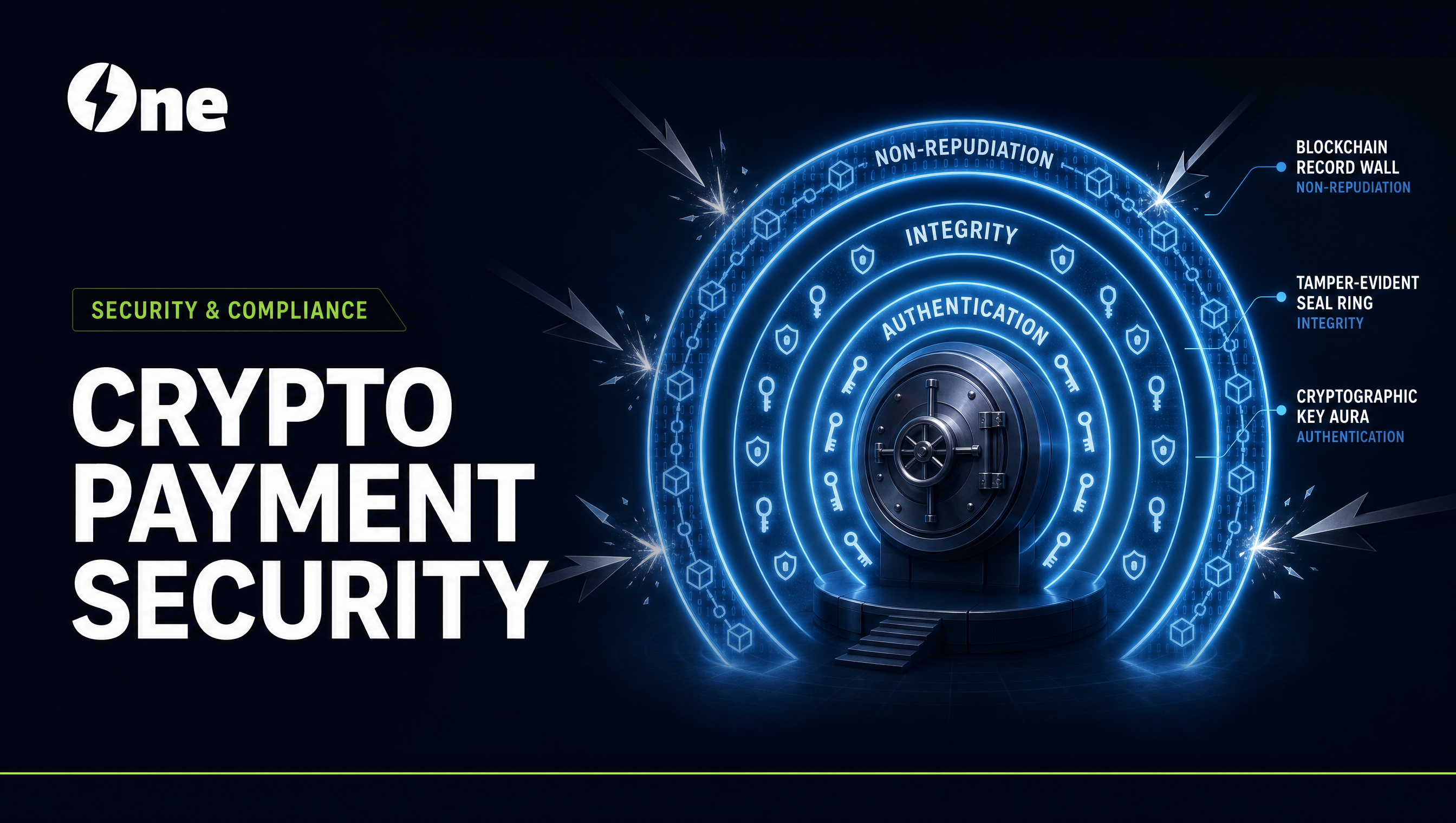
Crypto payment security covers three surfaces: authentication, integrity, and non-repudiation. Here is how blockchain handles each — and where real threats still live.
Payment fraud cost businesses $48 billion globally in 2023, according to Juniper Research. The dominant attack vector in that figure is familiar to any online merchant: chargebacks. A customer disputes a legitimate purchase, the card network reverses the payment, and the merchant absorbs the loss, plus a fee. Crypto payments eliminate chargebacks entirely because blockchain transactions are cryptographically final. But that is not the whole security picture.
Before integrating any crypto payment system, merchants and developers need to understand where crypto's security guarantees actually hold, where new threats emerge, and how to build a robust security posture on top of a sound payment gateway.
This guide covers the full security surface, from cryptographic fundamentals to practical access controls, for teams that need to make a credible integration decision.
- Crypto payments solve three classic security problems, authentication, integrity, and non-repudiation, through cryptography and immutable ledgers, not institutional authority.
- Chargebacks do not exist on-chain. Confirmed transactions cannot be reversed by any third party.
- New threats emerge at the integration layer, including webhook spoofing, wrong-address sends, underpayment exploits, and compromised admin accounts.
- HMAC-signed webhooks are the single most important developer-level security control for crypto payment integrations.
- Trace IDs, audit logs, IP whitelisting, and TOTP 2FA form the operational security layer every production merchant integration needs.
The 3 Security Surfaces in Any Payment System
Every payment system, traditional or crypto, must solve three fundamental security problems. These problems exist because financial transactions involve two parties who cannot fully trust each other and are often communicating over networks that neither party fully controls. Without solutions to each problem, payments can be faked, altered, or denied after the fact.
Authentication asks whether the counterparty is who they claim to be. In card payments, authentication relies on the issuing bank vouching for the cardholder. The merchant trusts a chain of institutional authority that stretches from the cardholder's bank through the card network to the acquirer.
Integrity asks whether the payment message was tampered with in transit. Traditional payments use encrypted channels through TLS and signed messages between institutional parties. You trust that Visa's network has not been interfered with because Visa operates dedicated infrastructure you cannot audit directly.
Non-repudiation asks whether either party can later deny the transaction occurred. In traditional payments, this is handled by bank records, which are authoritative ledgers held by institutions. The merchant's acquirer and the cardholder's bank both have records that can be compared when a dispute arises.
These are not trivial problems. Institutional solutions to them have required centuries of financial infrastructure to build. Crypto solves all three without any of that infrastructure, using math instead of authority. That shift is what makes the security guarantees fundamentally different in character.
How Crypto Payments Handle Each Security Surface
Authentication via public-key cryptography. Every crypto wallet has a public key, which is the address, and a private key, which is the signing key. When a sender broadcasts a transaction, they sign it with their private key. The network verifies the signature against the public key. No institution mediates this. The mathematics of elliptic curve cryptography guarantee that only the holder of the private key could have signed that transaction, so authentication is cryptographic rather than institutional.
Integrity via Merkle trees and consensus. Every transaction is included in a block. That block is cryptographically hashed, and the hash of each block references the previous block, creating the chain. Modifying any historical transaction would invalidate every block that followed it, a computational impossibility on any major network. The blockchain itself is the integrity guarantee, and it requires no trusted intermediary to enforce.
Non-repudiation via the immutable public ledger. Every confirmed transaction is permanently recorded on a public ledger. Anyone can verify that a payment from address A to address B of amount X occurred at timestamp T, with transaction hash H. Because this ledger is public and auditable, neither party can deny a transaction that appears on-chain. This is a stronger non-repudiation guarantee than any private bank ledger, because it is publicly verifiable without trusting any single institution.
The practical implication for merchants follows directly: once a transaction is confirmed to the required depth, typically 1 to 6 confirmations depending on the network and amount, it is settled. No card network can reverse it. No customer can claim it never happened. The transaction hash is permanent evidence, and that permanence comes from mathematics rather than institutional policy.
Threats That Still Apply to Crypto Merchant Integrations
Crypto's cryptographic guarantees are strong. Yet they protect the blockchain layer, not the application layer your integration runs on. The real attack surface for merchant integrations sits above the chain, which is why even teams who understand blockchain security can still be compromised at the integration level.
Wrong address sends. Crypto addresses are long, case-sensitive strings. If your checkout flow displays a payment address to a customer, a compromised server or browser extension could substitute a different address. The customer's payment goes to the attacker's wallet, not yours. The blockchain faithfully processes this as a valid transaction, but to the wrong recipient. Address validation and HTTPS are the minimum controls here. Generating fresh addresses per invoice rather than reusing static addresses also limits the exposure window.
Webhook spoofing. Your payment gateway notifies your server via webhook when a payment is confirmed. If your server accepts any inbound HTTP request as a valid payment notification, an attacker who knows your webhook endpoint can POST a fake confirmation and trigger order fulfillment without paying anything. This is not a crypto vulnerability. It is an HTTP vulnerability, and the fix is HMAC signature verification, covered below.
Underpayment exploits. A buyer sends 99.1% of the required amount. Your system's payment matching logic rounds up and marks the invoice paid. The buyer receives goods worth the full amount while having paid slightly less. Over volume, this accumulates. The correct architecture is to configure an explicit minimum acceptance threshold and fail-flag invoices that fall below it rather than accepting them silently.
Key management failures. Your payment gateway API keys, webhook secrets, and admin credentials are the keys to your payment infrastructure. If an API key is committed to a public repository, stored in plaintext in a database, or shared over Slack, your entire payment flow is compromised regardless of how secure the underlying blockchain is. Because of this, key management hygiene is the highest-leverage security control at the integration layer.
How HMAC-Signed Webhooks Protect Integrations
HMAC stands for Hash-based Message Authentication Code. It is a standard cryptographic technique for verifying that a message came from a specific sender and has not been modified in transit. The reason it works is rooted in a property of hash functions: given the same input and the same secret key, the output is always identical, but no one can reproduce that output without knowing the key.
Here is how it works in practice for payment webhooks:
- Your payment gateway holds a secret key shared only between the gateway and your server.
- When a payment event occurs, the gateway computes an HMAC signature over the webhook payload using that secret key and a hashing algorithm, typically SHA-256.
- The gateway attaches the signature to the webhook request as an HTTP header.
- Your server receives the webhook, independently recomputes the HMAC signature using the same secret key, and compares the two signatures.
- If the signatures match, the payload is authentic and unmodified. If they do not match, reject the request.
An attacker who sends a fake POST to your webhook endpoint cannot produce a valid signature without knowing the secret key. Even if they capture a real webhook request and replay it, the payload contents can be validated against an expected nonce or timestamp to prevent replay attacks as well.
AIO implements HMAC-signed callbacks on all payment events. The shared secret is configurable per integration, can be rotated via API without downtime, and must be verified server-side before any payment is processed. Skipping this verification step, which many integrations do, turns a webhook into an open door for fake payment confirmations.
For implementation detail, see the dedicated guide: What Is HMAC and Why Crypto Payment Webhooks Must Be Signed.
How Trace IDs Enable Post-Incident Investigation
When something goes wrong in a payment flow, a webhook that did not fire, an order that was not fulfilled, a payment that appears confirmed on-chain but not in your system, the question is always the same: what exactly happened, and at what step?
A trace ID is a unique identifier assigned to a payment request at the moment of creation and propagated through every subsequent step, including address generation, on-chain detection, confirmation counting, webhook delivery, and audit log entry. It is the thread you pull to reconstruct any incident. Without it, those steps each live in separate systems with separate log formats and separate retention windows, so correlation becomes guesswork.
Without a trace ID, debugging a payment failure means manually correlating logs from your application server, the payment gateway, the blockchain explorer, and the webhook delivery system. At senior engineering rates, a single ambiguous incident can cost more in investigation time than dozens of individual transactions.
AIO attaches a trace ID to each payment request that covers the full lifecycle: address generation, on-chain detection, confirmation, webhook delivery, and a 30-day audit log. When a merchant contacts support with a payment question, the trace ID gives a complete, ordered timeline of every event in that payment's life.
For a deeper explanation of how trace IDs work in distributed payment systems, see: What Is a Trace ID in Payment Processing?
Access Control Best Practices
Cryptographic transaction security means nothing if your payment account itself is compromised. Access control at the platform level is the operational security layer, and it addresses the class of attacks that target humans and credentials rather than mathematics.
IP whitelisting. Restrict which IP addresses can make API calls to your payment gateway. If your server's IP is the only one that can call the API, a stolen API key is significantly less useful to an attacker, because they would need to also compromise your server's network origin. AIO supports IP whitelisting at both the account level and the individual API key level.
TOTP 2FA. Time-based One-Time Password two-factor authentication should be mandatory for any sensitive operation, including withdrawals, API key creation, webhook secret rotation, and account configuration changes. A compromised password alone is not enough to access the account. AIO enforces TOTP 2FA for sensitive operations.
API key rotation. API keys should be treated as temporary credentials. Rotate them on a schedule, quarterly at minimum, and immediately after any staff departure or suspected exposure. AIO's API key management supports multiple concurrent keys, enabling zero-downtime rotation by allowing you to create the new key, update your integration, and then revoke the old key.
Audit logs. Every sensitive action, including API key creation, withdrawal, configuration change, and login, should be logged with timestamp, actor, and IP address. AIO maintains a 30-day audit log accessible to account administrators. In a post-incident investigation, the audit log is often the difference between understanding what happened and guessing.
Least privilege. Assign each API key only the permissions it needs. A key used to create payment invoices does not need withdrawal permissions. AIO's multi-tenant account model supports Admin, Agent, Merchant, and Sub-account tiers, allowing precise permission scoping.
What Crypto Payments Do NOT Protect Against
Clarity here prevents dangerous overconfidence. Understanding the boundaries of what the cryptographic model covers is as important as understanding what it guarantees.
Social engineering. If an attacker convinces your finance team that a payment gateway maintenance window requires sending test funds to an external address, no cryptographic system prevents that. Human factors are outside the cryptographic trust model.
Compromised admin accounts. If an attacker gains access to your payment platform account through credential stuffing, phishing, or insider threat, they can redirect payment addresses, disable webhooks, or initiate withdrawals. TOTP 2FA and IP whitelisting significantly reduce this risk, but they are operational controls, not cryptographic guarantees.
Wrong address sends. If your system generates a correct address but a browser-level attack such as a malicious extension or DNS poisoning substitutes a different address that the customer sees and pays to, the transaction is permanently lost. Use HTTPS with HSTS, subresource integrity checks, and per-invoice address generation to minimize this window.
Smart contract vulnerabilities. If your integration uses a smart contract for settlement logic, that contract's code is the security surface. Bugs in smart contract code have been exploited for hundreds of millions of dollars in losses across the industry. If you use direct wallet-to-wallet transactions, as most payment gateway integrations do, this is not a concern.
The Compliance Layer: GENIUS Act, KYC, and 1099-DA
Security and compliance overlap at the regulatory layer. Three areas matter most for merchants accepting crypto payments in 2026.
GENIUS Act-compliant stablecoins. The Guiding and Establishing National Innovation for US Stablecoins Act mandates that payment stablecoins be issued by licensed entities maintaining 1:1 reserves with approved assets. For merchants, this means the stablecoins you accept, including USDC, USDT, and others issued by compliant entities, carry a much clearer legal and financial backing than pre-GENIUS Act instruments. Using compliant stablecoins is both a security posture and a regulatory one.
KYC at the gateway level. Enterprise-grade payment gateways handle Know Your Customer verification at the merchant onboarding layer. This limits your counterparty risk and satisfies AML obligations without requiring you to build KYC infrastructure yourself. If your gateway does not perform KYC on merchants, you may be inheriting compliance exposure.
1099-DA reporting. The IRS requires digital asset brokers and certain payment processors to issue 1099-DA forms for reportable transactions beginning in 2026. Understand your reporting obligations and ensure your payment infrastructure supports the necessary transaction data export.
How AIO Addresses the Full Security Stack
The security architecture of the payment gateway you choose determines your default security posture. AIO is built for merchants and developers who cannot afford gaps in any of the layers described above.
| Security Layer | Threat | AIO Control |
|---|---|---|
| Webhook integrity | Fake payment confirmations | HMAC-signed callbacks with configurable secret |
| Secret management | Exposed webhook secrets | Secret key rotation via API, zero-downtime |
| Delivery reliability | Missed webhooks | Retry pool with exponential backoff |
| Incident investigation | Ambiguous payment failures | Trace ID across full lifecycle, 30-day audit log |
| Account access | Compromised credentials | TOTP 2FA for sensitive operations |
| API access | Stolen API keys | IP whitelisting at account + key level |
| Permissions | Over-privileged integrations | Multi-type API key model, least-privilege scoping |
AIO handles pay-in and pay-out flows with HMAC-signed callbacks, trace IDs on every request, and a 30-day audit log, giving you the infrastructure layer that turns security principles into operational reality.
If you are evaluating crypto payment gateways for a production integration, the security checklist above gives you a concrete framework for comparing options. Read the developer-specific guides on HMAC webhook verification and payment trace IDs for implementation detail.
For teams earlier in their evaluation, What Are Crypto Payments? covers the fundamentals before you get to the security layer.
When you are ready to move to integration, the AIO documentation covers HMAC setup, trace ID usage, and access control configuration in detail.
Frequently Asked Questions
Can crypto payments be charged back?
No. Confirmed blockchain transactions are irreversible by design. There is no card network or bank that can reverse a settled on-chain payment. This eliminates chargeback fraud — the most expensive fraud vector for card-accepting merchants.
What is HMAC verification in payment webhooks?
HMAC (Hash-based Message Authentication Code) is a cryptographic technique where the payment gateway signs each webhook payload with a shared secret. Your server recomputes the signature on receipt and only processes the callback if both signatures match. This prevents attackers from faking payment confirmation events.
How do I protect my crypto payment API keys?
Store API keys in environment variables or a secrets manager — never in source code. Rotate keys on a fixed schedule or immediately after any suspected exposure. Use IP whitelisting to restrict which servers can call your API endpoints.
What is an underpayment exploit in crypto?
An underpayment exploit occurs when a buyer intentionally sends slightly less than the required amount, hoping the merchant system marks the payment as complete anyway. Merchants must configure a minimum acceptable threshold and reject or flag payments below it.
Does the GENIUS Act affect crypto payment security requirements?
The GENIUS Act regulates stablecoin issuers, not merchants directly. Merchants using GENIUS Act-compliant stablecoins benefit from stronger underlying asset guarantees and clearer regulatory standing.