What Is a Crypto Payment Gateway? How It Differs From a Crypto Exchange
A crypto payment gateway moves a specific asset from payer to payee with webhooks and order attribution. An exchange trades assets at market prices. Using an exchange for merchant payments is a common and costly mistake.
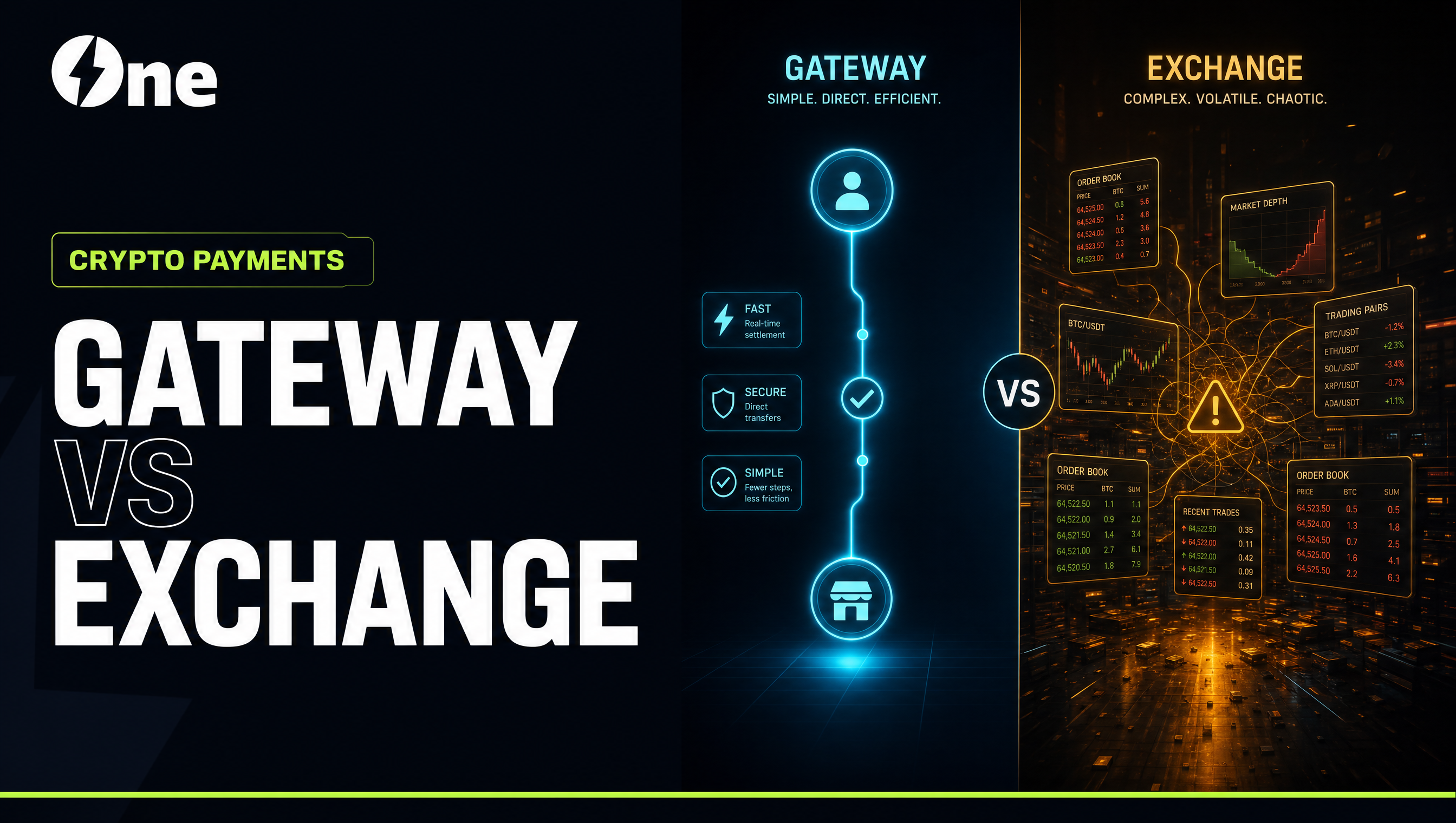
A crypto payment gateway and a crypto exchange are not interchangeable. An exchange discovers prices. It is a marketplace where buyers and sellers trade assets. A payment gateway settles transactions. It moves a specific amount from payer to payee at a pre-agreed value, confirms delivery, and signals your systems via webhook. Using an exchange for merchant payments is a common mistake that creates custody risk, compliance exposure, and an operational gap where automated webhook infrastructure should be.
This article explains what each does, how to tell them apart, and what a proper payment gateway needs to deliver.
What to Know
- A crypto payment gateway performs four core functions, including generating unique deposit addresses, monitoring the blockchain for incoming transactions, confirming payment completion, and delivering event webhooks to the merchant's systems.
- A crypto exchange is a marketplace for trading assets at market prices. It is built for price discovery and asset conversion, not for merchant payment flows.
- Three of the largest custodial crypto failures, FTX, Celsius, and Voyager, all held customer funds in exchange-style custody. Merchants using non-custodial payment gateways were unaffected because funds never sat in the platform's control.
- Exchanges typically lack webhook infrastructure, trace IDs, and idempotent payment lifecycle management, which are the operational requirements of a merchant integration.
- Non-custodial gateways route funds directly to merchant-controlled wallets. The gateway processes the payment but never holds the merchant's money.
What a Payment Gateway Does
A payment gateway is the operational layer between a customer's wallet and your business systems. When a customer initiates a crypto payment, a correctly architected gateway performs four distinct functions, and each one is required for the system to work reliably.
Address generation. The gateway creates a unique deposit address for each payment session. This ensures payments are attributable to specific orders, customers, or invoices. Reusing addresses creates reconciliation problems and privacy issues.
Transaction monitoring. The gateway watches the blockchain in real time for incoming transactions to the generated address. It detects the payment, checks the amount, and tracks confirmation progress against the required threshold, such as 1 confirmation for Solana or 6 for Bitcoin.
Confirmation and state management. Once the payment is confirmed to the required depth, the gateway updates the payment state through a sequence of pending, confirmed, and complete, and also handles expired, underpaid, and overpaid states, each of which requires a different merchant response. This state machine is what makes automated order processing possible.
Event delivery. The gateway sends webhooks (HTTP callbacks) to your server at each state transition. A properly implemented gateway signs these callbacks cryptographically using HMAC-SHA256, so your server can verify authenticity. It retries failed deliveries automatically.
Without all four functions working correctly, you cannot build a reliable, automated merchant payment integration. Exchanges provide none of them.
What a Crypto Exchange Does
An exchange is a price-discovery marketplace. It matches buy orders against sell orders, maintains an order book, and executes trades at clearing prices. Its core purpose is enabling users to exchange one asset for another at market rates.
Exchanges are built for traders, not for merchant payment operations. They offer trading APIs with operations such as submit order, cancel order, and get order book, but not payment APIs that generate payment addresses, monitor for incoming transactions, or fire webhooks on confirmation. These are fundamentally different use cases with different infrastructure requirements, so what works for one will not work for the other.
Some exchanges offer "payment buttons" or merchant tools, but these are built on top of exchange account infrastructure. That means merchant funds sit in custodial exchange accounts, and payments are typically attributed to exchange addresses rather than order-specific generated addresses.
Why Using an Exchange for Merchant Payments Is a Mistake
The practical problems with routing merchant payments through an exchange account are significant.
Custody risk. When a customer sends funds to an exchange address, those funds are in the exchange's custody, not yours. FTX processed billions in what appeared to be customer funds held safely. When it failed, those funds were inaccessible. Merchants who used FTX's merchant tools lost access along with everyone else.
No payment lifecycle management. Exchanges do not track which incoming transaction corresponds to which order. You receive a credit in your exchange account, but the system does not know it was for order number 4891 from a specific customer. As a result, reconciliation becomes a manual process.
No reliable webhook infrastructure. Exchanges may offer API polling, but polling is not real-time and not designed for merchant order-trigger workflows. A 30-second polling interval means order confirmation lags. Beyond that, there is no retry logic for failed events, no HMAC signature for security, and no trace ID to correlate events across your stack.
Compliance exposure. Holding merchant funds in a custodial exchange can create money transmission compliance questions in regulated jurisdictions. The exchange is acting as a custodian of business funds, which is a regulated activity in many jurisdictions that requires licensing.
Key Features of a Proper Payment Gateway
When evaluating crypto payment gateways, the following operational capabilities separate payment infrastructure from glorified wallet services.
Per-order address generation. Every payment should have its own unique deposit address. This is non-negotiable for reconciliation accuracy and privacy.
Webhook delivery with retry. Webhooks should fire at every payment state transition. Failed deliveries should retry automatically with exponential backoff. You should not have to poll an API to discover whether a payment completed.
HMAC-signed callbacks. Every webhook should be signed with a shared secret using HMAC-SHA256. Your server validates the signature before processing the event. Without this, an attacker can send a fake "payment confirmed" webhook to your endpoint and trigger fulfillment without a real payment.
Trace ID. A trace ID (or correlation ID) is a unique identifier that travels with the payment through every system and every event. When a payment fails or a webhook is replayed, the trace ID lets you find the exact chain of events across your logs, the gateway's logs, and the blockchain record.
Multi-chain support via single API. Supporting multiple chains from one integration reduces the operational burden of adding new payment options. The gateway abstracts chain-specific details so your code handles one unified API regardless of whether the payment came in on Base, Solana, or Tron.
Non-custodial settlement. The gateway should settle funds to your own controlled wallet, not hold them in a pooled exchange account. You retain control at all times.
Custodial vs Non-Custodial Gateway Comparison
| Feature | Custodial Gateway | Non-Custodial Gateway | Exchange (merchant use) |
|---|---|---|---|
| Merchant controls funds | No — gateway holds custody | Yes — direct to merchant wallet | No — exchange holds custody |
| Per-order address generation | Usually yes | Yes | Typically no |
| Webhook / callback support | Usually yes | Yes | Rarely |
| HMAC-signed callbacks | Varies | Yes (well-built gateways) | No |
| Trace ID / correlation ID | Varies | Yes (well-built gateways) | No |
| Multi-chain support | Varies | Yes (well-built gateways) | Varies |
| Failure mode | Platform failure = fund freeze | Platform failure = no new payments; existing funds safe | Platform failure = fund freeze |
Where AIO Fits
AIO is a non-custodial payment gateway. It generates per-order deposit addresses, monitors chains for incoming transactions, manages payment state machines, and delivers HMAC-signed callbacks with a trace ID across the full payment lifecycle. Funds settle directly to merchant-controlled wallets, so AIO never holds merchant balances in a pooled custodial account.
This architecture means that if AIO's infrastructure had a service interruption, merchants' already-settled funds would remain in their wallets. The system is designed so the gateway is a processing layer, not a bank.
For a broader guide on how to set up crypto payment acceptance for your business, see How to Accept Crypto Payments: Merchant Guide. For a technical deep dive into AIO's infrastructure, see What Is AIO's Crypto Payment Infrastructure.
Frequently Asked Questions
Can I use Coinbase or Binance as a payment gateway for my business?
Exchange-side payment tools exist but are not a substitute for purpose-built payment infrastructure. They typically lack per-order address generation, reliable webhook delivery, HMAC-signed callbacks, and non-custodial settlement. For low-volume hobby use they may be acceptable, but for any merchant integration that requires automated order processing and reliable reconciliation, exchange-based payment tools introduce meaningful operational and custody risk.
What is the difference between a custodial and non-custodial crypto payment gateway?
A custodial gateway holds merchant funds in accounts controlled by the gateway operator. A non-custodial gateway routes payments directly to merchant-controlled wallet addresses. The operational difference comes down to who controls the private keys to the funds. Non-custodial means the gateway processes the payment but never takes possession of the funds.
What is HMAC callback signing and why does it matter?
HMAC (Hash-based Message Authentication Code) signing means the gateway uses a shared secret to generate a cryptographic signature for each webhook payload. Your server recalculates the expected signature and compares it against the one sent. If they match, the webhook is authentic. This prevents attackers from sending fake "payment confirmed" events to your endpoint, which would otherwise allow them to trigger order fulfillment without making a real payment.
Do I need a payment gateway if I already have a crypto wallet?
A crypto wallet holds and sends funds but provides none of the merchant payment infrastructure, including per-order addresses, payment state management, webhooks, and reconciliation tooling. You could technically share a single wallet address for payments, but you lose the ability to attribute which payment came from which customer and cannot automate order processing. For any business with more than trivial transaction volume, a purpose-built payment gateway is necessary infrastructure, not optional tooling.
Frequently Asked Questions
Can I use Coinbase or Binance as a payment gateway for my business?
Exchange-side payment tools exist but are not a substitute for purpose-built payment infrastructure. They typically lack per-order address generation, reliable webhook delivery, HMAC-signed callbacks, and non-custodial settlement. For any merchant integration that requires automated order processing and reliable reconciliation, exchange-based payment tools introduce meaningful operational and custody risk.
What is the difference between a custodial and non-custodial crypto payment gateway?
A custodial gateway holds merchant funds in accounts controlled by the gateway operator. A non-custodial gateway routes payments directly to merchant-controlled wallet addresses. The operational difference is who controls the private keys to the funds. Non-custodial means the gateway processes the payment but never takes possession of the funds.
What is HMAC callback signing and why does it matter?
HMAC signing means the gateway uses a shared secret to generate a cryptographic signature for each webhook payload. Your server recalculates the expected signature and compares it against the one sent. If they match, the webhook is authentic. This prevents attackers from sending fake payment-confirmed events to your endpoint.
Do I need a payment gateway if I already have a crypto wallet?
A crypto wallet holds and sends funds but provides none of the merchant payment infrastructure: no per-order addresses, no payment state management, no webhooks, no reconciliation tooling. For any business with more than trivial transaction volume, a purpose-built payment gateway is necessary infrastructure, not optional tooling.