Pay-In Fee vs Payout Fee: Why Both Numbers Matter for Merchants
Most crypto gateways advertise only the pay-in rate. At $500k/month volume, a hidden 0.5% payout fee costs $30,000/year extra. Here is how to calculate your true processing cost.
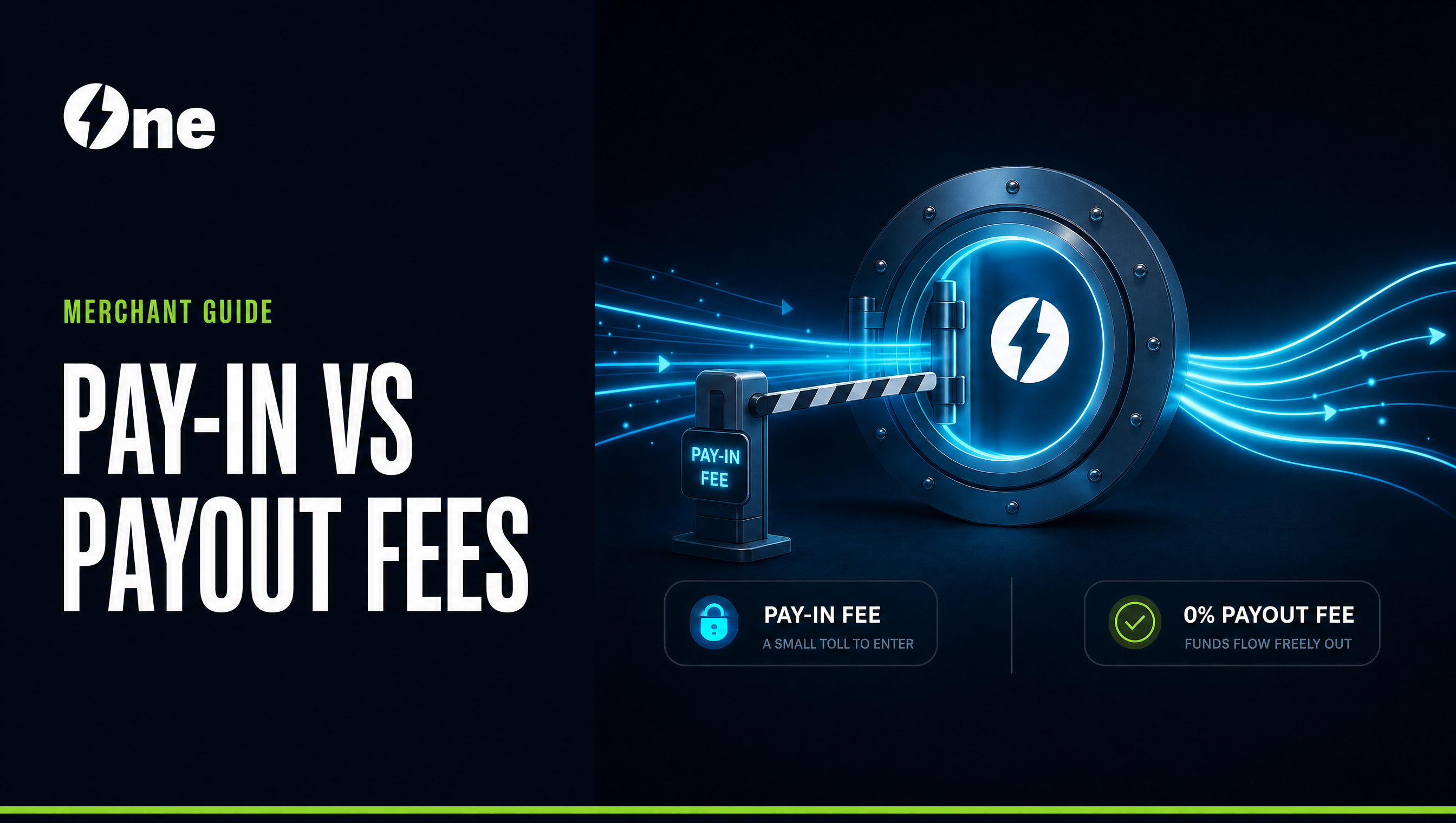
At $500,000/month in payment volume, a 0.5% payout fee costs $2,500/month, which is $30,000/year, on top of whatever pay-in rate you already pay. Yet most crypto payment gateway marketing shows only the pay-in rate. Comparing "1% vs 0.3%" without knowing the payout fee is like comparing flight prices without checking luggage fees.
This article explains exactly what pay-in and payout fees are, why gateways charge them separately, and how to calculate your true cost of processing.
What to Know
- A pay-in fee is charged when value enters the payment system, typically a percentage of each incoming transaction.
- A payout fee is charged when value leaves the system, specifically when the merchant withdraws or settles funds to their own wallet.
- Many gateways advertise only the pay-in rate. The payout fee is buried in documentation or applied automatically at settlement.
- The true cost of processing = (pay-in fee × inbound volume) + (payout fee × outbound volume). Both numbers matter.
- At $100,000/month volume, a 0.5% payout fee adds $500/month ($6,000/year) to costs that never appear in the headline rate.
- AIO charges 0.3% pay-in and 0% payout, so the full cost is the pay-in fee only.
What Is a Pay-In Fee?
A pay-in fee is charged on value entering the payment system. When a customer sends $500 in USDT to your payment gateway, the gateway takes a percentage, say 1%, leaving $495 in your gateway account. The fee is deducted at the point of receipt.
Pay-in fees are the most visible gateway cost because they appear directly in checkout flows and are prominently quoted in marketing. They represent the gateway's revenue for generating deposit addresses, monitoring the blockchain for incoming transactions, triggering webhooks, and managing the payment lifecycle. That is why gateways lead with this number: it is the one customers and merchants see first.
Pay-in fees typically range from 0.3% to 1.5% depending on the gateway, chain, and merchant tier.
What Is a Payout Fee?
A payout fee is charged when value leaves the system, specifically when the merchant requests withdrawal or settlement of accumulated funds to their own wallet or bank account. It is a separate transaction from the pay-in.
Payout fees can be structured as a percentage of the withdrawal amount, a flat fee per transaction, or both. A gateway might charge 0.5% per settlement request, $5 flat, or 0.3% with a $2 minimum. The structures vary significantly across providers.
Payout fees compensate the gateway for the cost of the outbound transaction: broadcasting the blockchain transaction, covering network gas for the outbound transfer, and managing the settlement workflow. In a custodial model, payout fees also reflect the gateway's cost of maintaining liquidity pools.
Why Gateways Charge Two Separate Fees
The pay-in and payout are technically distinct operations with different costs and risk profiles. Pay-in processing involves monitoring inbound addresses, confirming transactions, and delivering callbacks. Payout processing involves constructing and broadcasting outbound transactions, which consume gas and require signing infrastructure.
Beyond the technical distinction, charging separately lets gateways advertise a lower headline rate. A 0.5% pay-in + 0.5% payout sounds more attractive than "1% total," yet at equal inbound and outbound volume, the cost is identical.
Some gateways also profit asymmetrically from custodial float. If they hold your settled funds between payouts, they earn yield on that float. A high payout fee creates an incentive to delay settlements, which increases the float period. Merchants paying high payout fees may find themselves subsidising this model without realising it.
The Full Cost Formula
To compare gateways accurately, you need both numbers.
Total monthly processing cost = (pay-in rate × monthly inbound volume) + (payout rate × monthly outbound volume)
In most merchant scenarios, inbound volume equals outbound volume over time because you receive payments in and settle them out. The formula simplifies to:
Effective blended rate = pay-in rate + payout rate
A gateway quoting 0.8% pay-in + 0.5% payout has an effective blended rate of 1.3%. A gateway quoting 0.3% pay-in + 0% payout has an effective blended rate of 0.3%. The headline rates (0.8% vs 0.3%) tell only half the story.
Worked Example: $100,000/Month Volume
Assume a merchant processing $100,000/month, with full settlement each month (inbound = outbound volume).
| Gateway | Pay-In Rate | Payout Fee | Monthly Cost | Annual Cost |
|---|---|---|---|---|
| Gateway A | 1.0% | 0% | $1,000 | $12,000 |
| Gateway B | 0.5% | 0.5% | $1,000 | $12,000 |
| Gateway C | 0.8% | 0.5% | $1,300 | $15,600 |
| AIO | 0.3% | 0% | $300 | $3,600 |
Gateway A and Gateway B cost the same total despite very different headline rates. Gateway C, which looks competitive on pay-in, costs 30% more than Gateway A once the payout fee is included. AIO's effective cost is 0.3% regardless of settlement frequency.
The $30,000/Year Mistake at $500k/Month
Scale the same comparison to $500,000/month and the payout fee gap becomes material. A gateway with 0.5% payout on $500,000/month outbound is charging $2,500/month, which adds up to $30,000/year, purely on settlement. That is a staff salary at many businesses rather than a rounding error.
Merchants often discover this only after signing up and processing for a month. The onboarding conversation focused on the pay-in rate, while the payout fee was in section 4.3 of the pricing documentation.
How to Compare Gateways Correctly
Ask every gateway prospect the same three questions before evaluating their rates.
1. What is the payout fee? Ask for the exact structure: percentage, flat fee, or hybrid. Ask whether it applies per transaction or per settlement batch.
2. Are there minimum fees? A 0.1% payout fee sounds negligible until you learn it has a $10 minimum. At an average settlement of $500, that is a 2% effective rate.
3. Is there a holding period before settlement? Some gateways require funds to sit for 24–72 hours before withdrawal. This affects cash flow and implicitly creates float revenue for the gateway.
Once you have those answers, apply the full cost formula above. Compare effective blended rates rather than headline rates.
For a broader breakdown of how crypto payment fees are structured, including gas costs, chain selection, and settlement conversion, see Crypto Payment Fees Explained for Merchants. For a full overview of how AIO's fee structure works in practice, see What Is AIO's Crypto Payment Infrastructure.
Frequently Asked Questions
Why do some gateways charge a payout fee but not a pay-in fee?
Some gateways use a payout-only model where they absorb the cost of receiving transactions (often offsetting it through spread on conversion) and charge on settlement. This structure can appeal to merchants who want zero cost at checkout, yet the true cost surfaces at withdrawal. Always calculate total cost across the full payment lifecycle rather than at just one step.
Does AIO charge any fees on payout or settlement?
AIO charges 0.3% on pay-in and 0% on payout. There is no settlement fee, no withdrawal fee, and no minimum fee structure. Merchants settle the full received amount minus the 0.3% pay-in deduction, with no further deductions at payout.
Are network gas fees separate from the gateway payout fee?
Yes. Network gas is the blockchain's transaction cost paid to validators, and it is independent of the gateway's fee structure. Some gateways absorb gas into their quoted fees; others pass it through separately. On most modern chains (Base, Solana, Tron), gas is sub-cent and functionally immaterial. On Ethereum mainnet, gas can be $1–$15 depending on congestion. Confirm with any gateway whether their payout fee includes or excludes network gas.
Frequently Asked Questions
Why do some gateways charge a payout fee but not a pay-in fee?
Some gateways use a payout-only model where they absorb the cost of receiving transactions and charge on settlement. This structure can appeal to merchants who want zero cost at checkout, but the true cost surfaces at withdrawal. Always calculate total cost across the full payment lifecycle.
Does AIO charge any fees on payout or settlement?
AIO charges 0.3% on pay-in and 0% on payout. There is no settlement fee, no withdrawal fee, and no minimum fee structure. Merchants settle the full received amount minus the 0.3% pay-in deduction, with no further deductions at payout.
Are network gas fees separate from the gateway payout fee?
Yes. Network gas is the blockchain transaction cost paid to validators — it is independent of the gateway fee. Some gateways absorb gas; others pass it through. On modern chains like Base, Solana, and Tron, gas is sub-cent and functionally immaterial. Confirm with any gateway whether their payout fee includes or excludes network gas.