Crypto Network Gas Fees Explained: What Merchants Actually Pay
Ethereum mainnet gas averaged $2–$15 in 2024. Base L2 averages $0.002–$0.01. Same asset, 1000x cost difference. Here is what gas fees mean for merchants and how chain choice affects your costs.
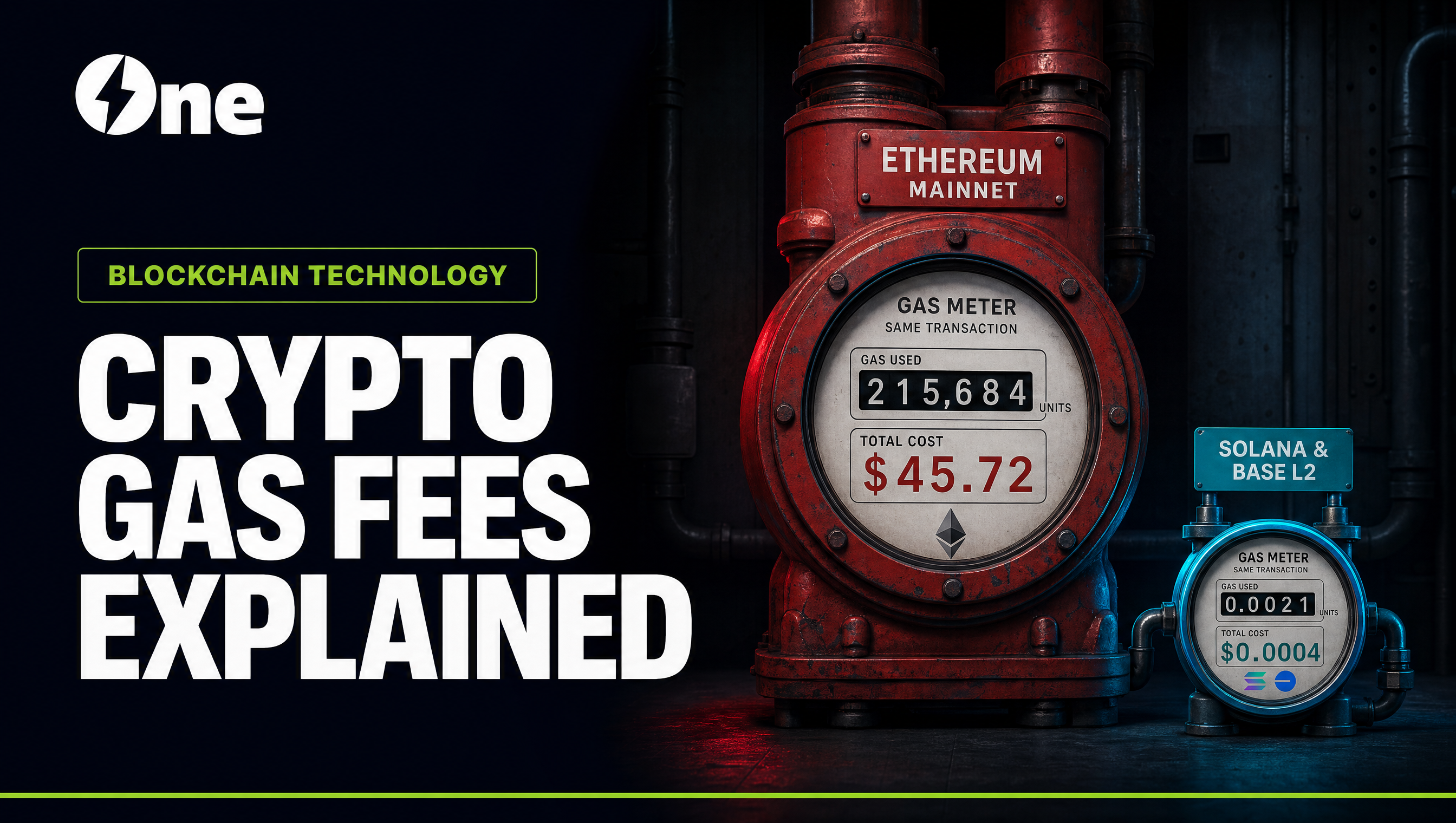
On Ethereum mainnet, the average gas fee for a simple ERC-20 transfer ran $2–$15 throughout most of 2024. On Base, an Ethereum Layer 2, the same transaction costs $0.002 to $0.01. Same asset class, same final settlement security, cost difference of roughly 1,000x. For merchants, chain selection is not a technical preference. It is a cost decision.
This article explains what gas fees are, who pays them, how they vary by chain, and how payment gateways handle them so you know what is and is not in your cost model.
What to Know
- Gas is the computational cost of executing a transaction on a blockchain. Validators consume real resources (electricity, hardware) to process transactions, and gas is the market mechanism that prices that resource.
- Gas is paid by the sender of a transaction. In most merchant payment flows, this is the customer (on pay-in) or the gateway (on payout/settlement).
- Gas costs vary by 100–1,000x depending on chain. Ethereum mainnet gas can be $2–$15+; Base, Solana, and Tron are consistently sub-cent.
- Payment gateway fees and network gas fees are separate cost items. A gateway fee covers the service layer; gas is paid to the blockchain network.
- Most merchant-grade payment gateways either absorb gas into their fee structure or route payments over chains where gas is negligible.
- For merchants, the practical question is: which chains does your gateway support, and does gas appear as a separate line item or is it absorbed?
What Gas Actually Is
Every action on a blockchain, including transferring tokens, executing a smart contract, or deploying code, requires computation. Validators (or miners, on proof-of-work chains) perform that computation, and gas is the unit that measures how much computation a given transaction requires.
A simple ETH transfer requires 21,000 gas units. An ERC-20 token transfer like USDT on Ethereum requires 45,000–65,000 gas units, because interacting with the token contract requires more computation than a plain ETH send. A complex DeFi swap involving multiple contracts can require 200,000–500,000+ gas units.
The total fee = gas units × gas price. Gas price is set by market demand: when the network is congested and many transactions are competing for inclusion, gas price rises, and when the network is quiet, it falls. That is why Ethereum mainnet gas is volatile and why Layer 2 chains, which process transactions in bulk and settle the result to Ethereum, can offer 100–1,000x lower gas costs. The L2 architecture amortises one Ethereum settlement across thousands of transactions, so each individual transaction bears only a tiny fraction of the base-layer cost.
Who Pays Gas in a Merchant Payment Flow
In a standard crypto payment flow, the gas payment structure follows the direction of funds.
On pay-in: the customer pays gas when they send the transaction from their wallet. The cost comes out of the customer's wallet balance, not the merchant's. The customer pays the transfer fee directly as part of initiating the payment. On modern low-gas chains, this is sub-cent and effectively invisible.
On payout (settlement to merchant wallet): the gateway constructs and broadcasts the outbound transaction. Whether the merchant or the gateway pays gas depends on the gateway's fee model. Some gateways absorb gas into their payout fee, while others pass it through as a separate deduction. On high-gas chains, this distinction matters.
Gas Fee Comparison by Chain
| Chain | Token Transfer Gas (approx.) | Stablecoin Transfer Gas | Typical Fee Range | Merchant Relevance |
|---|---|---|---|---|
| Ethereum mainnet | 21,000 gas | 45,000–65,000 gas | $1.50–$15.00 | Material for low-value transactions; significant on payout |
| Base (Ethereum L2) | 21,000 gas | ~45,000 gas | $0.001–$0.01 | Negligible — sub-cent in almost all conditions |
| Solana | ~5,000 compute units | ~5,000 compute units | $0.0001–$0.001 | Functionally zero for merchant use |
| Tron (TRC-20) | ~300,000 energy | ~30 TRX bandwidth | $0.001–$0.05 | Very low; commonly used for USDT payments |
| Bitcoin | ~250 vbytes | N/A (no native stablecoins) | $0.50–$10.00+ | Relevant for BTC-specific flows; not used for stablecoins |
Note: Tron is commonly used for USDT transfers specifically because Tether (USDT) has heavy liquidity on TRC-20 and gas is minimal. Base and Solana are the dominant infrastructure choices for new merchant integrations because of near-zero gas and fast finality.
Why Gateway Fee Does Not Equal Gas Fee
This distinction confuses many merchants at first evaluation. The gateway fee (e.g., 0.3%) is the service charge for the payment platform, covering deposit address generation, blockchain monitoring, webhook triggering, confirmation management, and the payment lifecycle API. The gateway takes this fee in exchange for the infrastructure layer it provides.
Gas is entirely separate. It goes to the validators who process the transaction on the blockchain, and the gateway has no control over gas prices, because those prices are set by market conditions on each chain. A good gateway either selects chains where gas is negligible, absorbs gas costs into their fee, or transparently passes it through.
A gateway charging 0.3% in fees does not mean gas is zero. It means the service layer costs 0.3%, and gas is an additional, chain-dependent cost on top of that. On Base or Solana, that additional cost is functionally $0.00. On Ethereum mainnet, it can exceed the gateway fee for small transactions, which is why chain selection matters so much for low-value retail payments.
When Gas Fees Matter to Merchants vs When They Don't
Gas fees become a real cost consideration in three scenarios.
Low average transaction value on high-gas chains. A $10 transaction on Ethereum mainnet with a $3 gas fee represents a 30% effective cost regardless of the gateway's quoted rate. That is why Ethereum mainnet is effectively not viable for retail-scale merchant payments. Base, the Ethereum L2, solves this problem directly: same USDC liquidity, same EVM compatibility, and sub-cent gas.
Frequent small payouts. If you request settlement every day on a chain where gas is $1–$2 per transaction, the cumulative annual cost of 365 settlement transactions adds $365–$730 in gas alone. Batching payouts weekly reduces this to $52–$104. Settlement frequency strategy matters on gas-sensitive chains, so it is worth building that decision into your operational workflow.
Custodial gateways with high internal gas costs. Custodial gateways manage large pools of customer funds and execute many internal transactions to keep books balanced. Their operational gas cost is high, and it tends to surface in higher fees or opaque payout structures.
Gas fees do not matter in practice for merchants processing payments over Base, Solana, or Tron with reasonably sized average transaction values. The gas footprint on these chains is so small that it has no effect on margin calculations.
How AIO Handles Gas for Merchants
AIO supports multi-chain payment acceptance and routes transactions over chains where gas costs are operationally negligible. The 0.3% pay-in fee is the gateway service charge; it does not include a hidden gas surcharge. On supported chains, gas costs are absorbed within the operational model and do not appear as separate merchant line items.
For merchants who want to understand the full cost model, including how pay-in fees, payout fees, and gas interact, see Crypto Payment Fees Explained for Merchants. For a technical overview of how on-chain payment mechanics work, see How Crypto Payments Work: On-Chain Mechanics.
Frequently Asked Questions
Does the merchant pay gas when a customer sends a crypto payment?
No. The sender of a blockchain transaction pays the gas fee from their own wallet. When a customer pays via crypto, they are the sender, so the gas cost comes out of their wallet rather than the merchant's. The merchant's gas exposure is on the payout side, when the gateway or merchant wallet initiates an outbound settlement transaction.
Why is Ethereum mainnet gas so much more expensive than Layer 2 chains?
Ethereum mainnet processes every transaction directly on its base layer, where block space is limited and demand is high. Layer 2 chains like Base batch thousands of transactions together, compress them, and post a single proof to Ethereum. This amortises the Ethereum settlement cost across many transactions, reducing the per-transaction cost by 100–1,000x. The trade-off is a slightly longer finality path, but for payment use cases this difference is immaterial.
Should I choose my crypto payment chain based on gas fees alone?
Gas fees are one important factor but not the only one. Also consider stablecoin liquidity on the chain (USDT and USDC have uneven liquidity across chains), your customers' wallet infrastructure (many retail crypto users have wallets set up for specific chains), and the gateway's multi-chain support. For most merchants in 2025–2026, Base, Solana, and Tron offer the best combination of low gas, strong stablecoin liquidity, and broad wallet support.
If a gateway advertises "no gas fees," what does that actually mean?
It typically means one of three things. The gateway operates over chains where gas is sub-cent and is economically absorbed. The gateway's fee structure bundles gas into the quoted percentage. Or the gateway subsidises gas costs as a competitive tactic. In all cases, verify which chains are supported and whether the "no gas" claim applies to both pay-in and payout. Gas never disappears. It is either absorbed, bundled, or passed through.
Frequently Asked Questions
Does the merchant pay gas when a customer sends a crypto payment?
No. The sender of a blockchain transaction pays the gas fee from their own wallet. When a customer pays via crypto, they are the sender — the gas cost comes out of their wallet, not the merchant's. The merchant's gas exposure is on the payout side, when the gateway or merchant wallet initiates an outbound settlement transaction.
Why is Ethereum mainnet gas so much more expensive than Layer 2 chains?
Ethereum mainnet processes every transaction directly on its base layer, where block space is limited and demand is high. Layer 2 chains like Base batch thousands of transactions together, compress them, and post a single proof to Ethereum. This amortises the Ethereum settlement cost across many transactions, reducing the per-transaction cost by 100–1,000x.
Should I choose my crypto payment chain based on gas fees alone?
Gas fees are one important factor but not the only one. Also consider stablecoin liquidity on the chain, your customers' wallet infrastructure, and the gateway's multi-chain support. For most merchants in 2025–2026, Base, Solana, and Tron offer the best combination of low gas, strong stablecoin liquidity, and broad wallet support.
If a gateway advertises 'no gas fees,' what does that actually mean?
It typically means one of three things: the gateway operates over chains where gas is sub-cent and economically absorbed, the gateway bundles gas into the quoted percentage, or the gateway subsidises gas costs as a competitive tactic. Gas never disappears — it is either absorbed, bundled, or passed through. Confirm which chains are supported and whether the claim applies to both pay-in and payout.