Credit Card Fees vs Crypto Payment Fees: The Full Cost Breakdown
Interchange alone averages 1.8% on US credit cards — more than most crypto gateways charge in total. Here is the full four-layer anatomy of card fees and how crypto compares.
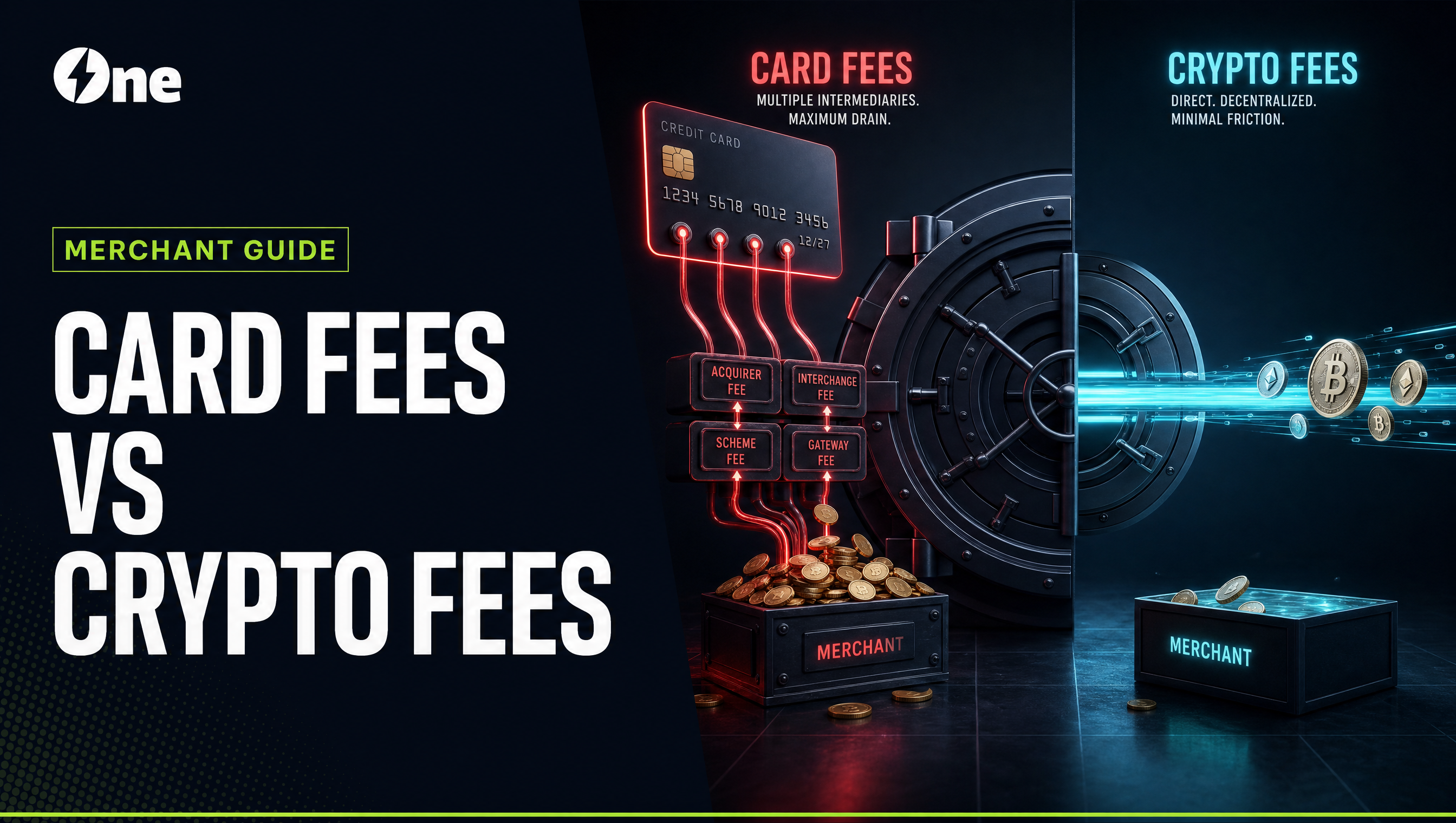
Interchange alone, the fee that goes to the card-issuing bank rather than your processor, averages 1.8% on US credit cards. That single component exceeds AIO's entire 0.3% pay-in fee. Yet most merchants have never seen a line-item breakdown of what they actually pay and who receives each fraction of a percent.
This article breaks down card processing fees at the component level, explains what crypto replaces and why, and gives you a worked cost model at two realistic volumes so you can make a grounded comparison.
What to Know
- Card processing fees have four distinct layers: interchange, assessment, processor markup, and chargeback reserve. Each goes to a different entity.
- Interchange (going to the card-issuing bank) alone averages 1.5–2.0% on US consumer credit cards, which is more than the total cost of most crypto payment solutions.
- Crypto eliminates interchange, assessment, and processor markup by replacing institutional trust with cryptographic verification. The "fee" that remains is network gas, which is typically sub-cent on modern chains.
- Cross-border card transactions carry an additional 1–2% foreign transaction fee and may include currency conversion spread, pushing total cost to 4–5%.
- Chargebacks can cost $20–$100 per dispute in processing fees alone, before any lost revenue. Crypto payments are irreversible by design.
- Crypto is not always better: if your customers primarily use credit cards and you need dispute resolution, switching entirely carries its own risk.
The 4-Layer Anatomy of a Card Fee
When a customer pays $100 with a Visa credit card, the $2.90 (typical blended rate) your processor charges is not one fee. It is four separate fees bundled into a single line item on your invoice. Here is who receives what.
Layer 1: Interchange — The Issuing Bank's Cut
Interchange goes to the bank that issued the customer's card. On a standard US Visa consumer credit card, Visa's published interchange rate is 1.51% + $0.10 for card-present, and 1.80% + $0.10 for card-not-present (e-commerce). Premium reward cards run higher, at 2.10% or more, because the bank funds cashback from this pool.
Interchange exists because issuing banks take on credit risk. If the customer does not pay their bill, the bank absorbs the loss. The fee compensates for that credit extension and the cost of fraud monitoring the issuing side performs, which is why it is the single largest component in the stack.
Layer 2: Assessment — The Network's Cut
Assessment fees go to the card network, whether Visa, Mastercard, Amex, or Discover. These are smaller: Visa charges 0.14% for consumer credit, while Mastercard charges 0.1375%. They cover the cost of operating the network rails, maintaining the authorization routing infrastructure, and providing the brand's fraud liability guarantees.
Layer 3: Processor Markup — Your Gateway's Cut
This is the only fee your payment processor actually keeps. It sits on top of interchange and assessment and varies by provider. Stripe charges 2.9% + $0.30 total (interchange + assessment + markup blended). Processors using interchange-plus pricing show this separately, while flat-rate processors bundle everything, which obscures the real cost structure.
Layer 4: Chargeback Reserve
High-risk merchants pay an additional 5–10% of monthly volume held in reserve, released after 180 days. Even standard merchants face per-dispute fees of $15–$100 and can lose their processing account if chargeback rates exceed 1% (Visa) or 1.5% (Mastercard). This is insurance against fraud that the merchant pays for.
What Crypto Replaces — and What Remains
Layers 1, 2, and 3 exist because the parties involved do not trust each other by default. The issuing bank does not trust that merchants will not fraudulently charge cards. The network does not trust that banks will settle. Processors do not trust that either side will behave without intermediaries guaranteeing settlement.
Cryptographic payment systems replace institutional trust with mathematical verification. A blockchain transaction is valid because the network of validators cryptographically confirms it, not because a bank guarantees it. There is no issuing bank, no card network, no processor intermediary, so the economic functions those layers performed, including credit extension, fraud insurance, and settlement guarantee, are either absent or handled differently.
What remains: network gas fees (the cost of validator computation, typically sub-cent on Layer 2 chains and Solana), the payment gateway's service fee for generating addresses, monitoring the chain, and delivering webhooks, and any on/off-ramp costs if you convert crypto to fiat.
The chargeback layer disappears entirely. Crypto transactions are irreversible, so a confirmed on-chain transaction cannot be disputed back. For merchants with fraud-heavy categories, this is a structural advantage. For merchants selling high-ticket goods where legitimate disputes happen, it is a consideration worth weighing carefully.
Worked Cost Example: $50,000/Month and $500,000/Month
The following comparison uses real published rates. Card processing is modeled at a blended rate of 2.9% + $0.30 per transaction (Stripe standard pricing), with an assumed average transaction value of $75. Crypto pay-in is modeled at 0.3% with 0% payout fee.
| Volume / Month | Card Processing (2.9% + $0.30) | Crypto Pay-In (0.3%) | Monthly Saving | Annual Saving |
|---|---|---|---|---|
| $50,000 | $1,650 | $150 | $1,500 | $18,000 |
| $500,000 | $16,500 | $1,500 | $15,000 | $180,000 |
| $500,000 (cross-border, 4.5%) | $22,500 | $1,500 | $21,000 | $252,000 |
Note: card figures exclude chargeback costs, which add $25–$100 per dispute. At a 0.5% chargeback rate on $500,000/month (250 transactions at $75 average, roughly 33 chargebacks), dispute fees alone add $800–$3,300/month.
The Cross-Border Premium on Card Payments
Domestic card fees are painful. International card fees are structurally different. When the card-issuing bank and the merchant's acquiring bank are in different countries, the interchange structure changes, currency conversion spread is applied, and an international transaction assessment surcharge is added.
The practical result: international credit card transactions regularly cost merchants 3.5–5.5% all-in. The breakdown typically includes standard interchange (~1.8%), network assessment (~0.14%), cross-border assessment fee (~0.8–1.0%), currency conversion spread (~1.0–2.0%), and processor markup (~0.5–1.0%).
For businesses selling into markets where card infrastructure is weaker, such as Southeast Asia, Latin America, Africa, and the Middle East, authorization rates also drop significantly. A 15–30% authorization failure rate on international cards is not unusual. Those failed transactions have zero revenue but still consume checkout abandonment cost.
Stablecoin payments eliminate the cross-border premium entirely. A USDT payment from a customer in Thailand costs exactly the same to process as one from a customer in Texas, because the blockchain does not know or care about issuing country.
When Card Processing Is Still the Better Choice
This comparison is not an argument that every merchant should abandon cards. Card processing wins in several real scenarios.
If your customer base is retail consumers who do not hold crypto, forcing a crypto checkout creates friction that will cost you conversion. The fee saving is worthless if you lose 20% of sales at checkout.
If your product category has a high rate of legitimate customer disputes, such as travel, software subscriptions, or marketplace transactions, the chargeback mechanism protects your customers and, by extension, your reputation. Removing it is not free.
If you operate in a regulated industry where card payments provide a compliance audit trail that your legal team or auditors require, the administrative cost of switching needs to be factored in.
The practical strategy for most merchants: run crypto payments as a parallel option rather than a replacement. Customers who choose crypto cost you 0.3% instead of 2.9%. Customers who prefer cards still convert, and you reduce fee burden across the mix without forcing anyone.
Full Comparison: Card vs Crypto Payment Fees
| Factor | Card Processing | Crypto Payment (e.g. AIO) |
|---|---|---|
| Typical total fee (domestic) | 2.5–3.5% | 0.3% pay-in + 0% payout |
| Cross-border fee | Additional 1–2% + FX spread | None — same fee globally |
| Chargebacks | Yes — $15–$100/dispute + revenue loss | No — transactions are irreversible |
| Settlement speed | T+1 to T+2 (domestic), T+3–5 (international) | Minutes (depending on chain and confirmations) |
| Customer fraud risk | High — card-not-present fraud, friendly fraud | Low — transaction is final once confirmed |
| Reserve requirement | Sometimes 5–10% rolling reserve for high-risk | None |
| Cross-border reach | Limited by bank relationships, authorization rates | Global — any wallet can pay |
| Customer dispute mechanism | Yes — chargeback process | No — requires merchant's own refund policy |
How AIO Fits Into This Picture
AIO's fee structure, at 0.3% pay-in and 0% payout, means the entire cost of accepting a crypto payment is 0.3% of transaction value. There is no hidden payout fee, no reserve requirement, and no chargeback liability. For merchants already accepting cards, adding AIO as a parallel option is additive: it costs nothing for customers who choose cards, and saves significantly for those who pay in crypto.
For high-volume merchants, cross-border-heavy businesses, or operators in categories with elevated card fraud, the math on a mixed payment stack is compelling. The annualized saving at $500,000/month in volume is not a rounding error.
If you want a detailed walkthrough of how crypto payment fees are structured beyond the gateway level, including gas, network selection, and settlement conversion costs, see Crypto Payment Fees Explained for Merchants. For a full overview of AIO's infrastructure, see What Is AIO's Crypto Payment Infrastructure.
Frequently Asked Questions
Why is interchange so much higher than the other card fee components?
Interchange compensates the issuing bank for credit risk and fraud losses. When a customer disputes a charge, the issuing bank typically refunds the customer before recovering funds from the merchant. That credit extension and fraud insurance is expensive, and interchange is the mechanism the card networks use to fund it. Assessment fees and processor markups are smaller because those parties take on less risk.
Do all crypto payments avoid chargebacks?
Confirmed on-chain transactions are technically irreversible. The blockchain cannot be unwound. A payment gateway can still facilitate a refund by initiating a new outbound transaction, but that refund is at the merchant's discretion rather than subject to a bank-administered chargeback process. Merchants are responsible for defining and communicating their own refund policies.
Is the 0.3% crypto fee the only cost I pay?
On the gateway side, yes. The 0.3% covers the pay-in and there is no payout fee with AIO. Network gas fees are typically absorbed or are negligible on modern chains (sub-cent on Base, Solana, Tron). If you later convert crypto to fiat through an exchange or OTC desk, that conversion carries its own spread, typically 0.1–0.5% depending on volume and method.
Why do cross-border card fees cost so much more?
Cross-border card transactions involve additional fees at multiple layers. The card network charges a cross-border assessment surcharge, the acquiring bank may charge an international transaction fee, and currency conversion introduces a spread between the wholesale exchange rate and the rate the merchant receives. Each layer adds 0.5–1%, compounding to 1–2% above domestic rates. Crypto payments have no equivalent layer, because the blockchain treats all transactions identically regardless of where payer and payee are located.
Frequently Asked Questions
Why is interchange so much higher than the other card fee components?
Interchange compensates the issuing bank for credit risk and fraud losses. When a customer disputes a charge, the issuing bank typically refunds the customer before recovering funds from the merchant. That credit extension and fraud insurance is expensive, and interchange is the mechanism the card networks use to fund it.
Do all crypto payments avoid chargebacks?
Confirmed on-chain transactions are technically irreversible — the blockchain cannot be unwound. However, a payment gateway can still facilitate a refund by initiating a new outbound transaction. The difference is that this is at the merchant's discretion, not subject to a bank-administered chargeback process.
Is the 0.3% crypto fee the only cost I pay?
On the gateway side, yes — 0.3% covers the pay-in and there is no payout fee with AIO. Network gas fees are typically absorbed or are negligible on modern chains. If you later convert crypto to fiat through an exchange or OTC desk, that conversion carries its own spread, typically 0.1–0.5%.
Why do cross-border card fees cost so much more?
Cross-border card transactions involve additional fees at multiple layers: the card network charges a cross-border assessment surcharge, the acquiring bank may charge an international transaction fee, and currency conversion introduces a spread. Each layer adds 0.5–1%, compounding to 1–2% above domestic rates. Crypto payments treat all transactions identically regardless of where payer and payee are located.