AIO vs Stripe Crypto Payments: Fee and Feature Comparison for Merchants
Stripe charges 1.5% for crypto payments and settles to fiat. AIO charges 0.3% pay-in and 0% payout with non-custodial, multi-chain settlement. At $50k/month that gap is $7,200/year.
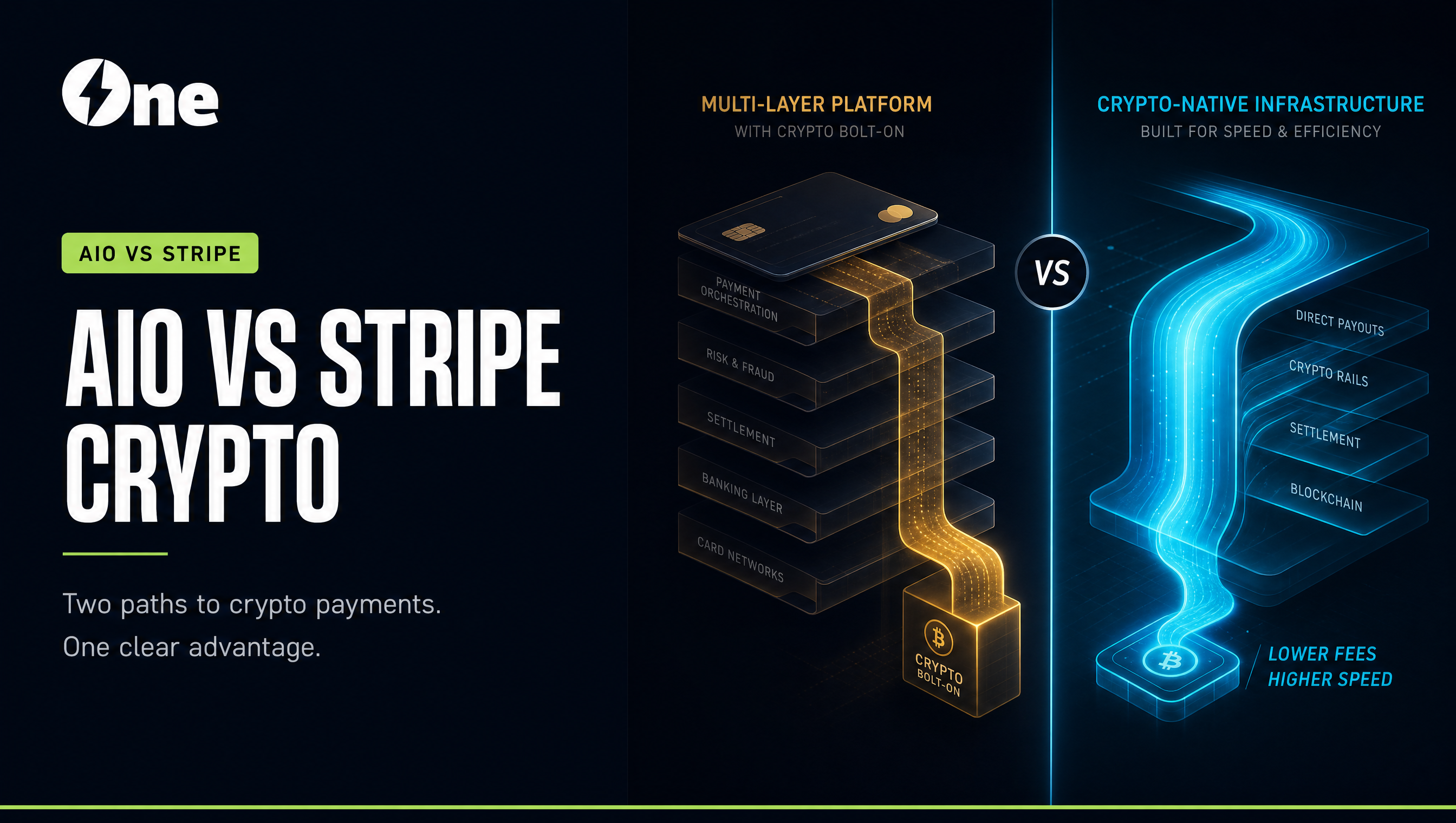
At $50,000 per month in crypto payment volume, Stripe costs $750. AIO costs $150. That gap of $600 per month, or $7,200 per year, is not a rounding error. It reflects a structural difference in how each platform was designed. Stripe is a card-first platform that added crypto as a feature, which means its fee reflects card-product pricing logic rather than the actual cost of moving value on-chain. AIO, by contrast, is crypto-native payment infrastructure, so its 0.3% fee reflects what on-chain settlement genuinely costs.
This comparison covers what each platform actually offers, where the fee difference comes from, and how to decide which is right for your business.
What to Know
- Stripe charges 1.5% for crypto payments and settles to fiat. AIO charges 0.3% pay-in and 0% payout.
- Stripe supports primarily USDC on limited chains. AIO supports multiple chains through a single unified API.
- Stripe is custodial, meaning it converts and holds funds before settlement. AIO is non-custodial, meaning funds go to your wallet directly.
- AIO provides HMAC-signed callbacks with a retry pool and trace ID across the full payment lifecycle. Stripe's webhook model follows its standard card-product implementation.
- AIO's multi-tenant model (Admin, Agent, Merchant, Sub-account) supports payment operators and platforms managing multiple merchants.
What Stripe Offers for Crypto Payments
Stripe added crypto payment acceptance in 2024, primarily targeting USDC on Ethereum and a small number of additional networks. The product is designed to fit inside Stripe's existing merchant workflow. You accept crypto, Stripe converts it, and you receive fiat in your Stripe balance like any other payment method.
That convenience has a price. Stripe charges 1.5% for crypto processing. This is not a blockchain fee or gas cost. It is Stripe's product margin on a service that competes with its own card-processing revenue, which is why Stripe prices crypto relative to cards rather than relative to the actual cost of on-chain settlement.
For merchants already inside the Stripe ecosystem, using Stripe for cards, invoicing, and payouts, adding crypto through Stripe requires zero additional integration work. That is genuinely useful if your crypto volume is low and you prioritise operational simplicity over cost.
What Stripe does not offer is true multi-chain breadth, non-custodial settlement, or infrastructure built for high-volume crypto-native operations.
What AIO Offers
AIO is built specifically for crypto payment operations. Because the platform settles payments directly on-chain rather than routing them through a fiat conversion layer, the fee structure, 0.3% pay-in and 0% payout, reflects actual on-chain settlement cost rather than a blended card-product margin.
Core capabilities include the following.
- Multi-chain, unified API: Accept payments across multiple chains with a single integration. No chain-specific SDKs or separate gateway accounts.
- Non-custodial: Settled funds go directly to the merchant's wallet. AIO does not hold your money.
- HMAC-signed callbacks: Every webhook is cryptographically signed. Your server verifies the signature before processing, so forged payment notifications are rejected at the protocol level.
- Retry pool: Failed webhook deliveries are queued and retried automatically. Manual resend is available from the dashboard.
- Trace ID: Every payment request carries a trace ID through the full lifecycle, from invoice creation to on-chain confirmation to settlement. This is what makes reconciliation and debugging feasible at scale.
- Multi-tenant model: The Admin, Agent, Merchant, and Sub-account hierarchy supports payment operators, white-label platforms, and merchants with multiple business units under a single account structure.
- IP whitelisting and TOTP 2FA: Operational security controls at the account level.
- 30-day audit log: Full event history for compliance and dispute resolution.
- Per-account fee configuration: Fee settings are configurable per merchant account, which matters for operators running platforms with multiple merchants at different volume tiers.
Side-by-Side Comparison
| Feature | Stripe (Crypto) | AIO |
|---|---|---|
| Pay-in fee | 1.5% | 0.3% |
| Payout fee | Included in 1.5% / fiat settlement | 0% |
| Settlement | Fiat (converted by Stripe) | Crypto to merchant wallet (non-custodial) |
| Chain support | USDC + limited chains | Multi-chain via unified API |
| Webhook security | Standard Stripe webhook signing | HMAC-signed, retry pool, manual resend |
| Custody | Custodial (Stripe holds funds) | Non-custodial (funds to merchant wallet) |
| Multi-tenant / platform model | Connect platform (Stripe-native) | 4-tier model (Admin/Agent/Merchant/Sub-account) |
| Trace ID | No dedicated cross-lifecycle trace | Yes — full lifecycle |
| Audit log | Event logs via dashboard | 30-day audit log |
| IP whitelisting | No | Yes |
Volume Cost Comparison
These figures use Stripe's 1.5% crypto fee and AIO's 0.3% pay-in fee. Payout fees are not included for Stripe since fiat settlement is bundled. AIO's payout fee is 0%.
| Monthly Volume | Stripe (1.5%) | AIO (0.3%) | Monthly Saving | Annual Saving |
|---|---|---|---|---|
| $10,000 | $150 | $30 | $120 | $1,440 |
| $50,000 | $750 | $150 | $600 | $7,200 |
| $200,000 | $3,000 | $600 | $2,400 | $28,800 |
| $500,000 | $7,500 | $1,500 | $6,000 | $72,000 |
When Stripe Makes Sense
Stripe is the right choice when any of the following apply.
- Your primary payment method is cards and crypto is a minor add-on
- You want zero additional integration work beyond your existing Stripe setup
- Your crypto volume is under $5,000 per month, so the fee difference stays under $60 per month and operational simplicity outweighs it
- You need automatic fiat settlement without any wallet or custody management
- You are in a jurisdiction where Stripe's compliance layer is sufficient for your risk profile
When AIO Makes Sense
AIO is the right choice when any of the following apply.
- Crypto payments are a meaningful share of your revenue, because the fee gap compounds quickly at volume
- You want non-custodial settlement so funds go directly to your wallet rather than being held by a third party
- You need multi-chain breadth without separate integrations per chain
- You are building a payment platform or managing multiple merchants, as AIO's 4-tier multi-tenant model is purpose-built for this
- You need HMAC-verified webhooks with retry guarantees for operational reliability
- You need trace IDs for reconciliation at scale
- You want per-account fee configuration across a merchant portfolio
The Core Structural Difference
The fee gap is real, but the more important difference is architectural. Stripe built crypto support onto a fiat-first product, so the result is convenient for low-volume use yet constrained in meaningful ways: limited chains, custodial settlement, and a fee that reflects Stripe's card-product pricing logic rather than the cost of moving value on-chain.
AIO, by contrast, was built as infrastructure for crypto payment operations from the start. Because the platform was designed around on-chain settlement rather than retrofitted onto a card network, the 0.3% fee reflects the actual cost structure. The non-custodial model, multi-chain API, HMAC webhooks, and multi-tenant architecture are not add-ons. Each one was designed to solve a real operational problem that crypto-native merchants face at volume.
If crypto payments are a strategic part of your business rather than an afterthought, AIO gives you the right infrastructure at the right price. Explore AIO's merchant documentation or read the full breakdown of crypto payment fee structures to see what the cost model looks like at your volume.
Frequently Asked Questions
What does Stripe charge for crypto payments?
Stripe charges 1.5% for crypto payment processing as of 2025–2026. It settles the converted value to fiat and supports a limited set of chains, primarily USDC. This fee is priced relative to Stripe's card product, not the actual cost of on-chain settlement.
Does AIO convert crypto to fiat automatically?
AIO is non-custodial and does not auto-convert by default. Settled funds go directly to the merchant's wallet in the original asset. Merchants who want fiat can route through their own exchange or OTC desk, preserving full control over timing and conversion rate.
Is AIO suitable for merchants who have never handled crypto before?
AIO provides a full merchant dashboard, webhook callbacks, and a unified API. However, because it is non-custodial, merchants are responsible for their own wallet setup and custody. Merchants who want a fully managed, fiat-out experience may find Stripe's crypto offering simpler to start with, at higher cost.
What chains does AIO support compared to Stripe?
AIO supports multiple chains through a single unified API, including Ethereum, Tron, BNB Chain, and others. Stripe's crypto payment support is primarily focused on USDC and a limited set of networks. AIO's multi-chain architecture lets merchants accept payments from the widest possible customer base.
Crypto Payment Fees Explained for Merchants · What Is AIO Crypto Payment Infrastructure
Frequently Asked Questions
What does Stripe charge for crypto payments?
Stripe charges 1.5% for crypto payment processing as of 2025–2026. It settles the converted value to fiat and supports a limited set of chains, primarily USDC. This fee is priced relative to Stripe's card product, not the actual cost of on-chain settlement.
Does AIO convert crypto to fiat automatically?
AIO is non-custodial and does not auto-convert by default. Settled funds go directly to the merchant's wallet in the original asset. Merchants who want fiat can route through their own exchange or OTC desk, preserving full control over timing and conversion rate.
Is AIO suitable for merchants who have never handled crypto before?
AIO provides a full merchant dashboard, webhook callbacks, and a unified API. However, because it is non-custodial, merchants are responsible for their own wallet setup and custody. Merchants who want a fully managed, fiat-out experience may find Stripe's crypto offering simpler to start with, at higher cost.
What chains does AIO support compared to Stripe?
AIO supports multiple chains through a single unified API, including Ethereum, Tron, BNB Chain, and others. Stripe's crypto payment support is primarily focused on USDC and a limited set of networks. AIO's multi-chain architecture lets merchants accept payments from the widest possible customer base.