AIO vs BitPay: Crypto Payment Fee and Feature Comparison
BitPay charges 1% and is built for merchants who want zero crypto exposure. AIO charges 0.3% pay-in and 0% payout with non-custodial settlement. At $200k/month the difference is $17,000/year.
At $200,000 per month in crypto payment volume, BitPay costs $2,000. AIO costs $600. That $1,400 monthly difference compounds to roughly $17,000 per year, which funds engineering time, marketing spend, or margin. To understand where it comes from, you need to understand what each platform was built to do, because the fee difference is a consequence of two different architectural choices, not an accident of pricing.
BitPay and AIO are both legitimate crypto payment processors, yet they are optimised for different operators. This comparison explains exactly what each offers, where the fee difference originates, and which is the better fit depending on your volume and settlement preferences.
What to Know
- BitPay charges 1% processing fee and offers fiat settlement. AIO charges 0.3% pay-in and 0% payout.
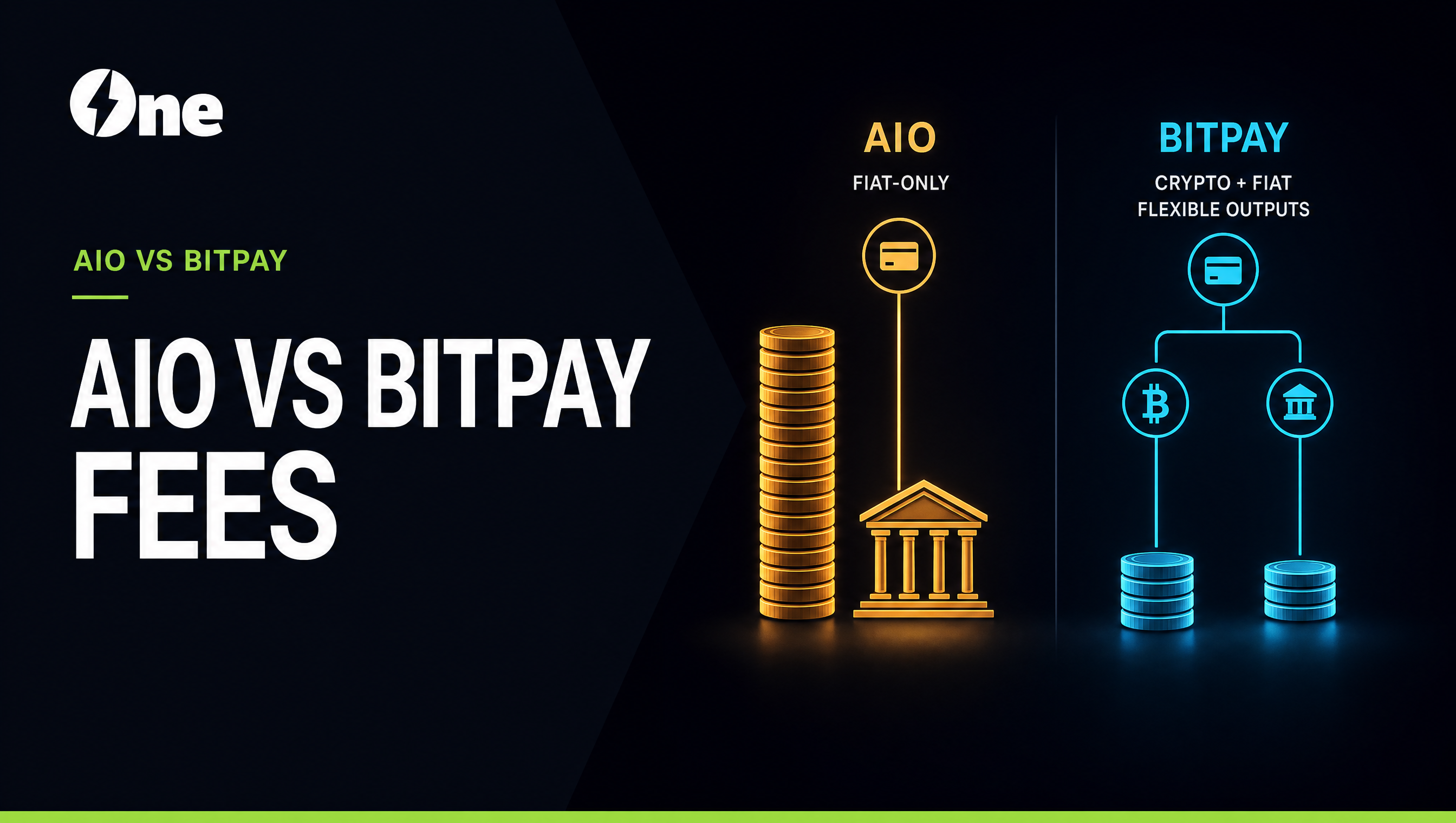
- BitPay is optimised for merchants who want zero crypto exposure, meaning it accepts crypto and delivers fiat. AIO is optimised for merchants who want to operate in crypto or need multi-chain flexibility.
- AIO is non-custodial. BitPay manages conversion and custody as part of its service.
- AIO's multi-tenant 4-tier model (Admin, Agent, Merchant, Sub-account) supports payment operators managing multiple merchants. BitPay is focused on individual merchant accounts.
- At $50k/month: BitPay = $500, AIO = $150. Difference: $4,200/year.
What BitPay Offers
BitPay is one of the longest-standing crypto payment processors, built initially around Bitcoin merchant acceptance and expanded to include Ethereum, stablecoins such as USDC and USDT, and a small number of other assets.
Its core value proposition is simplicity. You accept Bitcoin, ETH, or stablecoins from customers and receive fiat (USD, EUR, or GBP) into your bank account. BitPay handles the conversion and custody on your behalf. That is why this model suits merchants who want to offer crypto as a payment option without any operational exposure to crypto volatility.
BitPay charges 1% for this service. That fee covers the conversion, custody, and settlement workflow BitPay manages on your behalf, so you are effectively paying for a managed bridge between the crypto your customers hold and the fiat your business needs. The chain coverage is solid for major assets but narrower than a multi-chain infrastructure platform.
What AIO Offers
AIO is crypto payment infrastructure built for operators who need more than a single-merchant acceptance product. Because it settles directly on-chain rather than converting through a managed fiat pipeline, its fee structure, 0.3% pay-in and 0% payout, reflects on-chain settlement cost rather than the cost of a managed conversion service.
Key capabilities AIO provides that BitPay does not match include the following.
- Non-custodial settlement: Crypto goes directly to the merchant's wallet. No conversion unless the merchant arranges it separately.
- Multi-chain unified API: One integration, multiple chains. No separate gateway per chain.
- HMAC-signed callbacks with retry pool: Cryptographically verified webhook delivery with automatic retry on failure and manual resend from the dashboard.
- Trace ID across full lifecycle: One identifier follows a payment from invoice creation through detection, confirmation, and settlement, which makes reconciliation and debugging tractable at scale.
- Multi-tenant 4-tier model: The Admin, Agent, Merchant, and Sub-account hierarchy is built for payment operators managing portfolios of merchants.
- Per-account fee configuration: Fee settings are adjustable per merchant, enabling operators to run differentiated pricing tiers across their portfolio.
- IP whitelisting and TOTP 2FA: Security controls at the account and API level.
- 30-day audit log: Event history for compliance, reconciliation, and dispute resolution.
Side-by-Side Comparison
| Feature | BitPay | AIO |
|---|---|---|
| Pay-in fee | 1% | 0.3% |
| Payout fee | Included / fiat settlement | 0% |
| Settlement | Fiat (BitPay converts) | Crypto to merchant wallet |
| Custody model | Custodial | Non-custodial |
| Chain support | BTC, ETH, select stablecoins | Multi-chain via unified API |
| Webhook security | IPN with verification | HMAC-signed, retry pool, manual resend |
| Multi-tenant / platform | Single-merchant focused | 4-tier model for operators and platforms |
| Trace ID | No dedicated lifecycle trace | Yes — full lifecycle |
| Per-account fee config | No | Yes |
| IP whitelisting | No | Yes |
Volume Cost Comparison
| Monthly Volume | BitPay (1%) | AIO (0.3%) | Monthly Saving | Annual Saving |
|---|---|---|---|---|
| $10,000 | $100 | $30 | $70 | $840 |
| $50,000 | $500 | $150 | $350 | $4,200 |
| $200,000 | $2,000 | $600 | $1,400 | $16,800 |
| $500,000 | $5,000 | $1,500 | $3,500 | $42,000 |
When BitPay Is the Better Choice
BitPay makes sense when any of the following apply.
- You want crypto acceptance with zero operational crypto exposure, meaning fiat arrives in your bank with no wallet management required
- Your customer base primarily uses Bitcoin or ETH and you do not need broad multi-chain coverage
- Your volume is under $10,000 per month, so the $70 monthly fee difference does not justify a new integration
- You need a well-established processor for a traditional retail or e-commerce context where Bitcoin acceptance is a differentiator rather than a core revenue driver
When AIO Is the Better Choice
AIO is the right choice when any of the following apply.
- Crypto payments are a material revenue stream, because the fee gap at volume is significant
- You need non-custodial settlement so you retain control of funds without counterparty custody risk
- You need multi-chain breadth with a single API integration
- You are a payment operator or platform managing multiple merchants, as AIO's 4-tier multi-tenant model is built specifically for this use case
- You need HMAC-verified webhooks with retry guarantees for reliable payment event delivery
- You need per-merchant fee configuration across a portfolio
- You need trace IDs for reconciliation at scale
The Key Differentiator: Multi-Tenant Infrastructure
The most underappreciated difference between BitPay and AIO is not the fee. It is the account model, and the reason that matters is that account model determines what kinds of businesses can even be built on top of the platform.
BitPay is a merchant product. One business, one account, one fee structure. Because it was designed for individual merchant acceptance, it does not have a native concept of a payment operator managing a portfolio of sub-merchants with differentiated fee configurations.
AIO's Admin, Agent, Merchant, and Sub-account hierarchy was designed exactly for that use case. A payment operator can onboard multiple merchants, configure per-account fees, monitor all accounts under one Admin view, and use Agent accounts for reseller or distribution structures. That is why this is the infrastructure model for platforms, marketplaces, and payment-as-a-service businesses. It is not a feature you can retrofit onto BitPay.
For merchants, the comparison comes down to fee and custody preference. For payment operators and platforms, the architecture question matters more than the headline fee. Explore AIO's platform documentation or read the full crypto payment fee breakdown for more context on how fee structures work at volume.
Frequently Asked Questions
What does BitPay charge for crypto payment processing?
BitPay charges a 1% processing fee. It supports Bitcoin, Ethereum, and a selection of stablecoins, and offers fiat settlement for merchants who want to convert incoming crypto automatically. The 1% fee covers BitPay's conversion and custody service.
Can AIO settle to fiat like BitPay does?
AIO is non-custodial, so settled funds go to the merchant's own wallet in the original asset. Merchants who need fiat conversion handle it through their own exchange or OTC arrangement. This gives merchants full control over timing and conversion rate, but requires more operational setup than BitPay's managed conversion.
Which platform is better for a payment operator managing multiple merchants?
AIO's multi-tenant four-tier model (Admin, Agent, Merchant, Sub-account) is designed specifically for payment operators and platforms. BitPay is primarily a single-merchant solution. If you are building a payment platform or white-label gateway for other businesses, AIO's architecture is the more appropriate choice.
Does BitPay support HMAC webhook verification?
BitPay uses IPN (Instant Payment Notifications) with a verification layer. AIO uses HMAC-signed callbacks with a retry pool and manual resend capability. For developers who need cryptographically verifiable webhook delivery with retry guarantees, AIO's implementation provides more explicit security and reliability controls.
Crypto Payment Fees Explained for Merchants · What Is AIO Crypto Payment Infrastructure
Frequently Asked Questions
What does BitPay charge for crypto payment processing?
BitPay charges a 1% processing fee. It supports Bitcoin, Ethereum, and a selection of stablecoins, and offers fiat settlement for merchants who want to convert incoming crypto automatically. The 1% fee covers BitPay's conversion and custody service.
Can AIO settle to fiat like BitPay does?
AIO is non-custodial — settled funds go to the merchant's own wallet in the original asset. Merchants who need fiat conversion handle it through their own exchange or OTC arrangement. This gives merchants full control over timing and conversion rate, but requires more operational setup than BitPay's managed conversion.
Which platform is better for a payment operator managing multiple merchants?
AIO's multi-tenant four-tier model (Admin, Agent, Merchant, Sub-account) is designed specifically for payment operators and platforms. BitPay is primarily a single-merchant solution. If you are building a payment platform or white-label gateway for other businesses, AIO's architecture is the more appropriate choice.
Does BitPay support HMAC webhook verification?
BitPay uses IPN (Instant Payment Notifications) with a verification layer. AIO uses HMAC-signed callbacks with a retry pool and manual resend capability. For developers who need cryptographically verifiable webhook delivery with retry guarantees, AIO's implementation provides more explicit security and reliability controls.