
USDC vs USDT for Merchant Payments: Which Stablecoin Should You Accept?
USDC is GENIUS Act-compliant and US-regulated. Global USDT is not. Here is the practical comparison every merchant needs before choosing which stablecoin to accept.
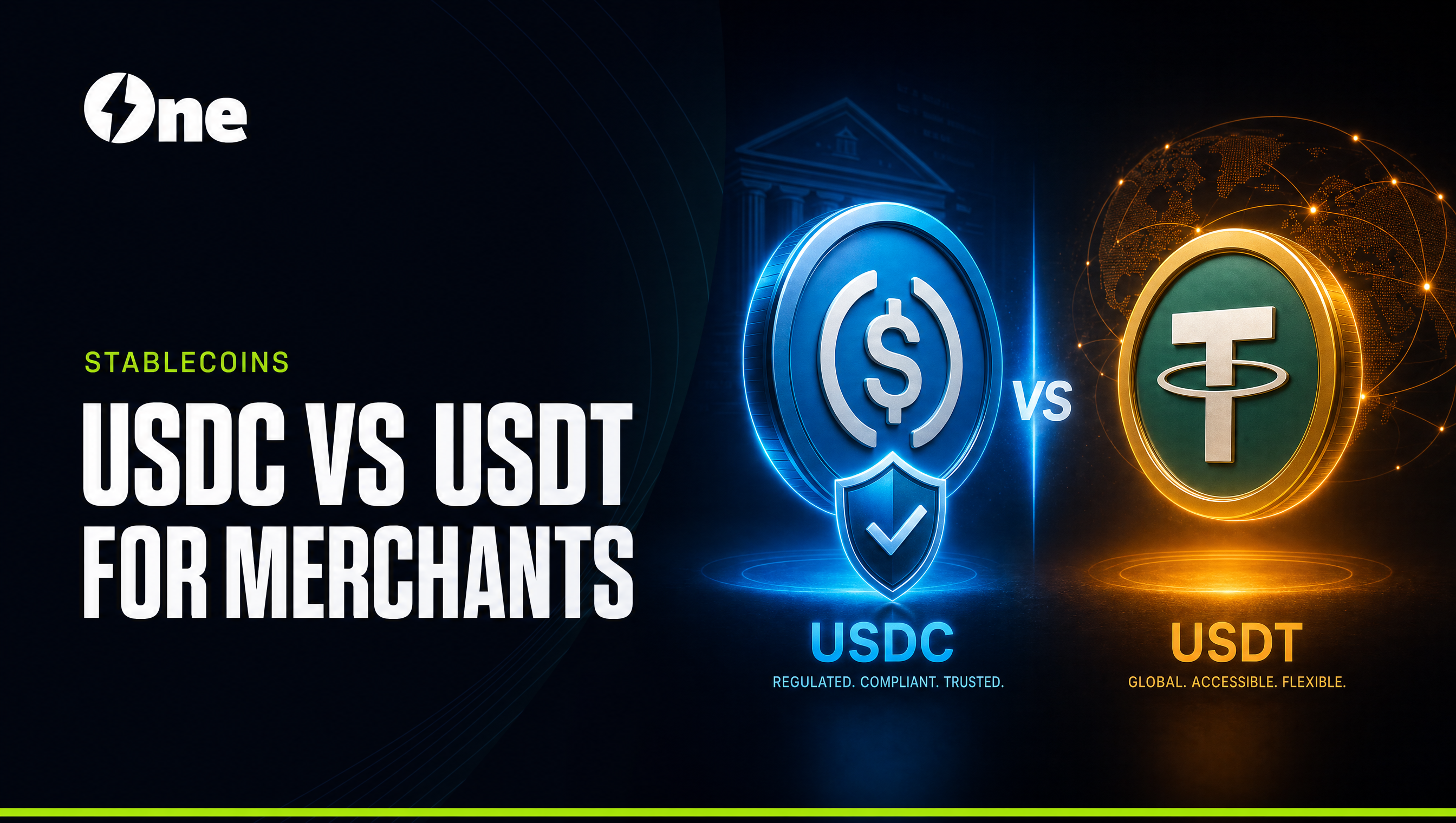
USDC and USDT both peg to $1. They both settle in seconds. Yet they are not the same product, and after January 2027, that difference has real regulatory weight for US merchants.
USDC is issued by a US-regulated entity, publishes monthly Big Four-audited reserve attestations, and is fully GENIUS Act-compliant. Global USDT is the world's most-used stablecoin by volume, but it is issued from the British Virgin Islands and does not meet GENIUS Act requirements. For merchants deciding which stablecoin to accept, that distinction now drives the answer for the US market.
What to Know
- USDC is GENIUS Act-compliant, US-regulated, with ~$45B in circulation and monthly audited reserves.
- Global USDT has ~$117B in circulation and is the dominant global stablecoin, but it is not GENIUS Act-compliant.
- USAT is Tether's US-market stablecoin, launched January 2026 via Anchorage Digital Bank, and is compliant, though newer and less liquid than USDC.
- For US merchants, USDC is the lower-regulatory-risk choice today. USDT remains dominant for non-US cross-border volume.
- January 2027 is the enforcement date. Start transitioning your payment stack now if you are relying on global USDT for US transactions.
The Key Difference: Regulatory Standing and Reserve Transparency
The fundamental distinction between USDC and global USDT is not technical. It is structural. USDC is issued by Circle, a US-incorporated company operating under state money transmission licences. Circle publishes monthly reserve attestations conducted by a Big Four accounting firm, confirming that every USDC in circulation is backed 1:1 by cash or short-term US Treasuries. That transparency is a precondition for GENIUS Act compliance, which is why USDC qualifies.
Global USDT is issued by Tether Ltd., incorporated in the British Virgin Islands. Tether has historically published reserve breakdowns, but those disclosures have faced scrutiny over their composition and audit standards. More relevantly for merchants, Tether Ltd. is not a licensed US entity under the GENIUS Act framework. That does not make global USDT worthless, as it remains the most liquid stablecoin in the world, yet it changes the regulatory calculus for US-based businesses after January 2027.
Tether addressed this by launching USAT, a separate stablecoin issued specifically for the US market through Anchorage Digital Bank, an OCC-supervised institution. USAT is GENIUS Act-compliant, but it is a different token from global USDT with its own liquidity profile and adoption curve.
Side-by-Side Comparison
| Feature | USDC | Global USDT | USAT |
|---|---|---|---|
| Issuer | Circle (US) | Tether Ltd. (BVI) | Tether / Anchorage Digital Bank (US) |
| Reserve backing | Cash + short-term US Treasuries | Mixed (cash, Treasuries, other) | 1:1 USD-backed (OCC-supervised) |
| Reserve audits | Monthly, Big Four auditor | Periodic attestations | Per GENIUS Act requirements |
| GENIUS Act status | ✅ Compliant | ❌ Not compliant | ✅ Compliant |
| Circulation (2025-26) | ~$45 billion | ~$117 billion | Growing (launched Jan 2026) |
| Chains supported | Ethereum, Solana, Base, Polygon, Arbitrum, and more | Ethereum, Tron, Solana, and many others | US-focused, expanding |
| Best for | US merchants, regulated platforms, B2B payments | Global cross-border, non-US markets, crypto-native flows | US merchants wanting Tether liquidity with compliance |
When to Use USDC vs USDT by Merchant Type
US e-commerce and SaaS businesses: USDC is the default choice. It is compliant, widely supported on US-regulated platforms and exchanges, and your 1099-DA reporting chain is cleaner when using a GENIUS-compliant stablecoin throughout. The liquidity is sufficient for all practical merchant payment volumes.
Cross-border B2B payments with non-US counterparties: Global USDT still dominates in markets outside the US, particularly Southeast Asia, Latin America, and parts of Europe, where it is the default settlement token on local exchanges. If you are paying international suppliers or contractors, USDT may be what they expect and what their local exchange handles efficiently. That said, monitor the January 2027 US enforcement position before using it for inbound US revenue.
iGaming and high-volume global merchants: Both stablecoins are likely part of your stack. The practical approach is to accept USDC for US-facing payments and maintain USDT support for non-US player or customer flows, while tracking what your payment processor's compliance position is as 2027 approaches.
Businesses concerned about reserve transparency: USDC's monthly Big Four-audited attestations make it the stronger choice if your compliance or finance team needs to document the quality of the assets underlying your stablecoin receipts. This matters increasingly for businesses in regulated industries or those with institutional investors scrutinising their balance sheets.
Merchants evaluating USAT: USAT is worth tracking if you have existing relationships with Tether-native platforms and want GENIUS compliance without migrating entirely to Circle's infrastructure. As of June 2026, USDC has substantially deeper liquidity and broader platform support, so USAT is a viable option for future-proofing but may require more manual settlement work today.
What Changes for US Merchants After January 2027
The GENIUS Act enforcement date creates a clear decision point. After January 2027, operating with a non-compliant stablecoin in the US market is not automatically illegal for merchants, because the Act's obligations land on issuers, not recipients. But the downstream effects matter.
US-regulated exchanges and payment processors will likely stop supporting global USDT for fiat on-ramp and off-ramp flows if Tether Ltd. cannot obtain a GENIUS-compliant licence by then. That means your ability to convert USDT receipts to dollars through regulated channels may become constrained. The liquidity advantage that global USDT holds today could deteriorate rapidly in the US market once enforcement begins.
The cleaner path is to shift your US stablecoin stack to USDC or USAT before that transition happens at the infrastructure level, rather than being forced to migrate under time pressure.
For a full breakdown of the GENIUS Act timeline and what it requires, see our GENIUS Act guide for merchants. For the broader context on stablecoin acceptance, our stablecoin payments guide covers the operational setup in detail.
AIO.cash supports USDC and USAT for merchant pay-ins, with non-custodial settlement directly to your wallet and no conversion required. If you are re-evaluating your stablecoin stack ahead of the 2027 enforcement window, AIO gives you GENIUS-compliant rails with no lock-in.
Frequently Asked Questions
Is USDT banned for US merchants after January 2027?
Global USDT is not banned, but it is not GENIUS Act-compliant. US merchants accepting non-compliant stablecoins after enforcement begins in January 2027 may face regulatory uncertainty. Tether's US-issued product, USAT, is compliant and available via Anchorage Digital Bank.
Which stablecoin has the highest liquidity for merchants?
Global USDT has the largest total circulation at approximately $117 billion, making it the most liquid stablecoin globally. USDC has roughly $45 billion in circulation and dominates on regulated US platforms. For US merchants, USDC offers deeper liquidity on compliant venues.
What is USAT and how is it different from USDT?
USAT is Tether's GENIUS Act-compliant stablecoin issued for the US market through Anchorage Digital Bank, an OCC-supervised institution. It launched in January 2026. Unlike global USDT (issued from BVI), USAT meets US regulatory requirements.
Does it matter which stablecoin I accept for tax reporting?
Yes. Form 1099-DA (effective January 1, 2026) requires processors converting crypto to fiat to report cost basis and proceeds to the IRS. Using a GENIUS-compliant stablecoin through a licensed processor simplifies this reporting chain for your business.