
What Is a Trace ID in Payment Processing? How AIO Makes Every Payment Auditable
A payment trace ID is a unique identifier propagated through every step of a transaction lifecycle. Here is why distributed payment systems cannot operate reliably without one.
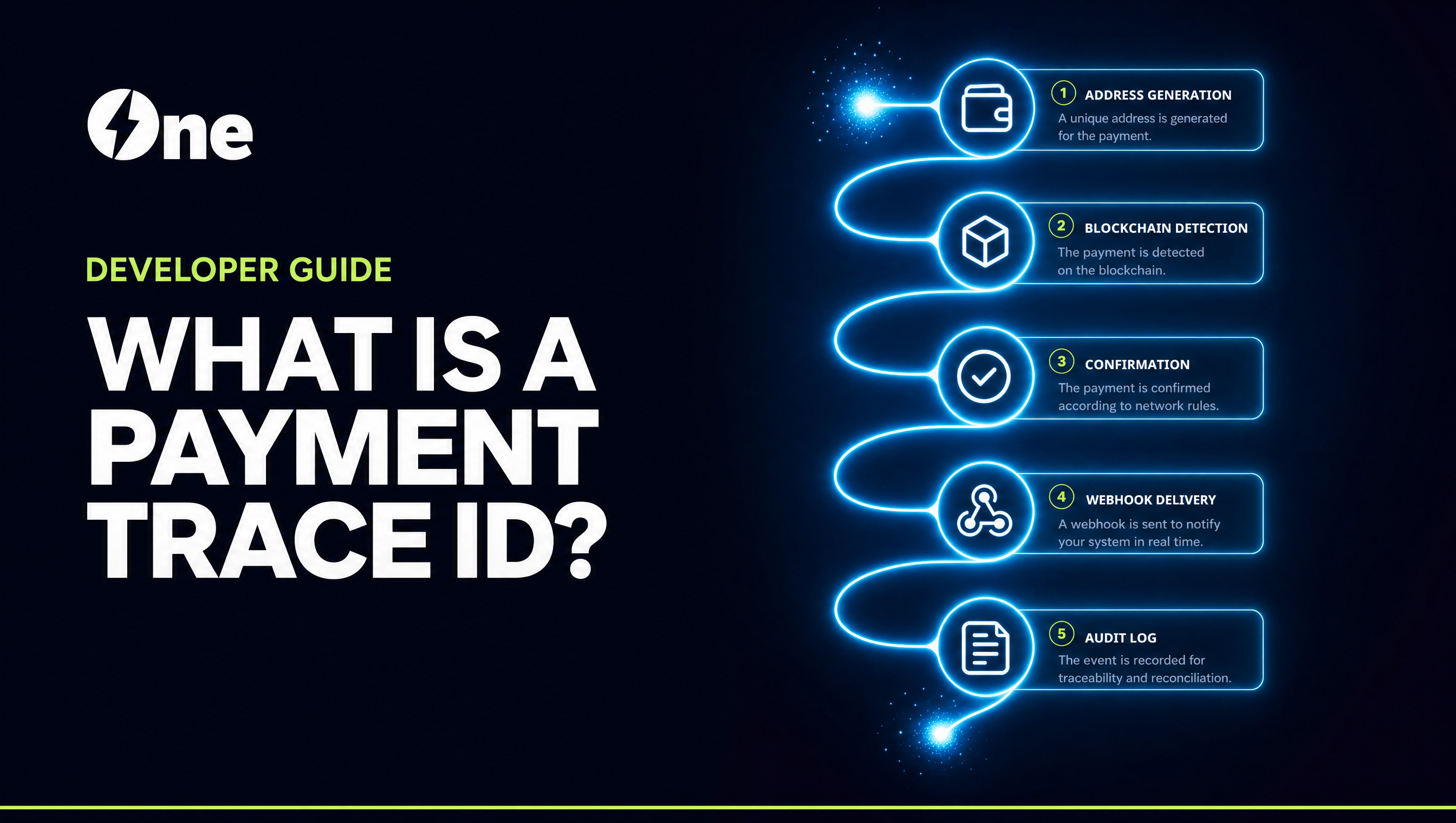
A payment trace ID is a unique identifier assigned to a payment request the moment it is created, then carried through every system that touches that payment, including address generation, on-chain detection, confirmation counting, webhook delivery, and audit logging. It is the single reference that lets you reconstruct exactly what happened to any payment, at any step, without manually correlating logs across disconnected systems.
- A trace ID follows a payment through every off-chain and on-chain step from creation to confirmed webhook receipt.
- Without a trace ID, debugging a failed payment in a distributed system requires correlating 3 to 4 independent logs manually, a time-consuming process that often reaches no definitive conclusion.
- AIO's trace ID covers the full lifecycle: address generation, on-chain detection, confirmation, webhook delivery, and a 30-day audit log.
Why Distributed Payment Systems Need Trace IDs
A crypto payment is not a single action. It is a chain of discrete events across multiple systems, including your application, the payment gateway, the blockchain network, and your webhook handler. Each system is independently operational, which means each can fail independently.
When a customer pays and your system never marks the order as complete, the failure could have occurred at any of these steps. The address may have been generated but not returned correctly. The on-chain transaction may have been broadcast but not detected. The transaction may have been detected but confirmations may never have reached the required threshold. Confirmations may have been reached but the webhook delivery may have failed. Or the webhook may have been delivered but your server may have rejected it.
Distributed systems fail in partial ways. That is the defining characteristic of this architecture, and it is why a shared identifier threading through every layer is not optional. A trace ID propagated through every step creates a single thread that can reconstruct exactly what happened. Without it, your debugging process becomes manual log archaeology across systems that may have different timestamps, different formats, and different retention windows.
At $150 per hour for senior engineering time, a single ambiguous payment failure that takes two hours to diagnose costs more than dozens of individual transaction fees. Because of this, trace IDs are not a nice-to-have. They are the operational infrastructure that makes a distributed payment system supportable at scale.
What AIO's Trace ID Covers
Not all trace ID implementations are equal. A trace ID that only covers the on-chain portion of a payment is useful for blockchain lookups but leaves the failure modes that matter most, including missed webhooks, undetected transactions, and delivery retries, completely dark. That is why the scope of the trace ID is as important as its existence.
AIO's trace ID spans the full payment lifecycle:
- Address generation. The trace ID is created when a payment address is generated for an invoice. Every subsequent event is linked to this ID from the start.
- On-chain detection. When the payment gateway's blockchain monitoring detects an inbound transaction to the payment address, that detection event is recorded against the trace ID, including the transaction hash, amount, and timestamp.
- Confirmation counting. Each new block confirmation is logged. You can see exactly when the payment reached 1 confirmation, when it reached the required threshold, and how long each step took.
- Webhook delivery. The timestamp and HTTP response of each webhook delivery attempt is recorded against the trace ID. If the initial delivery failed and the retry pool redelivered it, both attempts appear in the trace.
- Audit log entry. The final state of the payment, confirmed, failed, expired, or underpaid, is stored in a 30-day audit log accessible via the AIO dashboard, searchable by trace ID.
This means every payment has a complete, ordered timeline: when the address was issued, when the money hit the chain, when each confirmation arrived, when your server was notified, and what your server responded. One reference. No gap.
How to Use Trace IDs in Practice
For merchant support teams, when a customer reports a payment that has not been credited, the trace ID from the payment session can be looked up in the AIO audit log immediately. In most cases, the issue is visible within seconds: the transaction is awaiting confirmations, the webhook delivery failed with a 5xx error, or the payment arrived slightly under the accepted threshold. As a result, support resolution time drops from minutes to seconds.
For developers debugging integrations, during integration testing, trace IDs let you trace a specific test payment through your full stack. If your webhook handler is rejecting callbacks, the trace ID shows exactly what was delivered, with what headers and body, at what time. If you are seeing duplicate order fulfillments, the trace shows whether multiple webhook delivery attempts triggered your handler more than once, and whether your handler is correctly implementing idempotency.
For operations and finance teams, trace IDs are the reconciliation key. When a payment appears in your blockchain wallet but not in your order management system, the trace ID links the on-chain transaction hash to the gateway event to the webhook delivery attempt. Reconciliation gaps become traceable to specific system failures rather than unexplained discrepancies.
Trace IDs also underpin the broader security posture described in the full crypto payment security guide. When used alongside HMAC-signed webhooks, explained in detail at What Is HMAC and Why Crypto Payment Webhooks Must Be Signed, they give you both prevention, because HMAC stops fake events, and investigation, because trace IDs reconstruct real ones.
If you are building a production payment integration, ensure your gateway provides trace IDs across the full off-chain and on-chain lifecycle, not just a transaction hash. The difference is the difference between a system you can operate confidently and one you can only watch and hope.
AIO's developer documentation covers trace ID lookup, audit log search, and webhook delivery history in the integration reference. Start at aio.cash to review the full API surface.
Frequently Asked Questions
What is a trace ID in payment processing?
A trace ID is a unique identifier assigned to a payment request at creation and propagated through every system that touches that payment — address generation, on-chain detection, confirmation, webhook delivery, and audit logging. It gives operators a single reference to reconstruct the full timeline of any payment event.
Why do crypto payments need trace IDs if the blockchain has a transaction hash?
A blockchain transaction hash only covers the on-chain portion of the payment. The trace ID covers the entire request lifecycle including off-chain steps: address generation, payment detection before confirmation, webhook delivery, and merchant system receipt. Many failures happen in these off-chain steps, which the transaction hash alone cannot diagnose.
How long does AIO retain trace ID audit logs?
AIO retains audit log data including trace IDs for 30 days. This covers the support and investigation window for the vast majority of payment disputes and debugging sessions.