Stablecoin Cross-Border Payments: Why Merchants Are Switching From SWIFT
SWIFT is a messaging network, not a settlement network. Each correspondent banking hop adds fees and days. Stablecoins settle peer-to-peer on a shared ledger in seconds, removing every intermediary. For merchants, that means 0.3%–1% vs 3.5%–5% for cross-border card transactions.
Cross-border card transactions cost merchants 3.5% to 5%. Stablecoin cross-border payments cost 0.3% to 1% with same-day settlement. The difference is structural, not incremental, and it comes from understanding what SWIFT actually is.
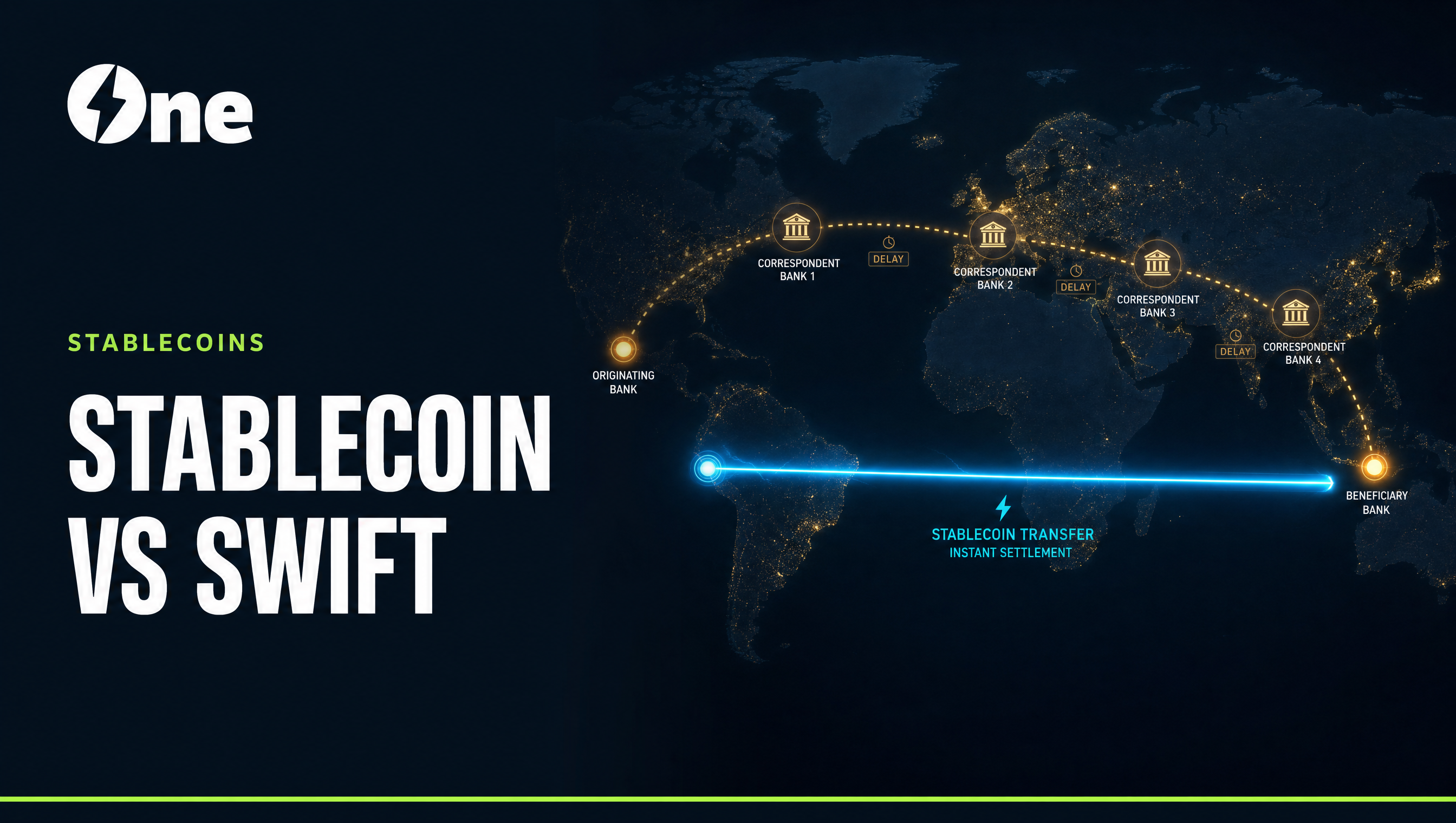
SWIFT is not a settlement network. It is a messaging network. It tells banks what to do, while settlement, the actual movement of value, happens through chains of correspondent banks, each adding a fee and a day. Stablecoins remove every correspondent hop by settling peer-to-peer on a shared ledger. That is why the fee difference is not 10% to 20% cheaper. It is 80% to 90% cheaper.
What to Know
- SWIFT transmits payment instructions between banks but does not move money directly. Actual settlement travels through correspondent banking chains, typically 2 to 4 banks per international transfer.
- Each correspondent bank charges 0.1% to 0.3% and adds roughly one business day. Total SWIFT cross-border cost sits at 3% to 5% for retail, plus FX spread.
- Stablecoins settle on a shared public ledger, sender to recipient directly, with no correspondent banks. Settlement time runs seconds to minutes depending on the chain.
- Cross-border card transactions include a foreign transaction fee, typically 1% to 3%, on top of the base card processing fee.
- The GENIUS Act (US, 2025 to 2026) establishes a federal framework for payment stablecoins, requiring 1:1 reserve backing and AML/KYC compliance, which provides a regulated path for stablecoin cross-border payments.
How SWIFT Actually Works
The Society for Worldwide Interbank Financial Telecommunication (SWIFT) was founded in 1973 to solve a real problem. Banks in different countries used incompatible messaging systems, which made international transfers slow and error-prone. SWIFT standardised the message format.
What SWIFT does is transmit standardised financial messages including payment instructions, confirmations, and statements between member banks. What it does not do is hold money, move money, or guarantee settlement timing.
The actual settlement process looks like this:
- Your customer's bank sends a SWIFT message instructing another bank to make a payment.
- If the sending bank does not have a direct relationship with the receiving bank, the message routes through one or more correspondent banks, which are banks that maintain accounts with each other and can bridge the relationship.
- Each correspondent bank in the chain debits and credits its own internal accounts, takes its fee, and forwards the instruction.
- The final receiving bank credits the recipient's account.
A payment from Singapore to Brazil, two countries without a large number of direct bilateral banking relationships, may pass through 3 to 4 correspondent banks. A payment from the US to Western Europe may pass through 1 to 2. Each hop adds one day and one fee.
The Cost of Each Correspondent Hop
Correspondent banks charge in two ways. First, a per-transaction fee, typically $10 to $25 for B2B transfers. Second, a percentage spread on foreign exchange conversion, typically 0.5% to 2% depending on the currency pair and relationship. On top of correspondent fees, the sender's bank and the recipient's bank each typically charge their own transaction fee.
For merchants receiving international card payments, the correspondent banking cost is embedded in the card network's cross-border interchange structure and the foreign transaction fee, typically 1% to 3% on top of base interchange.
The total cost of a cross-border payment via the traditional banking system breaks down as follows:
- Correspondent bank fees: 0.3% to 1.5% across the chain
- FX conversion spread: 0.5% to 2%
- Sending bank fee: $10 to $30 fixed
- Receiving bank fee: $10 to $20 fixed
- Total for a $10,000 B2B transfer: $50 to $200 in fees, 2 to 5 business days
How Stablecoin Settlement Removes Every Correspondent Hop
A stablecoin is a digital asset pegged to a fiat currency, typically the US dollar. USDC and USDT are the two largest, each with billions in daily transaction volume. Because they hold their peg through fiat reserves, a stablecoin dollar received is worth the same as a dollar sent. That is the foundation that makes them viable for cross-border payments.
When a merchant in Europe receives USDC from a buyer in Singapore, the transaction settles directly on the Ethereum, Tron, or Solana network with no correspondent bank chain, no SWIFT message routing, and no FX conversion unless the merchant chooses to convert.
The settlement path:
- Buyer sends USDC from their wallet.
- Transaction broadcasts to the blockchain network.
- Transaction confirms in the next block, seconds on Tron/Solana and roughly 1 to 3 minutes on Ethereum.
- Merchant's wallet receives USDC.
No bank needs to have a correspondent relationship with any other bank. No FX conversion occurs at the payment layer. The USDC the merchant receives is the same USDC the buyer sent, dollar-pegged, globally portable, and instantly verifiable on the public ledger.
Cost Comparison: SWIFT vs Card Cross-Border vs Stablecoin
| Method | Typical Merchant Fee | Settlement Time | Intermediaries | FX Cost |
|---|---|---|---|---|
| SWIFT wire (B2B) | $30 to $50 fixed + 0.5% to 1.5% | 2 to 5 business days | 2 to 4 correspondent banks | 0.5% to 2% spread |
| Card (cross-border) | 3.5% to 5% (interchange + card scheme + FX) | T+2 net settlement | Issuer, acquirer, card network | 1% to 3% foreign transaction fee |
| Stablecoin (USDC/USDT) | 0.3% to 1% (gateway fee only) | Seconds to minutes | None (peer-to-peer on-chain) | None at payment layer |
B2B Cross-Border: The Strongest Use Case
Stablecoin cross-border payments are useful for consumer e-commerce. They are transformative for B2B.
B2B payment characteristics that make stablecoins the better choice:
- Large invoice amounts: A 2% fee difference on a $50,000 invoice is $1,000. On a $500,000 monthly supplier relationship, that is $10,000 per month saved, which is serious money that justifies operational setup.
- Predictable payment schedules: B2B invoices have payment terms such as net 30 or net 60. Stablecoin payments can be scheduled or triggered against those terms without the 2 to 5 day correspondent chain delay.
- Both parties are businesses: Setting up a wallet and managing stablecoin flows is operationally straightforward for a treasury team. Both the buyer and supplier can integrate this into their ERP or payment workflow.
- Same-day settlement improves working capital: A supplier waiting 5 business days for a SWIFT transfer to clear has $500,000 in transit doing nothing. Stablecoin settlement in minutes improves cash flow measurably.
Compliance: GENIUS Act and Cross-Border Stablecoin Payments
The GENIUS Act (Guiding and Establishing National Innovation for US Stablecoins Act) passed in the US in 2025 to 2026, establishing the first federal framework for payment stablecoins. Key requirements for stablecoin issuers under the GENIUS Act include:
- 1:1 reserve backing in cash or cash-equivalent assets
- Monthly reserve attestation requirements
- AML/KYC compliance obligations
- Prohibition on unbacked algorithmic stablecoins claiming dollar peg
For merchants, transacting in USDC or USDT from regulated issuers means operating within this framework. The issuers, Circle for USDC and Tether for USDT, are subject to these requirements, not individual merchants. That said, merchants still carry their own KYC/AML obligations under the laws of every jurisdiction they operate in, so the GENIUS Act does not replace those requirements.
Cross-border stablecoin payments are not a regulatory grey area when using regulated stablecoins through a compliant gateway. The GENIUS Act specifically designates payment stablecoins as a defined instrument, which reduces the regulatory ambiguity that made some treasury teams hesitant in prior years.
Where AIO Fits
AIO supports multi-chain stablecoin acceptance through a single API, with a 0.3% pay-in fee and 0% payout fee. For merchants processing cross-border payments in USDC or USDT, AIO provides the gateway infrastructure without the correspondent bank chain, and at a fraction of the cost of card-based cross-border processing.
The non-custodial model means settled stablecoins go directly to the merchant's wallet. Merchants who want to convert to fiat arrange that separately through their treasury or exchange relationship, at a time and rate of their choosing.
For the full context on stablecoin payment infrastructure, the 2026 stablecoin payments guide for businesses covers asset selection, risk management, and integration. The comparison of crypto payments vs bank transfers covers the operational and compliance tradeoffs in more depth.
Frequently Asked Questions
Why is SWIFT slow for international payments?
SWIFT itself is only a messaging system. It tells banks what to do but does not move money directly. The actual settlement happens through a chain of correspondent banks, each holding accounts with each other. A payment from Singapore to Brazil might pass through three or four correspondent banks, each adding processing time, often one business day per hop, and a fee. Total transit time is typically 2 to 5 business days.
How do stablecoins settle cross-border payments faster than SWIFT?
Stablecoins settle on a shared public ledger, which means there are no correspondent banks and no messaging intermediaries. The sender and recipient transact directly. On Tron or Solana, USDT or USDC transactions confirm in seconds. On Ethereum, settlement takes minutes. No bank needs to have a correspondent relationship with another bank, so any two wallets can transact globally.
What compliance requirements apply to stablecoin cross-border payments?
As of 2026, the GENIUS Act in the US establishes a federal framework for payment stablecoins, requiring issuers to hold 1:1 reserves and comply with AML/KYC rules. Merchants using compliant stablecoin infrastructure are transacting within this framework. However, merchants still need to verify their own KYC/AML obligations under the regulations of every jurisdiction they operate in.
Are stablecoin cross-border payments suitable for B2B use cases?
Yes. B2B cross-border is arguably the strongest use case for stablecoin payments. Invoice amounts are larger, which means fee savings are material, payment terms are predictable, and both parties are businesses with wallets and treasury processes. A supplier in Asia receiving USDC from a buyer in Europe gets the same dollar-pegged value with no correspondent bank spread and same-day settlement.
Stablecoin Payments Business Guide 2026 · Crypto Payments vs Bank Transfers
Frequently Asked Questions
Why is SWIFT slow for international payments?
SWIFT itself is only a messaging system — it tells banks what to do, but does not move money directly. The actual settlement happens through a chain of correspondent banks, each holding accounts with each other. A payment from Singapore to Brazil might pass through three or four correspondent banks, each adding processing time (often one business day per hop) and a fee. Total transit time is typically 2–5 business days.
How do stablecoins settle cross-border payments faster than SWIFT?
Stablecoins settle on a shared public ledger — there are no correspondent banks and no messaging intermediaries. The sender and recipient transact directly. On Tron or Solana, USDT or USDC transactions confirm in seconds. On Ethereum, settlement takes minutes. No bank needs to have a correspondent relationship with another bank — any two wallets can transact globally.
What compliance requirements apply to stablecoin cross-border payments?
As of 2026, the GENIUS Act in the US establishes a federal framework for payment stablecoins, requiring issuers to hold 1:1 reserves and comply with AML/KYC rules. Merchants using compliant stablecoin infrastructure are transacting within this framework. However, merchants still need to verify their own KYC/AML obligations under the regulations of every jurisdiction they operate in.
Are stablecoin cross-border payments suitable for B2B use cases?
Yes — B2B cross-border is arguably the strongest use case for stablecoin payments. Invoice amounts are larger (meaning fee savings are material), payment terms are predictable, and both parties are businesses with wallets and treasury processes. A supplier in Asia receiving USDC from a buyer in Europe gets the same dollar-pegged value with no correspondent bank spread and same-day settlement.