What Is Blockchain Settlement? Why It Matters for Merchants
Blockchain settlement explained for merchants: what it means, how it differs from T+2 banking, why it eliminates settlement risk, and what finality means in practice.
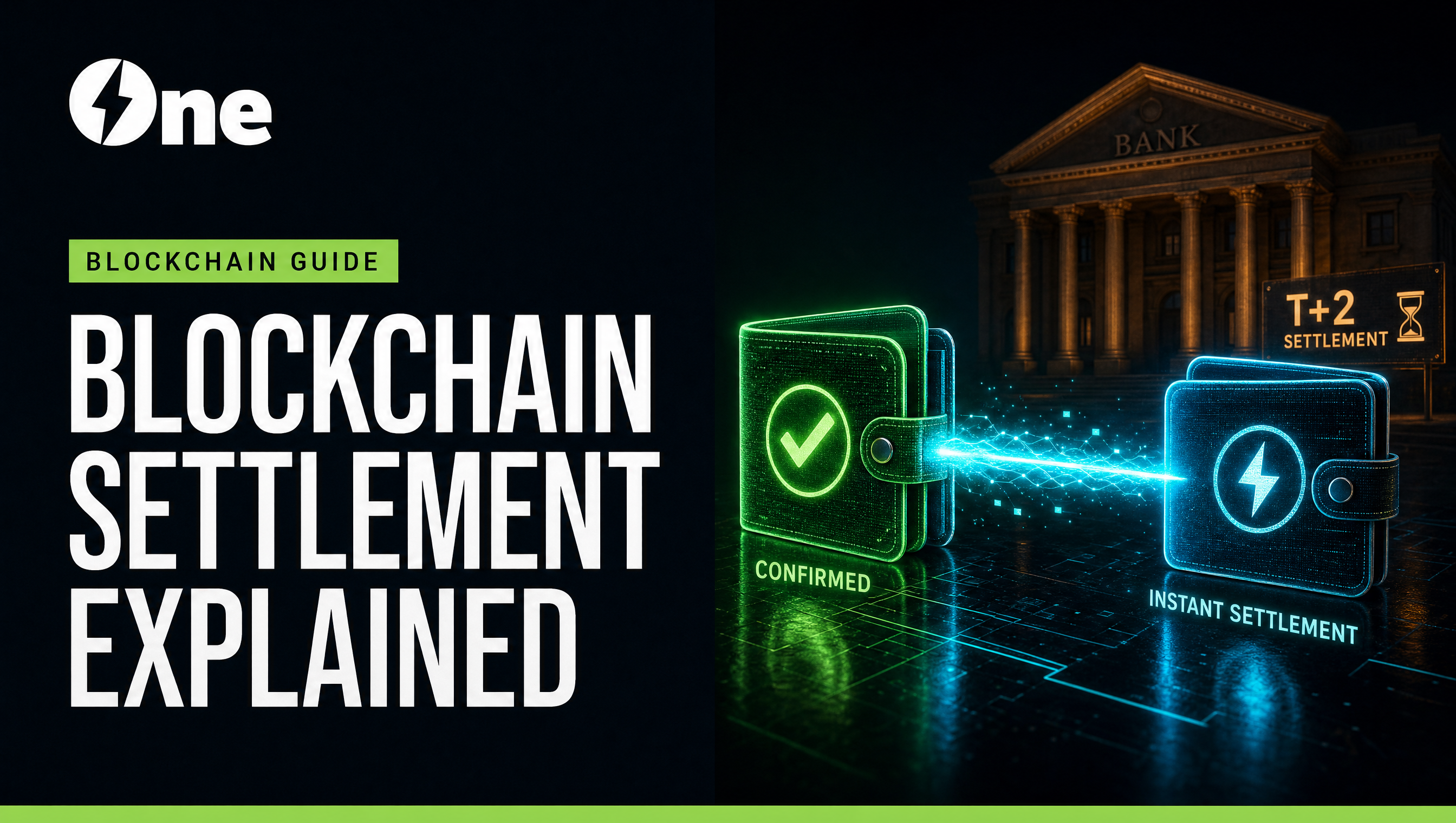
Stablecoins on Base settle in roughly two seconds. A domestic US ACH transfer takes one to three business days. An international wire takes one to five days. That gap is not a minor operational inconvenience. It is a structural difference in how money actually moves, and it has direct consequences for merchant cash flow, settlement risk, and payment operations.
Settlement is one of the most misunderstood terms in payments. Most merchants think of it as "when the money arrives." The real definition is more precise, and more important.
What to Know
- Settlement is the moment a payment becomes irrevocable, not the moment it appears in your account.
- In traditional banking, settlement happens T+1 to T+2: you have a payment promise on day one, settled funds on day two or three.
- In crypto, settlement happens at on-chain confirmation, seconds to minutes after the payment is broadcast.
- The gap between payment and settlement is called settlement risk: the risk that a counterparty fails before settlement completes.
- Blockchain settlement eliminates settlement risk by collapsing that gap to near-zero.
- Finality varies by chain and consensus mechanism; merchants should understand the difference between probabilistic and absolute finality.
What Settlement Actually Means
Settlement is the final, irrevocable transfer of funds. It is distinct from authorisation (permission to charge), clearing (reconciling records between institutions), and payment (the instruction to move money).
In a Visa card transaction, the sequence looks like this: authorisation at point of sale, clearing within 24 hours, and settlement between the acquiring bank and issuing bank within one to two business days. The merchant may see funds in their account within one business day, but those funds are not truly settled because they can be reversed through a chargeback for up to 120 days after the transaction date.
Settlement, in the strict sense, means no party can unilaterally reverse the transfer. In traditional banking, that moment arrives days after the payment instruction.
Why T+2 Settlement Exists in Traditional Banking
T+2 is not a natural law. It is the residue of historical infrastructure.
Settlement in traditional finance requires multiple institutions to update their internal ledgers and net positions against each other. A card payment involves the merchant's acquiring bank, the card network (Visa or Mastercard), the cardholder's issuing bank, and often a payment processor in between. Each institution runs its own ledger, so reconciliation across those ledgers happens in batches, overnight, through central clearing houses.
When Lehman Brothers collapsed in September 2008, it had an estimated $500 billion in unsettled trades across global markets. Counterparties who had sold assets to Lehman, or bought from it, faced the question of whether those trades would complete. This is settlement risk at scale: the possibility that a counterparty fails in the window between agreement and final settlement.
T+2 exists because the underlying infrastructure was built around paper records, human reconciliation, and business-day batch processing. Even with modern digital systems, the institutional architecture still operates largely in the same sequential, intermediary-heavy pattern.
How Blockchain Settlement Changes the Equation
A blockchain is a shared ledger maintained by a distributed network of nodes. There is no central clearing house, no batch reconciliation window, and no sequence of intermediary approvals. Because every node holds the same copy of the ledger, there is no handoff between institutions that could fail or delay.
When a crypto transaction is confirmed in a block, the ledger update is immediate and global. Every node sees the same state. The sender's balance decreases and the recipient's balance increases at the same moment, not across a two-day reconciliation window, but within the same block confirmation event.
This is not primarily a speed improvement. It is a structural change in when settlement risk disappears. In a T+2 system, two days of counterparty risk exist between every payment instruction and its final settlement. In a confirmed blockchain transaction, that window is measured in seconds.
Settlement Time Comparison
| Payment Method | Settlement Time | Reversibility Window | Cross-Border Cost |
|---|---|---|---|
| SWIFT International Wire | 1–5 business days | Recall possible during clearing | $25–$50 + FX spread |
| US Domestic ACH | 1–3 business days | Up to 60 days (unauthorised) | Not applicable |
| Credit/Debit Card | 1–2 business days | Up to 120 days (chargeback) | 1.5–3% FX fee |
| Bitcoin | 10–60 minutes (6 confirmations) | None after confirmation | Variable fee, no FX |
| USDC on Base | ~2 seconds | None after confirmation | Under $0.01 |
| USDC on Solana | Under 1 second | None after confirmation | Under $0.001 |
Finality vs. Confirmation: What Merchants Need to Understand
Confirmation and finality are related but not identical.
Probabilistic finality is what Bitcoin offers. A transaction with one confirmation is very likely to be permanent, but a sufficiently well-resourced attacker could theoretically rewrite it by outpacing the honest network. With each additional confirmation, the probability of reversal drops exponentially. Six confirmations on Bitcoin is considered economically final for all practical purposes.
Absolute (or economic) finality is what Ethereum's Proof of Stake offers through its "finalized" checkpoint mechanism. Once a block is finalized under Ethereum's consensus, reversing it would require destroying at least one-third of all staked ETH, which amounts to billions of dollars of collateral, making it economically irrational rather than merely difficult.
Layer 2 networks like Base settle batches back to Ethereum L1, inheriting Ethereum's economic security for final settlement while providing fast "soft" finality at the L2 level for individual transactions.
For merchant operations, the practical implication is straightforward: treat Layer 2 stablecoin confirmations as final for retail payment values. For high-value Bitcoin transactions, wait for the confirmation depth appropriate to the transaction size.
Implications for Merchant Cash Flow
T+2 settlement creates a float problem. A merchant processing $100,000 per day through card payments has, at any point, roughly $200,000 to $300,000 in transit, meaning money earned but not yet available. For high-volume merchants, this float is a permanent working capital drain.
Crypto settlement eliminates that float. Funds received are available immediately after confirmation. There is no holding period, no reserve requirement imposed by a payment processor, and no risk of settlement failure due to processor insolvency.
For cross-border merchants in particular, crypto settlement also eliminates the FX conversion delay. A merchant in Southeast Asia receiving USD stablecoins from a US customer gets USD-denominated value, settled in seconds, without a correspondent bank chain or a 2–3% FX conversion fee.
Payment infrastructure that combines fast on-chain settlement with clean reconciliation tooling, such as transaction-level reporting, webhook callbacks on confirmation events, and clear status states, turns this theoretical advantage into a practical operational improvement. AIO's non-custodial model means merchants retain control of settled funds directly, without a processor holding float on their behalf.
To understand the full mechanics of how transactions get confirmed, see How Do Crypto Payments Actually Work? For a broader introduction to accepting crypto in your business, What Are Crypto Payments? covers the fundamentals.
Frequently Asked Questions
What is the difference between payment and settlement?
Payment is the instruction to transfer value; settlement is the moment that transfer becomes irrevocable. In traditional banking, a card payment authorisation happens instantly, but the actual movement of funds between banks settles over one to three business days. In crypto, payment and settlement collapse into the same event: on-chain confirmation.
Why does T+2 settlement exist in banking?
T+2 exists because traditional financial infrastructure involves multiple intermediaries, including acquiring banks, card networks, issuing banks, and clearing houses, each needing time to reconcile their internal records. The delay is not a technical necessity. It is a legacy of paper-based processes that have been partially digitised but not fundamentally redesigned.
Is a one-confirmation crypto payment truly settled?
For most practical purposes, yes, particularly on Proof of Stake chains and Layer 2 networks. On Bitcoin, most merchants wait for three to six confirmations before treating a payment as settled, because Proof of Work finality is probabilistic. On Ethereum, Solana, and Base, single-confirmation finality is widely accepted for retail payment values.
What is settlement risk and how does crypto eliminate it?
Settlement risk is the risk that one party to a transaction defaults between the moment of agreement and the moment of final settlement. Lehman Brothers had hundreds of billions in unsettled trades when it collapsed in 2008, causing cascading failures. Blockchain settlement eliminates this risk by making the interval between agreement and irrevocable settlement a matter of seconds, not days.
Frequently Asked Questions
What is the difference between payment and settlement?
Payment is the instruction to transfer value; settlement is the moment that transfer becomes irrevocable. In traditional banking, a card payment authorisation happens instantly, but the actual movement of funds between banks settles over one to three business days. In crypto, payment and settlement collapse into the same event: on-chain confirmation.
Why does T+2 settlement exist in banking?
T+2 (trade date plus two business days) exists because traditional financial infrastructure involves multiple intermediaries — acquiring banks, card networks, issuing banks, and clearing houses — each needing time to reconcile their internal records. The delay is not a technical necessity; it is a legacy of paper-based processes that have been partially digitised but not fundamentally redesigned.
Is a one-confirmation crypto payment truly settled?
For most practical purposes, yes — particularly on Proof of Stake chains and Layer 2 networks. On Bitcoin, most merchants wait for three to six confirmations before treating a payment as settled, because Proof of Work finality is probabilistic. On Ethereum, Solana, and Base, single-confirmation finality is widely accepted for retail payment values.
What is settlement risk and how does crypto eliminate it?
Settlement risk is the risk that one party to a transaction defaults or fails between the moment of agreement and the moment of final settlement. Lehman Brothers had hundreds of billions of dollars in unsettled trades across global markets when it collapsed in 2008, causing cascading failures. Blockchain settlement eliminates this risk by making the interval between agreement and irrevocable settlement a matter of seconds, not days.