
What Is Form 1099-DA? Crypto Tax Reporting for Merchants in 2026
Form 1099-DA requires brokers — including payment processors that convert crypto — to report cost basis and proceeds to the IRS starting January 1, 2026. Here is what merchants using crypto payment gateways need to understand.
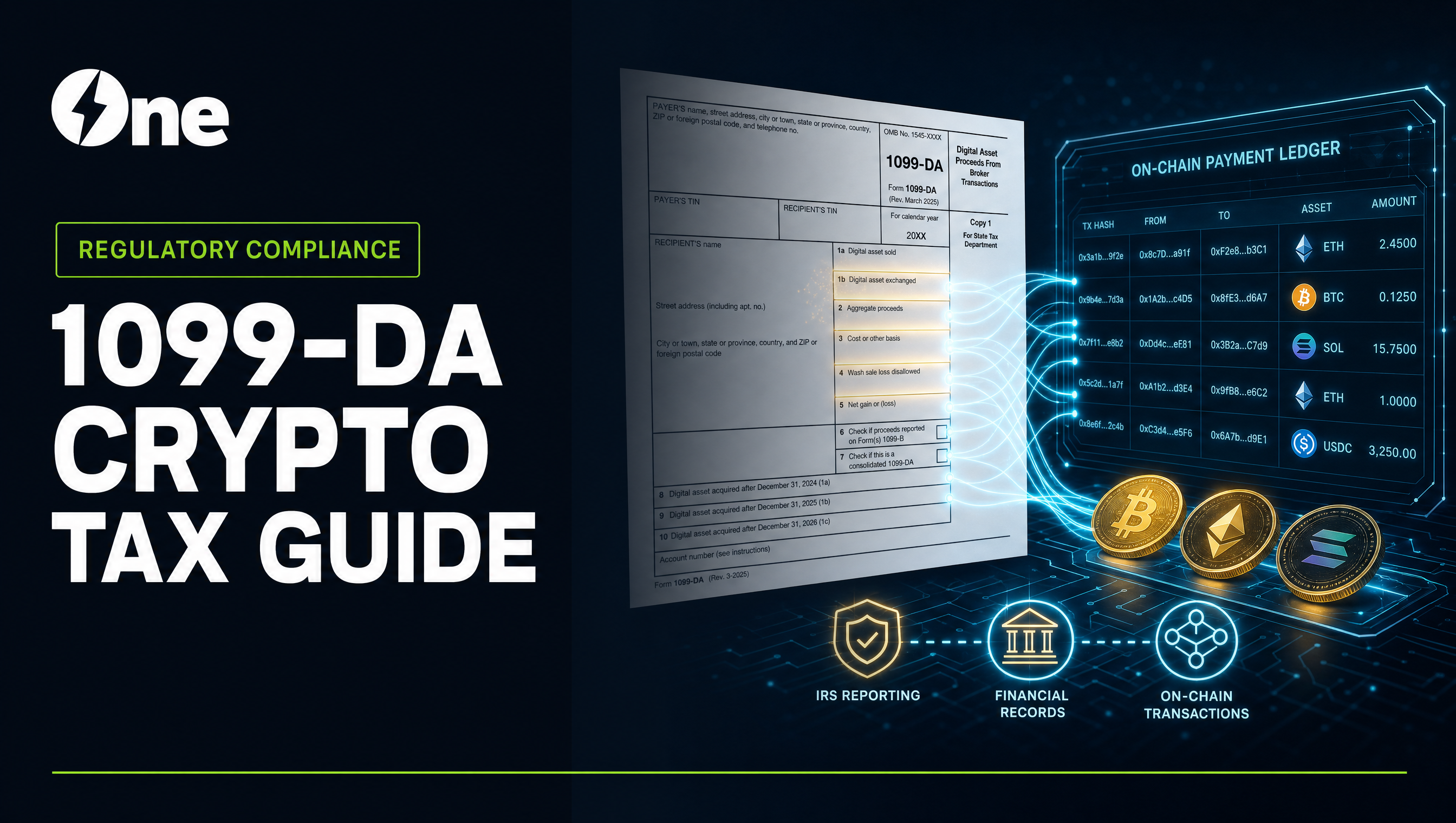
The IRS estimated $50 billion in unreported crypto gains in 2022. Form 1099-DA, effective January 1, 2026, is the primary enforcement mechanism. For merchants who accept crypto payments, understanding what it requires and whether your gateway handles it is now a compliance necessity.
The core concept is simple. The IRS treats crypto-to-fiat conversion as a taxable disposal event, the same as selling a stock. 1099-DA requires the entity facilitating that conversion, the broker, including payment processors that auto-convert, to report it to the IRS and to you, just as a stock broker reports a 1099-B.
What to Know
- Form 1099-DA is effective for transactions on or after January 1, 2026.
- It applies to brokers, including digital asset payment processors that convert crypto to fiat on behalf of merchants.
- 1099-DA reports cost basis and proceeds for digital asset disposals, equivalent to how Form 1099-B works for stock sales.
- Merchants using a gateway that auto-converts to fiat receive the form like a bank statement, because the gateway is the broker and handles the reporting.
- Merchants who hold stablecoins directly in their own wallet are responsible for tracking cost basis themselves, because the conversion event happens when they later sell or spend.
What Form 1099-DA Is
Form 1099-DA (Digital Assets) is an IRS information return introduced as part of the Infrastructure Investment and Jobs Act (2021), with final rules and an effective date of January 1, 2026 for transactions covered under the regulations.
Its function mirrors Form 1099-B used by stock brokers. When a broker facilitates the sale or conversion of a digital asset, they must report the proceeds and cost basis to both the IRS and the customer. This gives the IRS the data to cross-check against what taxpayers report on Schedule D for capital gains and losses.
The key legal classification is this: receiving crypto and converting it to fiat is a disposal event for tax purposes. You are treated as having sold the crypto at the moment of conversion. The gain or loss is the difference between the value at disposal and the value at acquisition, which is the cost basis. That is why the IRS modeled the form directly on 1099-B.
Who 1099-DA Applies To
The form applies to brokers of digital assets. The IRS definition of "broker" under the final 1099-DA rules includes the following entities:
- Cryptocurrency exchanges such as Coinbase and Kraken
- Digital asset payment processors that convert crypto to fiat on behalf of merchants
- Hosted wallet providers that facilitate sales
- Certain DeFi protocol operators under a phased implementation with a later effective date
What the definition does not cover for the initial 2026 implementation includes software wallets and non-custodial infrastructure that does not facilitate conversion. If you use a non-custodial gateway and receive crypto directly into your own wallet without any conversion by the gateway, the gateway is not acting as a broker for 1099-DA purposes.
What Information 1099-DA Captures
Each 1099-DA filing covers individual disposal events. For each transaction, the form captures:
| Field | Description |
|---|---|
| Digital asset type | The specific asset (Bitcoin, USDC, ETH, etc.) |
| Date acquired | When the broker received the asset on your behalf |
| Date sold/disposed | When the conversion or sale occurred |
| Proceeds | The fiat value received at the time of disposal |
| Cost basis | The fiat value at the time of acquisition (or the broker's best information) |
| Gain/loss | Proceeds minus cost basis |
| Holding period | Short-term (<1 year) or long-term (>1 year) |
What Merchants Who Auto-Convert Need to Do
The answer is: less than you think.
If your payment gateway converts incoming crypto to fiat before settling to your bank account, the model that Stripe and BitPay use, the gateway is acting as a digital asset broker. The gateway is required to issue you a 1099-DA for the conversion events it facilitates on your behalf.
From your side, this works like receiving a 1099-B from your stock broker. At tax time, you or your accountant use the 1099-DA to report the capital gains and losses on your tax return. The gateway has already done the cost basis and proceeds tracking, so you report what they send you.
The practical checklist for auto-convert merchants includes the following steps:
- Confirm your gateway's 1099-DA compliance status before the end of 2025
- Ensure your legal business name, EIN, and address in the gateway account are accurate, as this is what appears on the 1099-DA
- Retain the 1099-DA forms you receive, as you would any other tax document
- Work with a CPA familiar with digital asset taxation to report correctly on Schedule D
What Merchants Who Hold Stablecoins Need to Do
If your gateway is non-custodial, like AIO, and you receive stablecoins directly to your own wallet without any gateway conversion, you are not automatically covered by the gateway's 1099-DA reporting. The gateway is not your broker for purposes of the conversion you do later, and so the cost basis tracking responsibility sits with you.
When you eventually convert those stablecoins to fiat through an exchange, OTC desk, or other means, that conversion event triggers a taxable disposal. You need the following:
- Cost basis tracking. For USDC and USDT, the cost basis is typically $1.00 per token because they are dollar-pegged stablecoins. However, the IRS requires you to record the fair market value at the time you received them. For practical purposes, $1.00 is defensible for USDC/USDT under normal peg conditions. Maintain records regardless.
- Disposal records. When you convert, the exchange or OTC desk you use will issue a 1099-DA for that transaction. Retain those records.
- Accounting software. At meaningful volume, tracking stablecoin cost basis manually is operationally unsustainable. Crypto tax software such as Koinly, TaxBit, and Cointracker connects to your wallet addresses and exchange accounts to automate this tracking.
The gain or loss on a USDC-to-fiat conversion is typically minimal because USDC is pegged to $1.00. Yet the reporting requirement exists regardless. Failure to report is the risk the IRS is targeting with 1099-DA enforcement.
How to Verify Your Gateway Handles 1099-DA
If you are evaluating or currently using a gateway that auto-converts, ask directly. The questions to ask include these:
- Is the gateway registered as a digital asset broker with the IRS for 1099-DA reporting purposes?
- Will it issue 1099-DA forms to merchants for conversions processed in 2026?
- What is the timeline for sending forms, given that the IRS deadline for 1099 forms is January 31 of the following year?
- How are cost basis records maintained and what methodology is used, such as FIFO or specific identification?
If your gateway cannot clearly answer these questions, treat it as a compliance risk. Either switch to a gateway with clear 1099-DA compliance, or take responsibility for your own cost basis tracking.
Common Mistakes to Avoid
- Assuming stablecoin receipts are tax-free. Receiving USDC is not a taxable event, but converting or spending it is. The peg makes the gain/loss trivial, yet the reporting obligation exists.
- Not updating business info with your gateway. A 1099-DA issued to the wrong EIN or address creates reconciliation headaches at tax time.
- Treating 1099-DA the same as a 1099-K. 1099-K reports gross receipts for payment card and third-party network transactions. 1099-DA reports capital gains events. They are different forms with different treatment on your tax return.
- Missing the distinction between custodial and non-custodial gateways. A non-custodial gateway that never touches or converts your funds is not your broker. Your compliance obligations are different, and the responsibility for basis tracking falls to you.
For the broader crypto compliance landscape: the GENIUS Act merchant guide covers the stablecoin regulatory framework that intersects with 1099-DA. The fundamentals of crypto payments provides context on how payment flows and asset types affect your tax position.
Frequently Asked Questions
What is Form 1099-DA and when does it take effect?
Form 1099-DA is an IRS information return that requires brokers, including digital asset payment processors that convert crypto to fiat, to report the proceeds and cost basis of digital asset disposals. It takes effect for transactions occurring on or after January 1, 2026. Brokers must provide the form to customers and to the IRS, similar to how stock brokers provide Form 1099-B.
Does 1099-DA apply to merchants who accept crypto payments?
It depends on how your gateway works. If your payment processor converts incoming crypto to fiat on your behalf, the processor is acting as a broker and is required to issue 1099-DA for those conversions. If you use a non-custodial gateway and receive crypto directly to your own wallet without the gateway converting it, the gateway is not your broker, so you track cost basis yourself when you later convert.
What information does Form 1099-DA capture?
1099-DA captures the type of digital asset, the date acquired, the date sold or disposed of, the proceeds, and the cost basis. This parallels the 1099-B form used for stock brokerage reporting. The goal is to give the IRS the information needed to verify that capital gains on crypto disposals are correctly reported on tax returns.
What should merchants who hold stablecoins do to prepare for 1099-DA?
Merchants who receive stablecoins directly into their own wallets without a broker converting are not automatically covered by their gateway's 1099-DA reporting. They need to track the cost basis of each stablecoin received, typically $1.00 for USDC/USDT pegged assets, and report any gain or loss when they convert or spend it. Crypto accounting software such as Koinly, TaxBit, or Cointracker can automate this tracking.
What Are Crypto Payments: A Guide · GENIUS Act Stablecoin Payments: Merchant Guide 2026
Frequently Asked Questions
What is Form 1099-DA and when does it take effect?
Form 1099-DA is an IRS information return that requires brokers — including digital asset brokers such as crypto payment processors that convert crypto to fiat — to report the proceeds and cost basis of digital asset disposals. It takes effect for transactions occurring on or after January 1, 2026. Brokers must provide the form to customers and to the IRS, similar to how stock brokers provide Form 1099-B.
Does 1099-DA apply to merchants who accept crypto payments?
It depends on how your gateway works. If your payment processor converts incoming crypto to fiat on your behalf, the processor is acting as a broker and is required to issue 1099-DA for those conversions. If you use a non-custodial gateway and receive crypto directly to your own wallet without the gateway converting it, the conversion event only occurs when you later sell — and you are responsible for tracking that cost basis yourself.
What information does Form 1099-DA capture?
1099-DA captures the type of digital asset, the date acquired, the date sold or disposed of, the proceeds, and the cost basis. This parallels the 1099-B form used for stock brokerage reporting. The goal is to give the IRS the information needed to verify that capital gains on crypto disposals are correctly reported on tax returns.
What should merchants who hold stablecoins do to prepare for 1099-DA?
Merchants who receive stablecoins directly into their own wallets — without a broker converting — are not automatically covered by their gateway's 1099-DA reporting. They need to track the cost basis of each stablecoin received (typically $1.00 for USDC/USDT pegged assets, but record it) and report any gain or loss when they convert or spend it. Crypto accounting software such as Koinly, TaxBit, or Cointracker can automate this tracking.