November 13, 2025
Tokenization demand is no longer tied to Bitcoin: Tokenisation no longer moves in Bitcoin’s shadow
As institutions decouple asset tokenization demand from cryptocurrency speculation, payments platforms must prioritize stablecoin-enabled rails and enterprise readiness
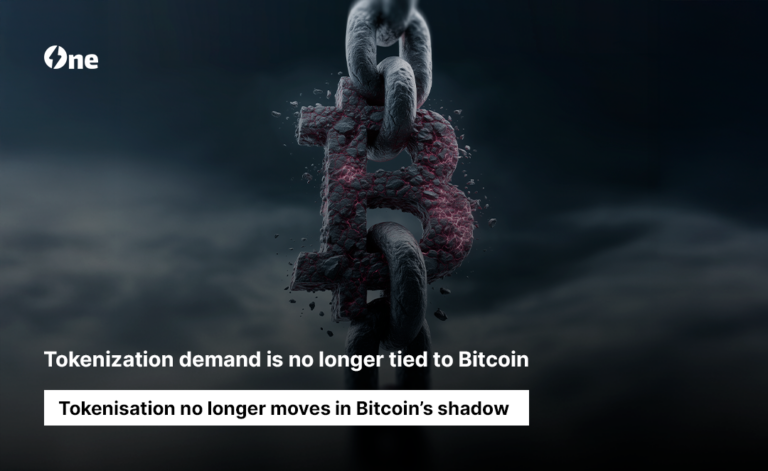
Institutional interest in asset tokenization is evolving in a meaningful way. According to Galaxy Digital’s head of tokenization, Thomas Cowan, tokenization demand is no longer closely tied to the price of Bitcoin as tokenized assets and payment rails are standing on their own strategic foundations.
This shift matters for business leaders at payments platforms, fintech firms and treasury operations. What it highlights is that the stablecoin layer and token-enabled payment/settlement infrastructure are rising from the shadow of crypto speculation into enterprise-grade utility.
What’s changed: Data and insights
- Cowan states: “We’re getting to the point where it’s almost independent of the price of Bitcoin, that people see the benefits that blockchain can have to move and store traditional financial assets.”
- A recent industry report finds that institutional tokenization has moved from exploratory to actionable, with stronger institutional demand, regulatory engagement, and enterprise readiness.
- Tokenization is no longer just about digital currencies; it is increasingly about real world assets (RWAs), e.g., bonds, real estate, funds, etc., represented on-chain and settled via programmable rails.
Why stablecoins and payments rails benefit
For payments platforms and enterprise finance teams, this decoupling brings several strategic benefits:
- Predictable settlement rails
Stablecoins offer less volatility than cryptocurrencies like Bitcoin, enabling use cases such as treasury transfers, cross-border payouts, embedded payroll or vendor settlement. - Tokenized asset synergy
Tokenized real world assets (RWAs) complement stablecoins by providing yield-bearing or collateralized flows that link into payment rails. As tokenization gains traction independent of crypto cycles, stablecoin usage becomes more fundamental. - Efficiency & programmability
On-chain assets and stablecoin rails allow for automation (smart contracts), 24/7 global settlement, fractional ownership and lower cost structures. This shifts payments from “just moving money” to “programmable money”. - Enterprise readiness
Since interest in tokenization is less speculative and more utility driven, firms can justify investment in compliant payment rails, stablecoin settlement and infrastructure built for scale rather than crypto hype.
How AIO addresses this evolving landscape
At AIO, we recognize that the strategic centre of payments is shifting. Here’s how we help businesses capitalize:
- We support stablecoin settlement rails that integrate directly into business payments, treasury flows and cross-border transfers, reducing exposure to volatility and enabling predictable liquidity.
- We provide token-agnostic rails which enable clients to embed tokenized asset flows and stablecoin settlement in a unified architecture, giving flexibility to adopt new asset types as tokenization accelerates.
- We build with enterprise governance, auditability and regulatory readiness in mind. As tokenization becomes independent of crypto cycles, infrastructure must align with standards for custody, settlement, transparency and risk management.
- We help companies transition from “crypto speculation infrastructure” to “business payments infrastructure,” focusing on utility, scalability and alignment with institutional adoption rather than market swings.
Looking forward: What decision-makers should consider
- Audit your payment rails
Do your rails support stablecoin settlement with institutional-grade controls? Can you easily integrate tokenized-asset flows? - Separate speculation from utility
Build your payments roadmap assuming tokenization and stablecoin usage will grow even if Bitcoin and crypto markets aren’t booming. - Plan for modularity
Tokenization momentum means asset types will expand; your infrastructure should support switching or adding token types without major rebuilds. - Prepare for enterprise adoption
As institutional players embrace tokenized assets and stablecoin rails, your ecosystem should be ready with compliance, settlement visibility and performance metrics that matter to treasury teams.
Conclusion
The decoupling of tokenization demand from Bitcoin’s price is a watershed moment for payments infrastructure. It signals that the market is maturing, not just chasing crypto price swings, but building rails for real world financial flows using stablecoins and tokenized assets.
For payments and fintech executives the question isn’t “if” but “how fast and how well” they can adopt these rails. At AIO, we stand ready to help businesses turn this transition into strategic advantage.