November 21, 2025
Banks, Fintech & Token-Payments: The New Era of Hybrid Payment Rails
As banks and fintechs partner with token rail platforms, a new era of layered payment infrastructure is emerging. Discover how token rails alongside core fiat systems offer strategic benefits, and how AIO supports this transition.
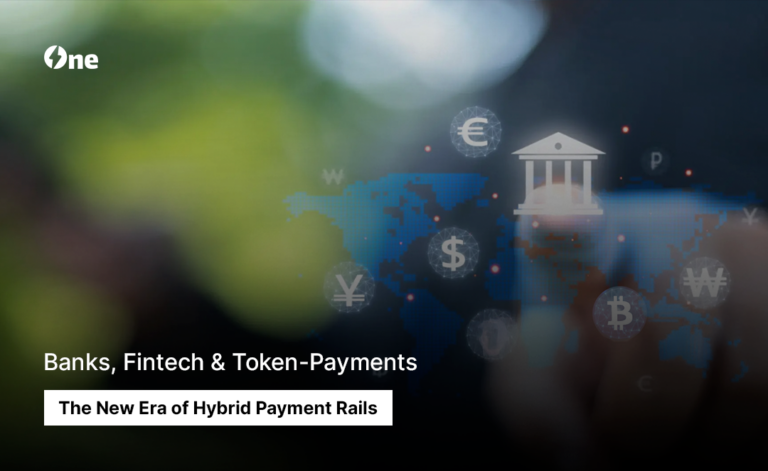
Payment rails are entering a phase of reinvention. Traditional systems such as nostro/vostro accounts, correspondent banking, ACH, and SWIFT, are being challenged by token rails and digital asset settlement networks that promise speed, global reach, and lower cost. At the same time, banks and fintechs are recognizing that the future does not favor either legacy or token rails exclusively. The winners will be those that layer token rails alongside core systems. According to research, 86% of central banks globally are actively researching digital assets (cryptocurrencies, stablecoins, token rails) and 60% are already experimenting.
The legacy rails problem for banks & fintechs
Traditional payment rails still dominate but they come with limits:
- Multiple intermediaries, correspondent networks and pre-funding tie-ups add cost and lock up working capital.
- Settlement delays and time zones mean cross-border payments often take days rather than hours.
- Fintechs operate with agility but often lack bank-grade infrastructure; banks have regulation and reach but struggle with legacy tooling.
Token rails offer alternatives. McKinsey & Company describes tokenized cash as a direct challenge to traditional global payments rails. In short, without hybrid rails, banks risk being bypassed by fintech-token combos. On the other hand, fintechs risk building rails banks won’t trust.
The emergence of hybrid payment rails: What it means
Hybrid payment rails or more accurately, layered payment rails, combine fiat and token infrastructure to optimize cost, speed, compliance and reach.
- The orchestration layer is central, routing payments between legacy or token rails based on business rules (cost, geography, asset type).
- A recent blog on payment rails warns that blockchain-based networks are “redefining cross-border money movement.”
- For banks and fintechs, this means building architecture that keeps trusted fiat settlement rails in place while integrating token rails as a strategic layer for select flows.
Key strategic benefits for banks & fintechs
Speed & settlement
Token rails enable near-real-time settlement compared to days for many traditional corridors.
Cost efficiency
Fewer intermediaries, less pre-funding and less FX drag drive cost savings. Research from McKinsey shows tokenized cash can materially reduce cost and complexity.
Global reach & 24/7 operations
Token networks operate continuously, enabling cross-border flows even outside banking hours.
New business models
Banks and fintechs can issue or partner on stablecoins, embed token rails, and even launch merchant platforms.
Risk and governance
While token rails add flexibility, they require bank-grade compliance, fallback to fiat rails, and robust governance.
How AIO enables complementary token rail adoption
AIO does not replace your core fiat rails, it complements them. Our infrastructure is designed to be a token rail layer you plug into your existing systems, so you get the best of both worlds:
- Token-payment rails built to integrate: AIO allows banks, fintechs and platforms to keep their existing fiat rails while layering in token rails for new value flows.
- Stablecoin swap module: Seamless conversion between fiat and token rails; token rails become an optional but high performance layer.
- Low-fee, high-speed token settlement: For flows where cost and speed matter most.
- Regulatory-ready governance: Token rails with audit trail, fallback logic and enterprise-grade compliance.
Vertical relevance:
- A bank issuing a stablecoin for corporate clients uses AIO’s token rail as an adjunct rail while keeping settlement on its core system.
- A fintech-merchant partner uses AIO’s token gateway to add token rail capability for merchants, complementing fiat settlement.
- A global payments platform uses AIO’s token rail for cross-border rapid settlement, while domestic flows stay on fiat rails.
Strategic checklist for payment / fintech / bank leaders
- Audit your existing rails: What percentage of your flows remain fiat-only?
- Map cost, settlement-time, working-capital tie-up: Could token rail layering reduce this?
- Identify token-rail tier-in opportunities: Which corridors or flows benefit most from token rails?
- Assess governance & fallback readiness for token rails: Are you ready for token rail adoption without sacrificing regulatory trust?
- Choose a partner for token rail layering: You want an infrastructure provider that complements, not replaces, your established rails. AIO is built for this layered model.
Conclusion
The era of layered payment rails is here. For banks and fintechs that adopt token rails alongside their core systems, the opportunity is clear: faster, cheaper, global settlement; new business models; future-proof infrastructure. If your organization is evaluating how to integrate token payments and build layered rails, let’s talk.
Contact AIO today to explore how our token rail layer can complement your existing infrastructure and power your next growth phase.