November 17, 2025
Stabelcoins are no longer niche: They’re becoming the backbone of global payments
Stablecoins are transforming payment rails with faster settlement, lower fees and global reach. Learn what enterprises must do now to embed tokenized payment infrastructure and how AIO helps deliver it.
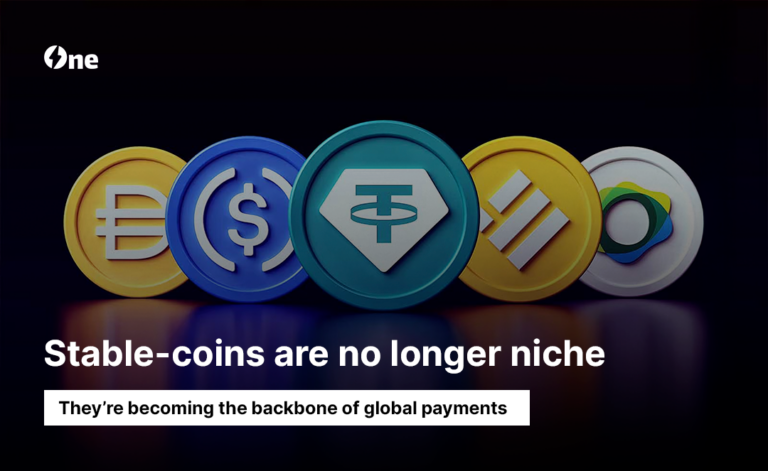
If you’ve been watching the payments industry lately you’ve seen a quiet revolution happening: stablecoins, digital tokens pegged to fiat currencies like the U.S. dollar, are inching toward the core of global payments infrastructure. Recent reports show they’re doing more than mere experimentation, they’re starting to challenge the rails that businesses, merchants and treasuries rely on every day. If you lead payments, treasury or innovation for a fintech or enterprise, now is the time to act. Because when rails change, your business payments must evolve too.
What the data shows
Several recent research reports underscore the scale of what’s happening:
- A McKinsey article describes how tokenized cash and stablecoins are enabling next-gen payments with global reach, cross-border speed and cost-efficiency.
- A Forbes report states that stablecoins processed around $9 trillion in payments in 2025, an 87% jump from the year before.
- An IMF analysis points to stablecoins’ potential to reshape how value flows across borders, especially where banking infrastructure is weak or costly.
In short, stablecoins are not just a niche within crypto, they’re becoming a strategic infrastructure for payment flows.
What this means for payment infrastructure
With this shift underway, businesses must rethink how their payment rails are built. Consider these three areas:
- Cost, speed and global reach
Traditional cross-border payments still face delays, high fees and currency conversion issues. Stablecoins promise near-real-time settlement, lower costs, and 24/7 global availability. - Tokenized rails must integrate with business operations
It’s not enough to “accept crypto payments” as a separate channel. Payment systems must embed token rails into merchant flows, treasury operations, supplier payments and settlement logic. Without that integration, you risk creating a siloed offering that underperforms when scale or complexity hits. - Governance, compliance and infrastructure maturity matter
With stablecoins moving toward mainstream use, enterprise expectations shift. Businesses must build token-rails that are resilient, auditable, compliant and operational in real time. Infrastructure readiness is a differentiator.
Why enterprises must act now
The competitive pressure is mounting as legacy payment rails are being challenged, and platforms built without future-ready token capabilities risk being left behind. Businesses that embed token rails, stablecoin swap modules and cost-efficient rails now will gain first-mover advantage. Those that delay may face higher integration costs, slower time-to-value and reputational risk.
How AIO helps
At AIO we’ve built payment rail infrastructure with enterprise-grade capabilities:
- Stablecoin swap
Seamlessly convert between token types or fiat-equivalent value so your business stays agile. - Low-fee, fast-settlement token rails
When volume scales or cross-border flows increase, you benefit from rails that minimise cost and latency. - Business-payments integration
Token rails embedded into your merchant services, treasury flows and operational stack so you’re not running a token-pilot, you’re executing payments at scale. - Governance & compliance readiness
Built-in audit-trail, fallback logic and enterprise controls ensure your token payments infrastructure meets both business and regulatory demands.
Strategic Checklist for Decision-Makers
- Audit your current payment-rail architecture: Can it handle high-volume, low-fee, token-based settlement?
- Map your cross-border cost and latency: How much could you save by migrating some flows to token-rails?
- Ensure token-rails are embedded, not optional: Are merchant services, treasury and payments fully integrated?
- Build governance & fallback logic: If token rails hit stress, do you have safe switching and visibility?
- Partner with infrastructure built for enterprise token-payments: Choose a provider with scale, integration and business focus.
Conclusion
Stablecoins are starting to become the backbone of global payments. For enterprises in fintech, blockchain and payments, this is your moment to upgrade infrastructure, embed token-rails and optimize for speed, cost and global reach.
If you’re ready to build payment systems for the token-rail stablecoin era, let’s talk.