Should Merchants Accept RLUSD? Ripple's Stablecoin in 2026
Should merchants accept RLUSD? A first-principles look at Ripple's stablecoin backing, regulation, and liquidity versus USDC and USDT in 2026.
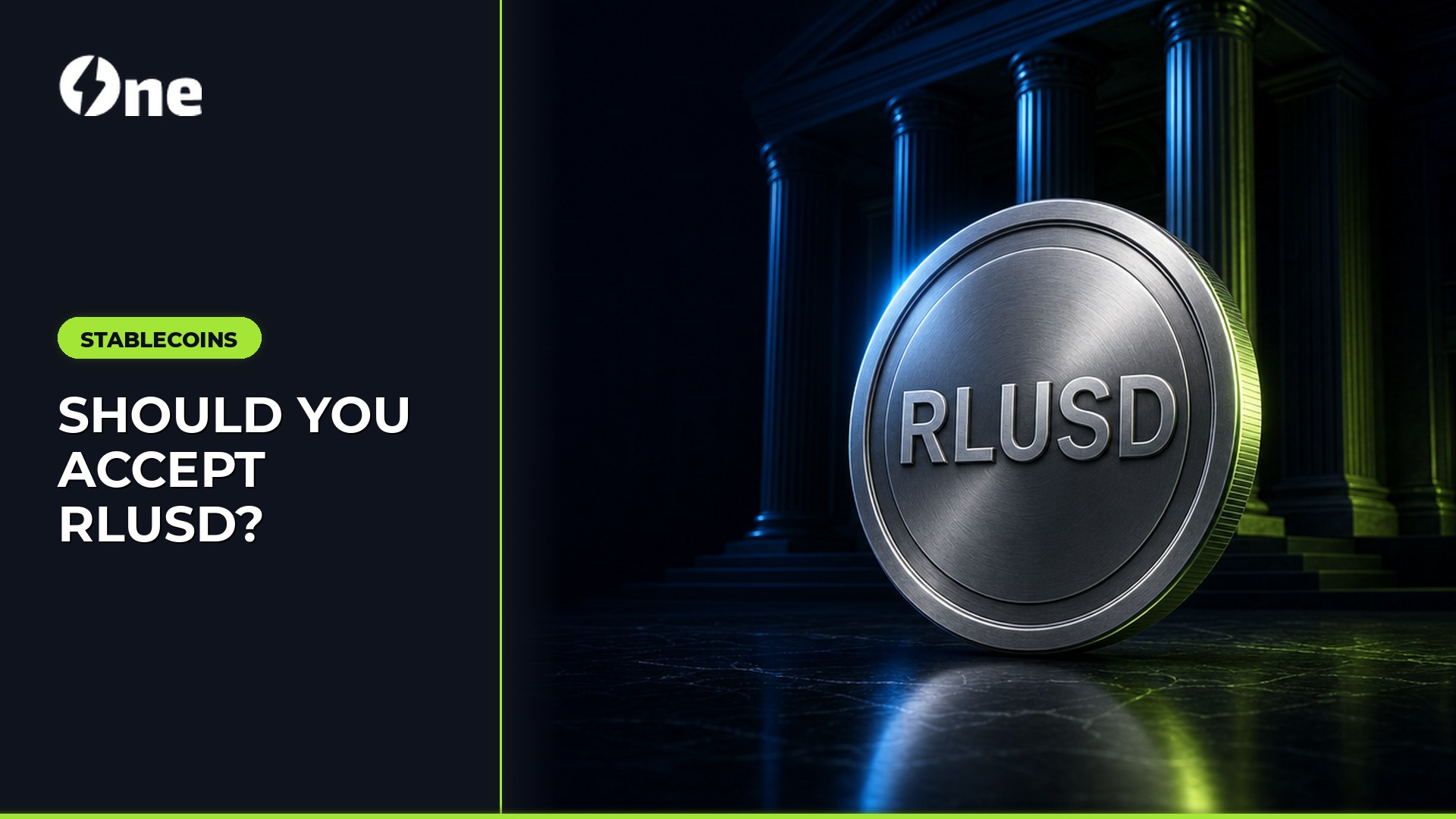
For most merchants the question of whether to accept RLUSD merchant payments comes down to one thing, which is whether a newer stablecoin is solid enough to settle real revenue on. RLUSD is Ripple's dollar-backed stablecoin, and in 2026 it crossed roughly $1.6 billion in market cap with the Bank of New York named as its primary reserve custodian. That combination of bank-grade reserves and a regulated issuer is what makes it worth a serious look rather than a quick dismissal.
The honest answer is that RLUSD is now safe enough to accept for many businesses, but it is not yet a like-for-like replacement for USDC or USDT on liquidity. A merchant should judge any new stablecoin on three things, which are who backs the reserves, where it is regulated, and where it has liquidity. RLUSD scores well on the first two and is still catching up on the third. This guide walks through each one from the ground up so you can decide where RLUSD fits in your checkout and settlement stack.
What to Know
- Reserves and custody, RLUSD is backed by US dollar deposits, short-term Treasuries, and cash equivalents, with the Bank of New York named as primary reserve custodian, which is a stronger custody arrangement than most stablecoins disclose.
- Regulation, RLUSD is issued under a New York trust charter, putting it in the regulated tier alongside USDC rather than the offshore tier where USDT sits.
- Liquidity, RLUSD passed roughly $1.6 billion in market cap and earned a place among the six regulated stablecoins in Mastercard's June 2026 on-chain settlement expansion, yet it is still far smaller than USDC and USDT, so deep order-book liquidity is thinner.
- Practical takeaway, accepting RLUSD makes sense when you can settle it through a gateway that auto-converts and swaps for you, because that removes the liquidity risk of holding a smaller coin directly.
What is RLUSD and who actually backs it?
RLUSD is a stablecoin, which at its most basic level is a blockchain token that one company promises is always worth one US dollar. The promise only holds if that company keeps one dollar of safe assets in reserve for every token it issues. So the first question for any stablecoin is never the technology. It is what sits in the reserve and who is holding it.
For RLUSD, the reserve is held in US dollar deposits, short-term US Treasury bills, and cash equivalents. What sets it apart is the custodian. Ripple named the Bank of New York as the primary custodian of those reserves, and BNY is one of the oldest and largest custody banks in the world. That matters because a stablecoin's weak point is rarely the token itself. The weak point is whether the backing assets are real, segregated, and held somewhere a regulator can reach them.
This is the same lesson the market learned the hard way with earlier stablecoin scares, where the fear was never the code but the reserves behind it. RLUSD is built to answer that fear directly. A merchant does not have to take Ripple's word for the dollar peg, because a major regulated bank is holding the assets that back it.
Is RLUSD regulated enough for a business to accept?
Regulation matters to a merchant for a practical reason, which is recourse. If a stablecoin issuer fails, your ability to recover funds depends on what legal framework the issuer operates under. An offshore issuer with no clear regulator leaves you with little to lean on. A regulated issuer sits inside a supervisory system with reserve rules, audits, and oversight.
RLUSD is issued under a New York trust charter, which places it in the regulated tier of US dollar stablecoins. That puts it in the same broad category as USDC, which is also issued by a US-regulated entity. It is a different category from USDT, which is issued offshore and has historically been more opaque about reserve composition. For a merchant, regulated issuance is what turns a stablecoin from a speculative asset into something closer to a digital cash instrument you can defend to your finance and compliance teams.
Ripple is also pushing RLUSD into institutional channels deliberately. In June 2026 it expanded RLUSD to institutions in Türkiye through local partners, and Mastercard named RLUSD one of six regulated stablecoins in its on-chain settlement expansion that same month. Those moves signal that RLUSD is being positioned as bank-grade infrastructure rather than a retail trading token. For a deeper grounding in how a regulated stablecoin payment actually works, see our explanation of what a stablecoin payment is.
How does RLUSD compare to USDC and USDT?
The fundamental difference between these three coins is not speed or chains. It is the trade-off between regulation and liquidity. USDT wins on liquidity because it is the most traded stablecoin in the world, but it is the least transparent on reserves. USDC sits in the middle as the most established regulated coin with deep liquidity. RLUSD matches USDC on regulation and custody quality, yet it is still building the liquidity depth the older two already have.
| Factor | RLUSD | USDC | USDT |
|---|---|---|---|
| Backing | USD deposits, short-term Treasuries, cash equivalents, BNY as custodian | Cash and short-term Treasuries, regulated reserve managers | Reserves disclosed in attestations, historically less transparent |
| Regulation | New York trust charter, US-regulated issuer | US-regulated issuer | Offshore issuer, lighter disclosure |
| Liquidity | Roughly $1.6B market cap, growing but smaller | Tens of billions, deep liquidity | Largest stablecoin, deepest liquidity |
| Chains | XRP Ledger and Ethereum, expanding to more networks | Many major chains | Many major chains |
The table makes the practical point clear. If your only goal is the deepest market and widest exchange support, USDT and USDC still lead. If your goal is a regulated, bank-custodied dollar token that you can stand behind, RLUSD now belongs in the same conversation. For a fuller head-to-head on the two incumbents, our USDC versus USDT comparison for merchant payments breaks down where each one fits.
Why does liquidity matter so much when you accept a stablecoin?
Liquidity is the one area where RLUSD is genuinely behind, so it is worth explaining why a merchant should care. When a customer pays you in a stablecoin, you usually do not want to hold that coin forever. You want to convert it into the currency or settlement asset your business runs on. Liquidity is simply how easily you can do that conversion without losing value to a thin market.
A coin with tens of billions in circulation, like USDC or USDT, can be swapped or sold in size with almost no price impact. A smaller coin can move against you if you try to convert a large amount at once, because fewer buyers are standing ready. RLUSD is growing fast and now has Mastercard-level settlement support, but its market is still a fraction of the size of the incumbents. That is the real risk of accepting a newer stablecoin directly, and it is not about whether the peg holds.
This is exactly the problem a payment gateway is built to absorb. Instead of you managing liquidity for each coin, the gateway handles conversion at the moment of settlement. That is why the right way to accept RLUSD is rarely to sit on it yourself, and almost always to route it through infrastructure that settles it for you into a stablecoin you already trust.
How a merchant can accept RLUSD without re-integrating
The biggest operational fear with any new coin is the integration work. Adding a payment method usually means new code, new testing, and new reconciliation logic. That fear is what keeps most merchants on two or three coins long after a better option appears.
This is where a multi-chain gateway changes the math. AIO.cash supports many chains through a single API, so adding a new accepted coin like RLUSD does not mean rebuilding your checkout. You price your products in dollars, and AIO handles automatic fiat-to-stablecoin conversion plus built-in crypto-to-stablecoin swaps, so an incoming payment can settle into the stablecoin you actually want to hold. Because the settlement coin and chain are configurable, you can switch what you accept without re-integrating.
The economics work in the merchant's favor too. AIO charges 0.3% on pay-ins and 0% on payouts, which is the lowest combined fee structure in the market. AIO is also non-custodial, so the platform never holds your private keys and you keep control of your funds. For the full picture of running stablecoin checkout in a business, our stablecoin payments business guide covers the operational details end to end.
A simple decision framework for accepting RLUSD
Use a short test before adding RLUSD to your checkout. Each step builds on the one before it, so work through them in order.
- Confirm the backing. RLUSD passes here because it is reserve-backed with the Bank of New York as primary custodian, which is a stronger custody story than most coins offer.
- Confirm the regulation. RLUSD passes because it is issued under a New York trust charter, putting it in the regulated tier with USDC.
- Check the liquidity for your size. If you process small to mid-size volumes and settle through a gateway that converts for you, RLUSD's smaller market is not a problem. If you plan to hold large balances directly, treat the thinner liquidity as a real constraint.
- Decide how you will settle it. The cleanest path is to accept RLUSD and convert at settlement rather than holding it, so liquidity risk stays off your balance sheet.
Most merchants who clear the first two steps will find RLUSD passes the test, as long as settlement is handled by infrastructure rather than by hand. The coin is sound. The thing to manage is how you convert it.
What are the risks of accepting RLUSD in 2026?
The main risk is not reserve quality, because BNY custody and regulated issuance largely address that. The main risk is the one already covered, which is thinner liquidity than the incumbents. If you hold RLUSD directly in large amounts, you take on conversion risk that you would not face with USDC or USDT.
A second consideration is exchange and chain coverage. RLUSD is expanding quickly, with new listings and added chains arriving through 2026, but it is not yet supported everywhere the older coins are. Before you accept it, confirm that your settlement path actually supports RLUSD on the chain you intend to use. A gateway that already lists RLUSD as a supported coin removes this concern, because the coverage question becomes the provider's job rather than yours.
Frequently asked questions
Is RLUSD safe for merchants to accept?
RLUSD is reasonably safe to accept because it is backed by US dollar reserves with the Bank of New York as primary custodian and is issued under a New York trust charter. The remaining caution is liquidity, since its market is smaller than USDC and USDT. Settling RLUSD through a gateway that converts it removes most of that concern.
How does RLUSD compare to USDC for payments?
RLUSD and USDC are similar on what matters most, since both are regulated US dollar stablecoins with transparent reserves. The main difference is liquidity, where USDC is far larger and more widely supported. RLUSD is a credible regulated alternative that is still catching up on market depth.
What backs the value of RLUSD?
RLUSD is backed by US dollar deposits, short-term US Treasury bills, and cash equivalents held in reserve. The Bank of New York serves as the primary custodian of those reserves. This bank-grade custody is one of RLUSD's strongest selling points.
Can I accept RLUSD without changing my checkout integration?
Yes, if you use a multi-chain gateway like AIO.cash that supports many coins and chains through a single API. You can add RLUSD as an accepted coin and settle it into your preferred stablecoin without rebuilding your checkout. The conversion and swap are handled by the gateway.
Which chains support RLUSD?
RLUSD launched natively on the XRP Ledger and has expanded to Ethereum, with further chains being added through 2026. Before accepting it, confirm that your settlement provider supports RLUSD on the specific chain you plan to use. A gateway that already lists RLUSD handles this for you.
Where RLUSD goes from here
RLUSD entered 2026 as a serious regulated stablecoin rather than an experiment, and its trajectory points up. Bank-grade custody, regulated issuance, a place in Mastercard's settlement network, and fresh institutional listings all push it toward becoming a standard option merchants are expected to support. The one gap is liquidity, and that gap narrows every month the supply grows.
For a merchant, the smart move is to be ready to accept RLUSD without taking on the work or the liquidity risk of managing it directly. AIO.cash is a non-custodial crypto payment gateway that lets you do exactly that, with 0.3% on pay-ins, 0% on payouts, and AIO covering the network gas so you never touch it. Price in dollars, settle in the stablecoin you trust through automatic fiat-to-stablecoin conversion and built-in swaps, and add a coin like RLUSD through one multi-chain API without re-integrating. If you want to see whether RLUSD fits your checkout, explore how AIO settles stablecoin payments and start a conversation about your setup.
Frequently Asked Questions
Is RLUSD safe for merchants to accept?
RLUSD is reasonably safe to accept because it is backed by US dollar reserves with the Bank of New York as primary custodian and is issued under a New York trust charter. The remaining caution is liquidity, since its market is smaller than USDC and USDT. Settling RLUSD through a gateway that converts it removes most of that concern.
How does RLUSD compare to USDC for payments?
RLUSD and USDC are similar on what matters most, since both are regulated US dollar stablecoins with transparent reserves. The main difference is liquidity, where USDC is far larger and more widely supported. RLUSD is a credible regulated alternative that is still catching up on market depth.
What backs the value of RLUSD?
RLUSD is backed by US dollar deposits, short-term US Treasury bills, and cash equivalents held in reserve. The Bank of New York serves as the primary custodian of those reserves. This bank-grade custody is one of RLUSD's strongest selling points.
Can I accept RLUSD without changing my checkout integration?
Yes, if you use a multi-chain gateway like AIO.cash that supports many coins and chains through a single API. You can add RLUSD as an accepted coin and settle it into your preferred stablecoin without rebuilding your checkout. The conversion and swap are handled by the gateway.
Which chains support RLUSD?
RLUSD launched natively on the XRP Ledger and has expanded to Ethereum, with further chains being added through 2026. Before accepting it, confirm that your settlement provider supports RLUSD on the specific chain you plan to use. A gateway that already lists RLUSD handles this for you.