October 18, 2025
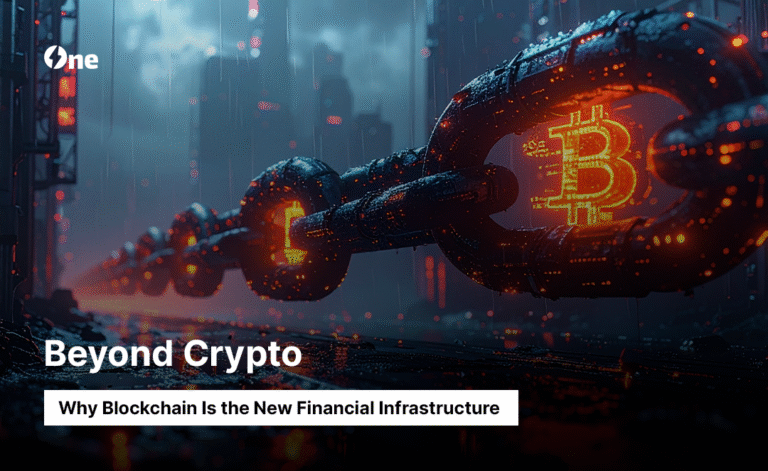
Beyond Crypto: Why Blockchain Is the New Financial Infrastructure
Blockchain is redefining global finance as the foundation of payments, tokenization, and liquidity. Explore how AIO connects enterprises to this new era.
For years, blockchain was dismissed as the technology behind cryptocurrencies: volatile, speculative, and niche.
In 2025, that narrative is obsolete.
Blockchain is no longer just about crypto.
It’s the new financial infrastructure powering payments, trade, and data exchange across global markets.
Enterprises, governments, and institutions are converging on a single reality: the next era of money will not run on top of blockchain. It will run through it.
The Quiet Revolution in Financial Infrastructure
Behind the headlines about Bitcoin ETFs and market volatility, a deeper transformation is underway.
Banks, fintechs, and multinational enterprises are building blockchain-native systems not for speculation, but for efficiency and interoperability.
From the European Central Bank’s digital euro pilots to JPMorgan’s tokenized deposits, blockchain is now the plumbing layer of global finance.
It’s no longer a question of “if blockchain fits in finance.”
It’s “how fast the financial system can adapt to blockchain.”
The Core Drivers Behind the Shift
Three macro forces are pushing blockchain from niche to necessity:
1️⃣ Real-Time Everything
- Enterprises no longer accept multi-day settlement delays.
Blockchain allows instant clearing, making 24/7 liquidity a baseline expectation.
2️⃣ Cost Efficiency
- Traditional payment systems eat into margins with 2-3% fees and operational overhead.
Blockchain reduces transaction costs to fractions of a percent, freeing up capital for reinvestment.
3️⃣ Interoperability
- Blockchain enables frictionless value exchange across currencies, assets, and geographies; the missing link for truly global digital commerce.
Together, these forces make blockchain not a replacement for financial infrastructure but its logical evolution.
Tokenization: The Bridge Between Traditional and Digital Finance
Tokenization, the conversion of real-world assets into blockchain-based tokens, is where institutional adoption is accelerating fastest.
- JPMorgan’s Onyx processes billions in tokenized deposits.
- MAS Singapore’s Project Guardian pilots tokenized government bonds.
- BlackRock’s BUIDL fund tokenizes U.S. Treasuries for global liquidity.
These are not crypto projects.
They’re financial infrastructure upgrades designed to make traditional assets programmable, portable, and instantly transferable.
Blockchain doesn’t replace the financial system.
It makes it intelligent.
The Rise of Institutional-Grade Blockchain Payments
Stablecoins and tokenized deposits are now fulfilling a decades-old goal: instant, cross-border value movement without friction.
According to Deloitte’s 2025 Blockchain in Payments Report:
- Over $7 trillion in stablecoin volume processed in Q1 2025 alone
- 80% of surveyed CFOs plan to adopt blockchain payments within 2 years
- Average settlement time reduced from 48 hours to under 5 seconds
This isn’t innovation for innovation’s sake, it’s measurable ROI.
Platforms like AIO are enabling enterprises to join this movement by embedding blockchain payments directly into existing financial operations without overhauling infrastructure.
How Blockchain Reinvents Financial Infrastructure
Let’s break down what blockchain does differently — and why it matters.
| Financial Function | Legacy System | Blockchain System |
| Settlement Time | T+2 (2 days) | Instant (seconds) |
| Transaction Fees | 2-3% average | 0.3-0.5% |
| Liquidity Access | Business hours only | 24/7/365 |
| Reconciliation | Manual & delayed | Automated & real-time |
| Transparency | Limited | Full auditability |
This transformation isn’t theoretical, it’s operational.
The world’s largest financial players are rebuilding on-chain because they can’t afford not to.
The Network Effect of Blockchain Integration
When finance becomes interoperable, it also becomes exponential.
The network effect of blockchain-enabled systems means:
- Each participant adds more value to the ecosystem.
- Liquidity becomes borderless.
- Cost savings compound with scale.
The first enterprises to integrate blockchain infrastructure will not only reduce costs, they’ll redefine competitive advantage.
The Role of AIO in a Blockchain-First Economy
In this new environment, infrastructure agility defines success.
Enterprises don’t need to reinvent their tech stack, they need systems that plug directly into the blockchain economy.
That’s where AIO delivers value:
- Multi-chain architecture for maximum compatibility
- Batch transfer systems for gas optimization
- API-first design for easy integration
- Real-time analytics for enterprise-grade insights
AIO acts as the connective tissue between existing systems and blockchain networks by enabling businesses to operate in the new digital infrastructure today.
The Executive Takeaway
Blockchain is no longer a buzzword in finance, it’s the operating system of the future.
It’s where payments, liquidity, and trust converge into a single programmable network.
And enterprises that build on it now will define the next financial era.
The future of money isn’t decentralized or traditional, it’s interconnected.
AIO helps businesses bridge that future, one transaction at a time. Connect your business to the future now with AIO.